

A chemical storage compatibility chart is an indispensable safety tool. At its core, it's a visual guide that sorts chemicals into reactive groups, using a simple coding system to help you prevent dangerous combinations.
The main job of this chart is to show EHS managers and lab technicians which chemicals can be safely stored near each other. Getting this right is how you prevent fires, explosions, or the release of toxic gases. Honestly, using a visual matrix like this is non-negotiable for running a safe and compliant facility.
Why A Chemical Compatibility Chart Is Essential
Think of a chemical compatibility chart as your first line of defense against accidents that are entirely preventable. By sorting substances into groups like acids, bases, flammables, and oxidizers, it gives you a clear, immediate reference for proper segregation. The price of getting this wrong can be catastrophic.
The consequences of improper storage aren't just theoretical. According to the U.S. Chemical Safety and Hazard Investigation Board (CSB), storage incompatibilities were a contributing factor in 25% of 1,200 chemical incidents they investigated between 2000 and 2020. These weren't minor issues; they led to massive damages and, tragically, loss of life. You can dig deeper into how these incompatibilities played a role in this detailed report on chemical storage safety.
Understanding The Core Principles
The whole idea behind a compatibility chart boils down to one thing: separating chemicals based on their hazard class. All of this critical information is laid out in each product's Safety Data Sheet (SDS).
Using a chart correctly is a straightforward process:
- Identify Hazard Classes: First, grab the SDS to figure out if a chemical is an acid, oxidizer, flammable, or something else.
- Locate Groups on the Chart: Next, find the corresponding storage groups on your chart for the chemicals you're working with.
- Interpret the Interaction Code: Finally, look at where those two groups intersect on the grid. The code there will tell you if the combination is safe, needs separation, or is absolutely forbidden.
Nailing this process is the key to preventing dangerous reactions. If you're not sure where to find this info, our guide on what is a safety data sheet is a great place to start. A good chart translates complex chemical data into simple, actionable safety rules that protect both people and property. Without one, you're just guessing, and that’s a gamble you can't afford to take.
How to Use The Complete Chemical Storage Compatibility Chart
A chemical storage compatibility chart is one of the most practical tools in your safety arsenal, but only if you know how to read it right. For EHS managers and lab techs, mastering this chart is key to turning safety theory into practice. It’s all about preventing dangerous reactions by making sure incompatible chemicals are never stored side-by-side.
The process always starts with your Safety Data Sheet (SDS). You need to identify the hazard class of every chemical you're storing. Just look at Section 2 of the SDS, which lays out the GHS hazard classifications. Once you know you're dealing with a "Flammable Liquid" and an "Oxidizer," you’re ready to use the chart.
This chart is essentially a visual map showing you how different chemical classes interact, which is critical for planning out your storage areas.
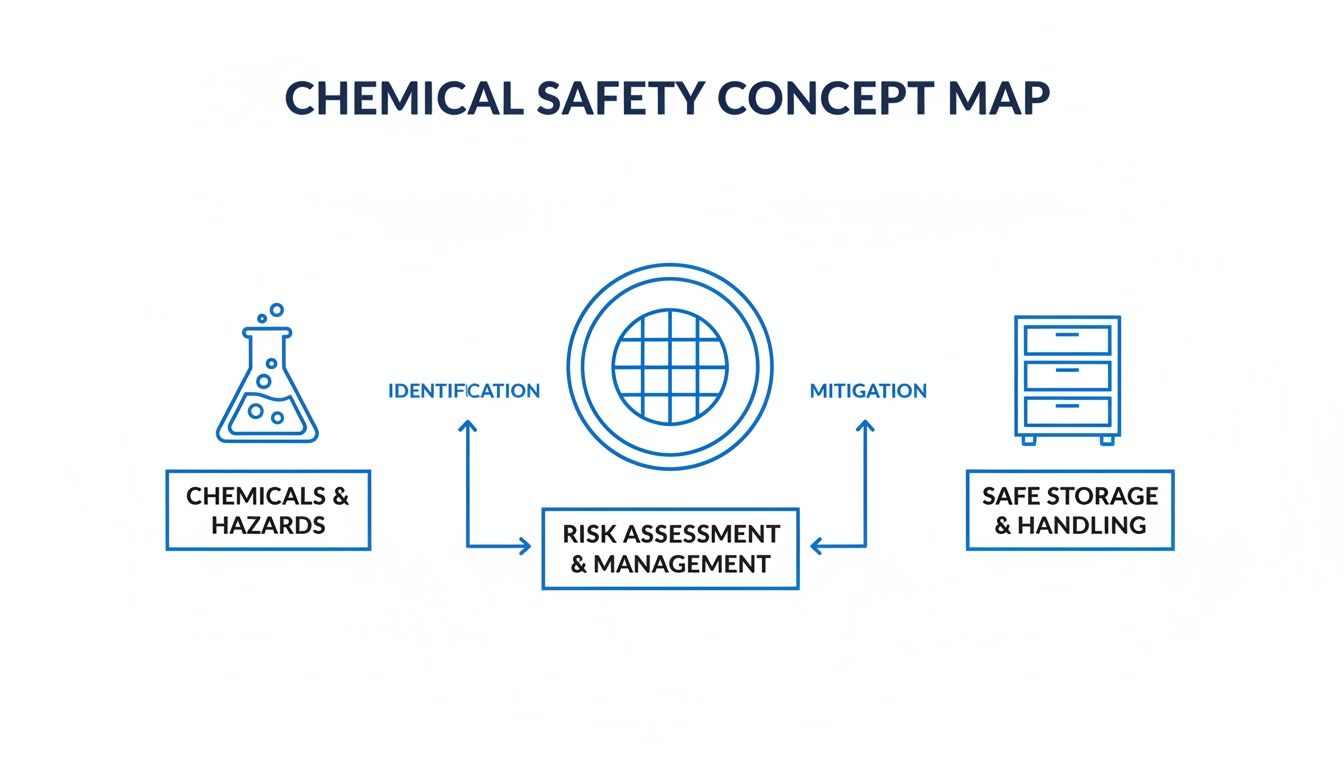
As you can see, the compatibility chart is the central piece connecting your chemical inventory to safe, compliant storage protocols.
Finding and Interpreting the Codes
Think of the compatibility chart as a simple grid. The hazard classes are listed down the side (Y-axis) and across the top (X-axis). To see if two chemicals can be stored together, find one class on the vertical axis and the other on the horizontal.
Follow that row and column until they meet in the middle. The code in that box is your answer.
For example, if you look up "Inorganic Acids" and "Caustics," the code at their intersection will tell you they're incompatible and must be stored apart. This is to prevent a violent exothermic reaction that can generate intense heat and dangerous splashes.
A Practical Walkthrough
Let's walk through a real-world scenario. You have a new shipment containing Nitric Acid (an Oxidizing Acid) and Ethanol (a Flammable Liquid). Where do you put them?
- Locate Classes on the Chart: Find "Oxidizing Acids" on one axis and "Flammable Liquids" on the other.
- Find the Intersection: Trace the row from one and the column from the other to the box where they meet.
- Read the Code: The code will almost certainly indicate they are highly incompatible. Often, this is shown with a red "X" or a specific warning symbol.
- Take Action: This tells you that nitric acid and ethanol must be stored in separate, approved cabinets. Regulations often demand a minimum separation distance of at least 20 feet between them.
Making the chemical storage compatibility chart a routine part of your process for every new chemical is a fundamental safety habit. It’s how you translate complex regulations into simple, actionable steps that protect your people and your facility every single day.
Key Chemical Storage Groups And Hazard Categories
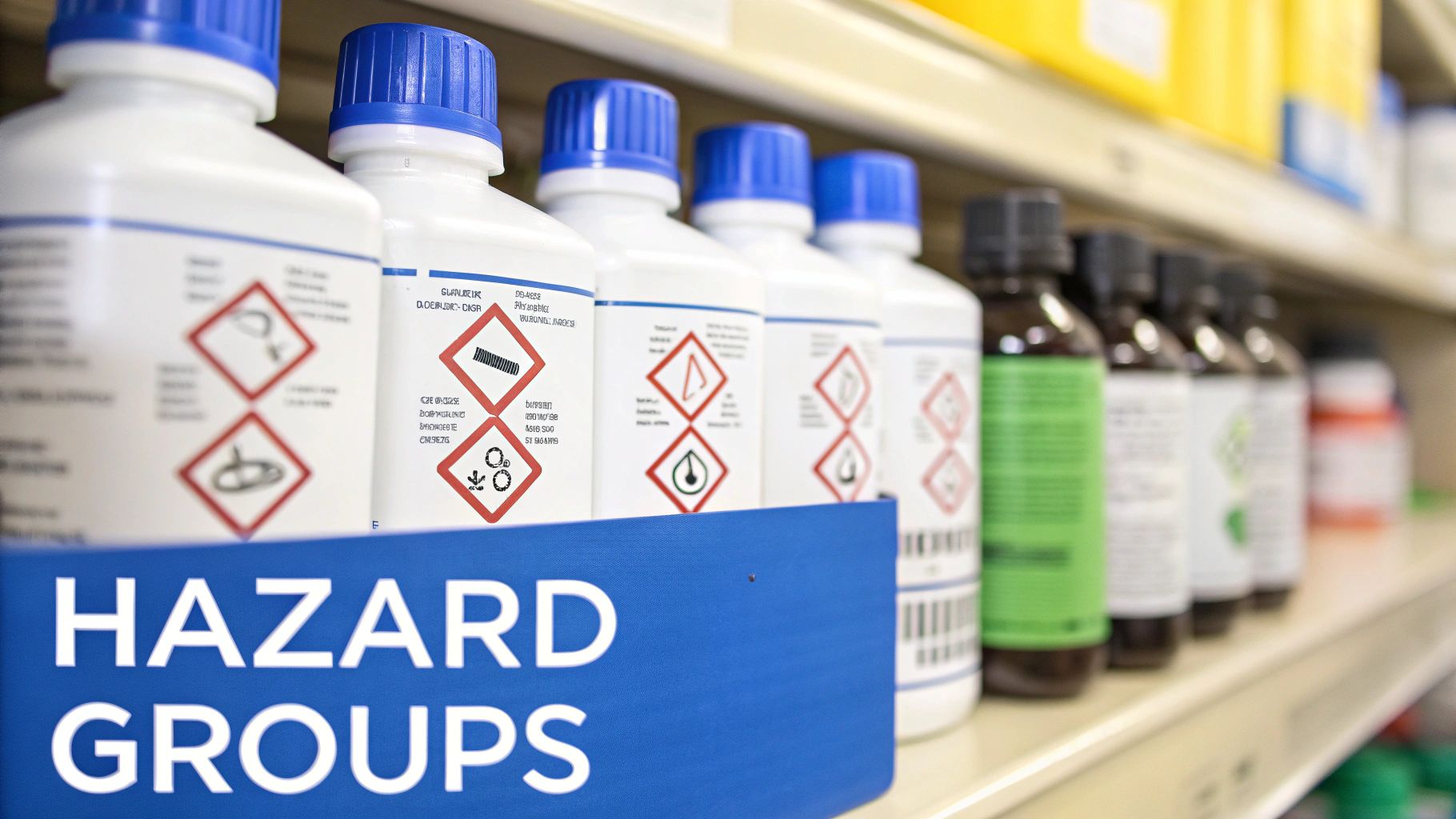
To get the most out of a chemical storage compatibility chart, you have to understand the logic behind it. Chemicals aren't just sorted randomly; they’re grouped based on shared reactive properties and potential hazards. Getting a handle on these categories is the first real step toward making chemical safety second nature.
This approach goes beyond just blindly following a chart. It gives your team a much deeper understanding of how to manage risk. Most standard chemical storage charts break substances down into 10-20 distinct groups to keep dangerous reactions from happening. For example, a common system might have 19 groups, showing that Group 1 (inorganic acids) can't be stored with Group 2 (organic acids) or Group 3 (caustics). Taking this structured approach helps prevent an estimated 60% of potential lab fires, according to data from Auburn University. You can see a great example of this kind of matrix and dig into these hazard groupings and their interactions to learn more.
Core Corrosive Groups
Corrosives are probably the most well-known hazard group, but it's crucial to know they aren't all the same. Simply lumping all corrosives together is a classic and dangerous mistake, since acids and bases react violently with each other.
Inorganic Acids: These are the strong, mineral-based acids that are highly corrosive and reactive. Think sulfuric acid, hydrochloric acid, and phosphoric acid. Keep them far away from bases and active metals.
Organic Acids: While generally less corrosive than their inorganic cousins, these acids are still a major hazard. Acetic acid and formic acid are common examples. They need to be kept separate from inorganic acids, bases, and especially from oxidizers.
Caustics (Bases): This group covers chemicals like sodium hydroxide and potassium hydroxide. They're extremely corrosive and will react with acids in a way that generates intense heat, a process known as an exothermic reaction. They absolutely need their own dedicated, separate cabinet.
Flammable And Reactive Groups
Moving beyond corrosives, reactivity and flammability are the defining traits for several other key storage groups. If you store these chemicals improperly, you're looking at a serious risk of fire, explosion, or the release of toxic gas.
A core principle of chemical safety is that a substance's ability to start a fire is just as critical as its ability to corrode. Separating flammables from oxidizers is non-negotiable—one is the fuel, and the other provides the oxygen.
Here are the main groups you need to be on the lookout for:
Flammable Liquids: This is a huge category that includes common solvents like ethanol, acetone, and hexane. They must be kept in approved flammable storage cabinets, well away from any heat or ignition sources.
Oxidizers: These substances, including things like hydrogen peroxide and nitric acid, can cause other materials to combust or can make an existing fire much worse. Keeping them separate from flammable and organic materials is a top priority.
Water-Reactive Substances: Chemicals such as sodium metal or calcium carbide react violently with water, often producing a flammable gas as a byproduct. These need to be stored in a very dry, well-protected location.
Meeting Regulatory And Compliance Requirements
A chemical storage compatibility chart isn't just a helpful guide—it’s a cornerstone of meeting serious legal and regulatory demands. Government bodies like the Occupational Safety and Health Administration (OSHA), the Environmental Protection Agency (EPA), and code-setting organizations like the National Fire Protection Association (NFPA) all have stringent rules about segregating hazardous materials. Failing to follow these regulations can lead to hefty fines, facility shutdowns, and, most critically, devastating accidents.
These standards aren't just suggestions; they form the legal backbone of your entire chemical storage plan. For example, OSHA's standard for flammable liquids, 29 CFR 1910.106, gets very specific about keeping flammables away from oxidizing agents. Likewise, NFPA codes offer granular detail on how to build and place storage cabinets and mandate minimum distances between different chemical families.
Translating Regulations Into Action
The real challenge is turning that dense regulatory language into practical, everyday actions on your facility floor. This is where your chemical storage compatibility chart proves its worth—it acts as the direct roadmap for doing just that. It helps you make sure your storage practices align with specific rules that are often buried deep within technical documents.
Here are a few key compliance actions that come straight from these standards:
- Specified Separation Distances: A common rule of thumb is keeping incompatible materials, like oxidizers and flammable liquids, at least 20 feet apart unless they are secured in approved storage cabinets.
- Secondary Containment: Many regulations mandate the use of secondary containment systems, such as spill pallets or containment berms. This is to ensure that if a container leaks, the spill is captured and can't mix with other incompatible chemicals.
- Approved Storage Cabinets: Using designated, fire-rated cabinets for flammable materials or corrosion-resistant cabinets for acids isn't just a good idea; it's a direct requirement under many codes.
The Globally Harmonized System (GHS) is absolutely fundamental to modern chemical safety. The pictograms and hazard statements on a chemical's label are what tell you which storage group it falls into on your compatibility chart. In that sense, the GHS is an indispensable part of your storage strategy.
Ensuring Team Competence And Documentation
Physical storage is only half the battle. True compliance means making sure your team is properly trained and your paperwork is meticulously maintained. Every employee who handles chemicals needs to understand the risks and be able to interpret the compatibility chart correctly. To get your team up to speed, it's worth exploring actionable compliance training best practices.
On top of that, keeping accurate records, especially up-to-date Safety Data Sheets (SDS), is non-negotiable. When an auditor walks through your door, they will expect to see these documents immediately. Our guide on maintaining Safety Data Sheet compliance provides clear steps for keeping your documentation in order, effectively closing the loop between your physical storage plan and your legal responsibilities.
Common Storage Mistakes and How to Avoid Them
Knowing how to read a chemical storage compatibility chart is one thing. Actually putting it into practice on a busy shop floor or in a crowded lab is another. This is where safety theory meets reality, and even small oversSasights can have huge consequences. Let's look at a few common, real-world mistakes to see just how critical these charts are.
Many of the most frequent errors come down to misclassifying chemical groups or simply not checking the Safety Data Sheet (SDS). For instance, someone might store all "corrosives" together, thinking they're all the same. That's a classic blunder. It completely overlooks the violent, heat-generating reaction that happens when you mix an acid with a base—a mistake that can cause dangerous chemical splashes and burns.
Storing Common Cleaners: Bleach and Ammonia
One of the most well-known—and dangerous—mistakes you can make at home also happens far too often in industrial settings: storing bleach (sodium hypochlorite) and ammonia-based cleaners together.
- The Hazard: When these two mix, they react and create toxic chloramine gas. Breathing this stuff in can cause severe respiratory damage, chest pain, and make it hard to breathe.
- The Fix: A quick glance at a chemical storage compatibility chart flags this immediately. Bleach is typically listed as an oxidizer (or a base), while ammonia is a base. The chart will show a clear incompatibility, demanding they be stored separately and preventing the accidental creation of a toxic gas cloud.
Mixing Oxidizing Acids with Flammables
Another error that sets the stage for disaster is storing strong oxidizing acids, like nitric acid, anywhere near flammable organic solvents like ethanol or acetone. This is an incredibly high-risk scenario.
This specific combination is so dangerous because the oxidizing acid can literally act as the ignition source for the flammable liquid. What you get is a fire that's incredibly difficult to put out because the oxidizer feeds it a constant supply of oxygen, making the blaze more intense and self-sustaining.
Your compatibility chart is the best defense against this. It will always place "Oxidizing Acids" and "Flammable Liquids" in separate, incompatible categories, often with a bright red "X" to signal extreme danger. The only safe solution is to keep them in dedicated safety cabinets, separated by a significant distance—regulations often require at least 20 feet. By making chart-checking a mandatory step for any new chemical that comes through the door, you can easily prevent these high-stakes mistakes and build a stronger safety culture.
Choosing The Right Chemical Storage Containers
Safe chemical management goes far beyond just keeping incompatible substances apart. The primary container itself is your first and most critical line of defense. If you choose the wrong material for your chemical storage, you're setting the stage for container degradation, cracks, and eventually, dangerous leaks and spills. Your entire storage system is only as strong as its weakest link, which makes container compatibility an absolutely vital part of your safety plan.
The container material must be able to withstand the chemical it's holding. Think about it: storing a strong corrosive in a standard metal can is a disaster waiting to happen. That corrosive will chew right through the metal, leading to a total containment failure. This is exactly why anyone involved in purchasing—from procurement teams to lab managers—needs a solid grasp of container materials.
Common Container Materials And Their Uses
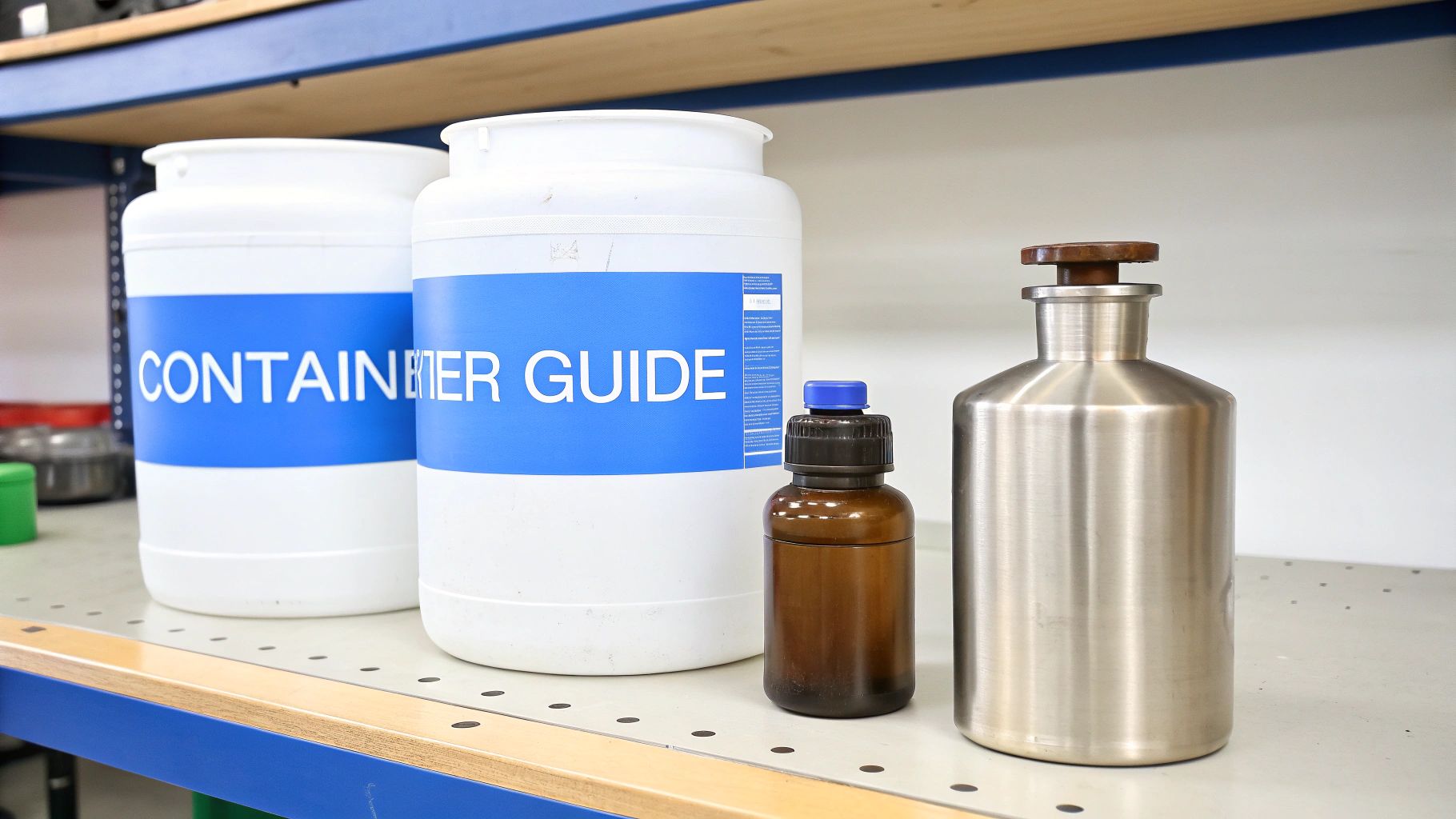
Different chemicals demand different kinds of containers; there's simply no one-size-fits-all solution here. Before you make any decision, consulting a chemical storage compatibility chart is non-negotiable.
- High-Density Polyethylene (HDPE): You'll see this everywhere, and for good reason. It's one of the most versatile plastics for chemical storage, offering fantastic resistance to a huge range of acids, bases, and alcohols.
- Glass: This is often the go-to material for high-purity solvents and specific acids. Borosilicate glass, in particular, is prized for its heat resistance and chemical inertness, though you always have to be mindful of its fragility.
- Stainless Steel: Perfect for flammable solvents and many organic compounds. Its major weakness, however, is its susceptibility to corrosion from strong acids, especially any containing chlorides.
- Polypropylene (PP): Known for its top-notch chemical resistance and stability at different temperatures, PP is another common choice for storing acids, bases, and a wide array of organic solvents.
Always, always check the Safety Data Sheet (SDS) for specific recommendations on container materials. Section 7 of the SDS is where you'll find crucial guidance on storage conditions, including container compatibility. A quick check here can prevent a very costly—and dangerous—mistake.
Quick Guide To Container Material Compatibility
To make the selection process a bit easier, here’s a quick-reference table that shows how common container materials hold up against major chemical classes. This is a great starting point for preventing container failure.
| Chemical Class | HDPE | Glass | Stainless Steel | Polypropylene (PP) |
|---|---|---|---|---|
| Strong Acids | Good to Excellent | Excellent (except HF) | Poor (risk of corrosion) | Excellent |
| Strong Bases | Excellent | Good (can etch over time) | Good to Excellent | Excellent |
| Organic Solvents | Varies (check specific solvent) | Excellent | Excellent | Varies (check specific solvent) |
| Oxidizing Agents | Fair to Good | Excellent | Good | Good |
| Aqueous Solutions | Excellent | Excellent | Excellent | Excellent |
Remember, this is a general guide. The specific concentration and temperature of your chemical can change everything, so always verify with detailed compatibility data for your exact conditions.
Making The Right Material Selection
With plastics like HDPE and LDPE being resilient against 80% of common chemicals, it's no surprise they dominate industrial use. For example, detailed compatibility charts show that HDPE shows 'little or no damage' after being immersed in a 50% sodium hydroxide solution for 30 days at 50°C. That makes it a perfect choice for strong bases that would eat away at other materials.
When you're picking out a container, your process should always be to cross-reference the chemical's properties with the material's resistance data. For an added layer of safety, especially when dealing with many smaller containers, think about using secondary containment like secure pallet cages. This simple step helps manage inventory and can contain any potential spills, reinforcing the integrity of your primary containers.
How NextSDS Automates Chemical Compatibility
Using a static chemical storage compatibility chart is a fundamental safety practice, but let's be honest, it has its limits. Manual checks rely entirely on human diligence. That means they can be slow and, more importantly, prone to error, especially if you're dealing with a large, constantly shifting inventory.
Every time a new chemical comes through the door, someone has to meticulously cross-reference it against everything already on the shelves. This manual process creates a window for oversights—mistakes that could easily lead to dangerous storage conflicts.
Modern chemical management software completely changes the game by automating this entire process. Instead of reacting to what's already on-site, these platforms turn compatibility screening into a proactive safety measure. They analyze Safety Data Sheets (SDS) the moment they're entered, flagging hazards and incompatibilities before a new substance ever hits your storage area. It's a huge leap forward for operational safety.
Proactive Risk Management and Compliance
NextSDS takes you beyond the constraints of a paper chart by building compatibility screening directly into your inventory workflow. When a new chemical is logged in your digital library, the platform gets to work, automatically analyzing its properties and checking it against every other substance you have.
This screenshot shows the clean, accessible interface of the NextSDS platform, designed to simplify complex chemical management tasks.
The dashboard gives EHS managers a single, centralized place to monitor inventory, pull up safety data, and track compliance.
If the system detects a potential conflict—say, an oxidizer is about to be stored next to flammable liquids—it sends an immediate alert. This gives your team a chance to correct the mistake before it happens. You can learn more about how these platforms work in our guide to chemical inventory management software.
Making Safety Workflows Smarter
Automation offers powerful tools that go far beyond what a simple chart can do, giving your team instant, actionable information right when they need it.
- Real-Time Inventory Screening: The system is always on, continuously monitoring your chemical inventory and flagging incompatible combinations the second they're identified.
- Automated Segregation Alerts: Get instant notifications if incompatible chemicals are stored too close to each other, making it much easier to maintain safe separation distances.
- Instant Mobile Access: By placing QR codes on containers and storage locations, your team gets immediate mobile access to critical safety data—handling procedures, PPE requirements, and emergency steps—right on the spot.
By automating these crucial checks, NextSDS helps ensure compliance with regulations like GHS and REACH, drastically reduces the risk of human error, and gives your team the confidence that their storage practices are sound.
Frequently Asked Questions About Chemical Compatibility
Even with a solid chemical storage compatibility chart, real-world situations can get tricky. You're not alone if you've ever stood in a chemical stockroom wondering where to put a substance with multiple hazards. This section tackles some of the most common questions that EHS managers and lab staff run into.
What Should I Do If A Chemical Has Multiple Hazard Classes?
It’s incredibly common for a single chemical to fall into several hazard classes—think of something that's both flammable and corrosive. The rule of thumb here is simple: you must respect the storage requirements for all its hazards. When in doubt, always default to the most restrictive storage guideline.
Take a flammable acid, for example. It’s a double threat. You have to keep it away from bases to prevent a nasty acid-base reaction, but you also need to store it far from any potential ignition sources because of its flammability.
When you're dealing with these complex chemicals, the Safety Data Sheet (SDS) is your ultimate source of truth. Dive into Section 7 (Handling and Storage). The manufacturer provides explicit instructions there, accounting for all the chemical's hazardous properties.
This is where a digital chemical management system really shines. These platforms can automatically cross-reference every hazard listed for a chemical, flagging complex storage conflicts that are easy to miss when you're just doing a manual check.
How Do Temperature And Concentration Affect Compatibility?
Temperature and concentration are game-changers. They can seriously alter how chemicals behave with one another. Your standard chemical storage compatibility chart is a great starting point, but it usually assumes you're working at room temperature with typical concentrations.
Higher temperatures almost always speed up chemical reactions. Two chemicals that are perfectly fine stored near each other at 70°F might become dangerously reactive if a heatwave pushes the storeroom temperature up.
Concentration is just as critical. A dilute acid might be okay in a high-density polyethylene (HDPE) container. But put that same acid in its concentrated form, and it could chew right through the plastic, causing a catastrophic failure. Always make sure your storage plan is built for the exact concentrations you have on hand. If your facility has unique temperature or pressure conditions, you need to dig deeper into technical data or perform a specific risk assessment.
Can I Create My Own Chemical Storage Compatibility Chart?
You technically can, but I would strongly advise against it, especially for anything more than a handful of very common, static chemicals. This is a high-risk task that demands a deep level of chemical expertise. It's far safer to start with a validated, industry-standard chart from a reliable source like OSHA or the EPA.
The biggest danger in making a chart from scratch is missing a less obvious—but potentially devastating—reaction. The world of chemical interactions is massively complex, and a homemade chart might not cover all the dangerous combinations.
A much better approach is to use a validated chart as your foundation. You can then add specific notes to it based on incompatibility information you pull from Section 7 of your chemicals' SDSs. For the highest degree of safety and to eliminate human error, your best bet is a digital system. These platforms use comprehensive, validated databases to automate compatibility checks, taking the guesswork out of the equation.
Where Do I Find The Information To Use A Compatibility Chart?
The single most critical document you need is the Safety Data Sheet (SDS) for each chemical. The SDS is packed with all the details you need for safe handling and storage.
To use your chart correctly, you'll need to focus on two key sections of the SDS:
- Section 2 (Hazards Identification): This is where you'll find the GHS pictograms and the chemical's official hazard classes. It’s the first piece of the puzzle for figuring out which storage group a chemical belongs to.
- Section 7 (Handling and Storage): This section gives you direct, actionable advice on storage conditions. Crucially, it lists materials that are known to be incompatible.
By comparing the information from these two sections against your chemical storage compatibility chart, you can confidently and correctly place every chemical in your inventory. Always, always make sure you're working with the latest SDS from the manufacturer to get the most accurate safety information.
Take the guesswork out of chemical safety. NextSDS automates compatibility screening by analyzing your Safety Data Sheets, providing real-time alerts on storage conflicts, and ensuring your inventory is always compliant. Discover a smarter way to manage chemical safety.