

When we talk about chemical waste management, we're not just talking about getting rid of unwanted by-products. It's a comprehensive system for handling, storing, transporting, and ultimately disposing of hazardous materials in a way that’s both safe and legally compliant. Think of it less as a chore and more as a crucial pillar supporting both environmental protection and workplace safety.
Establishing Your Chemical Waste Management Framework
It’s easy to see chemical waste as a costly problem to be dealt with, but that’s a risky mindset. A far better approach is to view it as a reverse supply chain. In this model, waste isn't just rubbish; it's a hazardous asset that you own and control, from the moment it’s created to its final, documented disposal. This simple shift in perspective moves the focus from reactive disposal to proactive, strategic management.
For any Health, Safety, and Environment (HSE) manager in Belgium, the real challenge is turning dense regional and EU regulations into a clear, day-to-day workflow. This is where things often get complicated. The process can be painfully manual, leading to a high risk of human error and a mountain of administrative work.
The Five Pillars of a Successful Programme
A truly effective chemical waste management programme doesn't happen by accident. It's built on a foundation of five core pillars, each representing a critical stage in the lifecycle of hazardous waste. If one pillar is weak, the whole structure is at risk.
The table below breaks down these five fundamental stages, outlining what each one aims to achieve and the key actions required from HSE managers.
Key Pillars of a Successful Chemical Waste Programme
| Pillar | Primary Goal | Key Action for HSE Managers |
|---|---|---|
| Identification & Classification | To know exactly what you have and the risks it poses. | Use Safety Data Sheet (SDS) information to correctly categorise waste according to its hazardous properties (e.g., flammable, corrosive, toxic). |
| Segregation | To prevent dangerous chemical reactions and ensure safe handling. | Physically separate incompatible waste streams. For instance, never store acids and bases together. |
| Handling & Storage | To contain waste safely on-site before disposal. | Implement compliant temporary storage with correct labelling, secondary containment, and proper ventilation at designated accumulation points. |
| Transport & Disposal | To ensure waste leaves your site and is treated legally and safely. | Partner with licensed carriers and facilities, ensuring a complete and accurate paper trail follows the waste from cradle to grave. |
| Documentation & Record-Keeping | To prove compliance and maintain a clear history of all waste activities. | Meticulously maintain all records, from initial classification and waste transfer notes to final disposal certificates. |
Understanding these pillars provides the structure needed to translate complex regulatory demands into practical, on-the-ground actions that actually work.
The goal is to first establish a clear 'why' before getting lost in the 'how'. When your team understands the purpose behind each step—from separating containers to filling out paperwork—they can move beyond just ticking boxes and start building a genuinely resilient safety culture.
This guide is designed to give you a solid conceptual footing, setting the stage for how modern digital tools can transform these manual, error-prone tasks into an automated, data-driven system. Before we dig into the specifics of Belgian law and hands-on procedures, it’s vital to have this foundational framework locked in. Everything that follows will build on these pillars, giving you the actionable details needed to protect your people, your operations, and the environment.
Juggling Belgian and EU Waste Rules
Handling chemical waste in Belgium means you’re not just following one set of rules, but skillfully weaving together local regulations with broader European Union directives. It's a layered system, with federal, regional, and EU authorities all having a say in how you operate.
Think of it like building a house. The EU lays down the foundational blueprint—these are the core directives and principles that apply to every member state. Then, the Belgian federal government builds the main structure, turning those EU directives into national law. Finally, the three regions—Flanders, Wallonia, and the Brussels-Capital Region—come in to finish the job, adding the specific fixtures and fittings that dictate exactly how waste must be managed on your site.
The EU Bedrock: REACH and CLP
At the very top, two crucial EU regulations set the stage for chemical safety. While they aren't waste laws per se, they’re the foundation for everything that follows because they define what makes a substance hazardous to begin with.
- REACH (Registration, Evaluation, Authorisation and Restriction of Chemicals): This is all about the production and use of chemical substances. When a chemical gets flagged as a Substance of Very High Concern (SVHC) under REACH, that has a direct knock-on effect on how you must handle its waste, usually demanding far stricter controls and paperwork.
- CLP (Classification, Labelling and Packaging): The CLP regulation is why we have standardised hazard pictograms and safety statements on chemical containers. It’s simple, really: the label on a brand-new chemical dictates the warnings needed for the waste container it eventually goes into. A corrosive product makes corrosive waste, and the labels have to show that journey.
Together, these regulations ensure a chemical's risks are clearly understood from the moment it’s made to the moment it becomes waste. This is the heart of the "cradle-to-grave" responsibility that sits with every producer.
Belgium's Regional Rulebooks
While the EU provides the grand vision, the specific, day-to-day rules you live by depend entirely on where your facility is located in Belgium. Each region has its own environmental agency, its own legislation, and its own way of doing things when it comes to permits, reporting, and disposal.
For instance, if you're in the Flemish Region, you answer to OVAM (the Public Waste Agency of Flanders). But the legal frameworks in Wallonia and the Brussels-Capital Region are entirely different. This means things like waste codes, paperwork requirements, and even the approved list of waste collectors can change completely depending on whether your site is in Antwerp, Charleroi, or Brussels.
Your job as a waste generator doesn’t stop when the collection truck pulls away. You are legally on the hook for that waste until it has been safely treated or disposed of at a fully licensed facility. That makes ironclad traceability an absolute must.
Getting this wrong isn't an option. The fines for non-compliance are steep, and in the worst-case scenarios, authorities can suspend your operational permits. Beyond the financial sting, cutting corners puts your people and the environment at serious risk.
This meticulous approach to waste is part of a bigger picture. Belgium is a standout leader in Europe for packaging waste recycling, hitting an incredible 79.2% recycling rate in 2020—the highest on the continent. This success is directly tied to its sophisticated management of chemical waste streams, as so much packaging, from drums to bottles, contains hazardous residues that need proper handling. You can learn more about Belgium's circular economy efforts and see how they shape these strategies.
Ultimately, staying compliant means understanding how all these legal layers connect. It starts with knowing your chemicals' hazards as defined by CLP, keeping tabs on their status under REACH, and then strictly following your region's rules for storage, transport, and disposal. This is how you ensure every single decision is safe, responsible, and fully compliant.
Getting Waste Classification and Segregation Right
If there's one step you absolutely cannot afford to get wrong in chemical waste management, it's classification and segregation. Think of it less like a procedural box-ticking exercise and more like the foundation of your entire safety system. Get this right, and everything else becomes safer. Get it wrong, and you're inviting disaster.
Mixing incompatible chemicals isn't just a minor error; it's how you get fires, toxic gas releases, and violent reactions. Proper segregation isn't just about being tidy—it's about preventing a very bad day at the office.
Your Guidebook: The Safety Data Sheet
So, how do you know what can and can't be mixed? The answer is already in your hands: the Safety Data Sheet (SDS). Every chemical product comes with one, and it's your definitive guide for understanding the risks involved, even when that chemical becomes waste.
When you're dealing with waste, you’re essentially looking at the chemical's hazards in reverse. To classify it properly, you need to go back to the original product's SDS.
Pay close attention to these specific sections:
- Section 2: Hazard Identification: This is your at-a-glance summary. The GHS/CLP pictograms and hazard statements give you an immediate visual warning of the main dangers.
- Section 9: Physical and Chemical Properties: Here's where you find the hard data—things like flash points and pH levels that tell you if a waste is flammable or corrosive.
- Section 10: Stability and Reactivity: This section is non-negotiable for segregation. It explicitly lists which materials must be kept separate to avoid dangerous reactions.
A classic, and terrifyingly common, mistake is mixing acidic waste with chlorinated solvents. Anyone who has consulted the solvent's SDS would know this combination can produce highly toxic chlorine gas. It's a prime example of why the SDS is so crucial.
The chart below shows how high-level EU directives filter down into national laws and, ultimately, the specific compliance actions you take on-site.
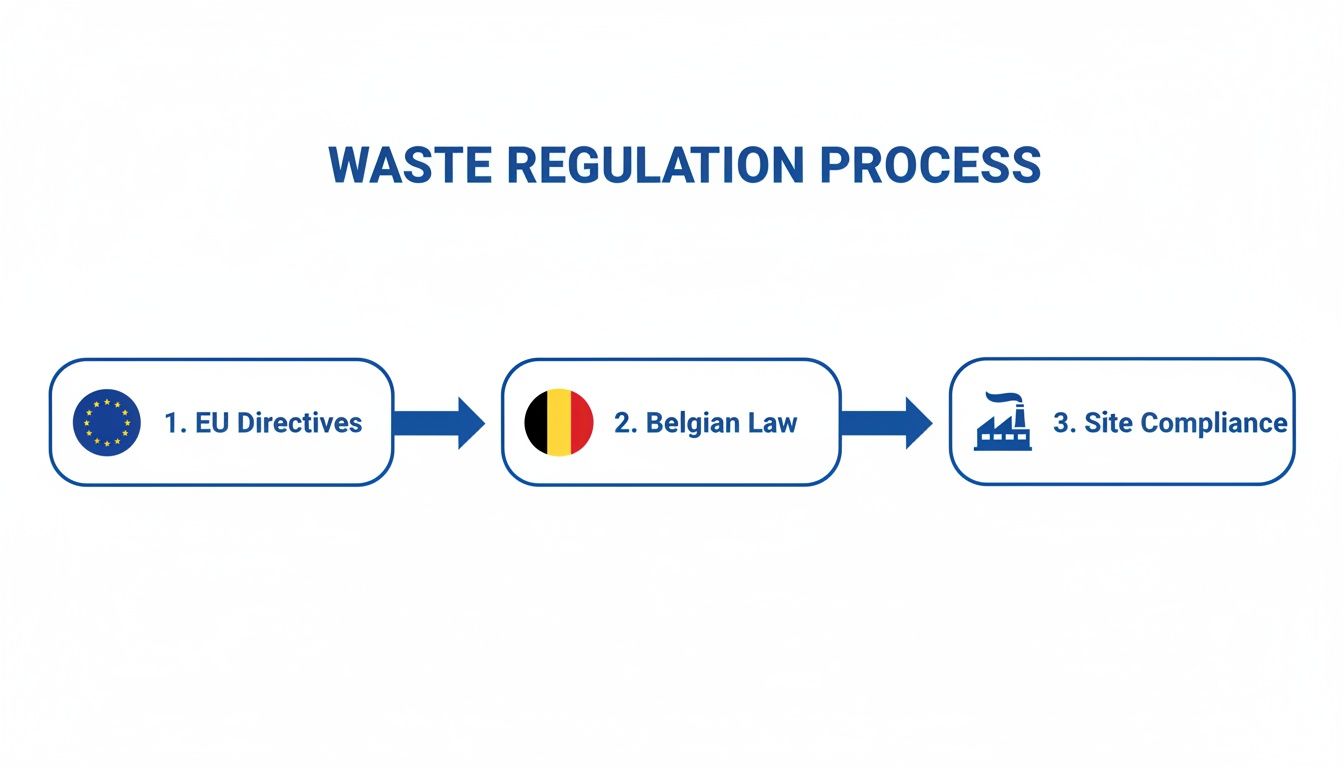
This process makes it clear that your site's segregation rules aren't arbitrary; they are a direct outcome of both Belgian law and broader European safety standards.
Creating a Foolproof Segregation System
Knowing the theory is one thing, but putting it into practice is what counts. You need a physical system that makes it easy for your team to do the right thing, every single time. This comes down to crystal-clear labelling and smartly placed collection points.
A truly effective system is built on two simple but powerful pillars: a clear colour-coding scheme and well-placed accumulation points.
1. A Colour-Coded Container System Assigning specific colours to different hazard classes removes ambiguity. While there isn't one globally mandated standard, a common and effective approach used across Belgian facilities is:
- Red: For flammable and ignitable waste.
- Yellow: For reactive and oxidising waste.
- Blue: For toxic waste that poses a health hazard.
- White: For corrosive waste (keeping acids and bases in separate containers).
- Green: For non-hazardous waste.
2. Satellite Accumulation Points These are small, temporary collection areas located right where the waste is generated—next to a lab bench or a production line, for example. This simple step drastically reduces the distance someone has to carry hazardous materials, which in turn minimises the risk of spills or accidental mixing along the way.
The goal is to design a system that makes human error almost impossible. When the right choice is also the easiest choice, thanks to clear visual cues and convenient placement, you dramatically cut the odds of a dangerous mistake.
This disciplined approach is a hallmark of Belgium’s wider waste strategy. The country's expertise in handling hazardous materials is reflected in its high recycling rates, a significant contribution to managing the EU's 99.6 million tonnes of hazardous waste generated in 2022. While neighbours like Germany and Finland process enormous volumes, Belgium focuses on efficiency, investing €700 million in advanced sorting technologies to improve the recycling of complex materials like chemical plastics. You can discover more about Europe's waste statistics to see how these national efforts fit into the bigger picture. This commitment to proper handling at every stage creates safer workplaces and a healthier environment for everyone.
Implementing Safe Storage and Transport Protocols
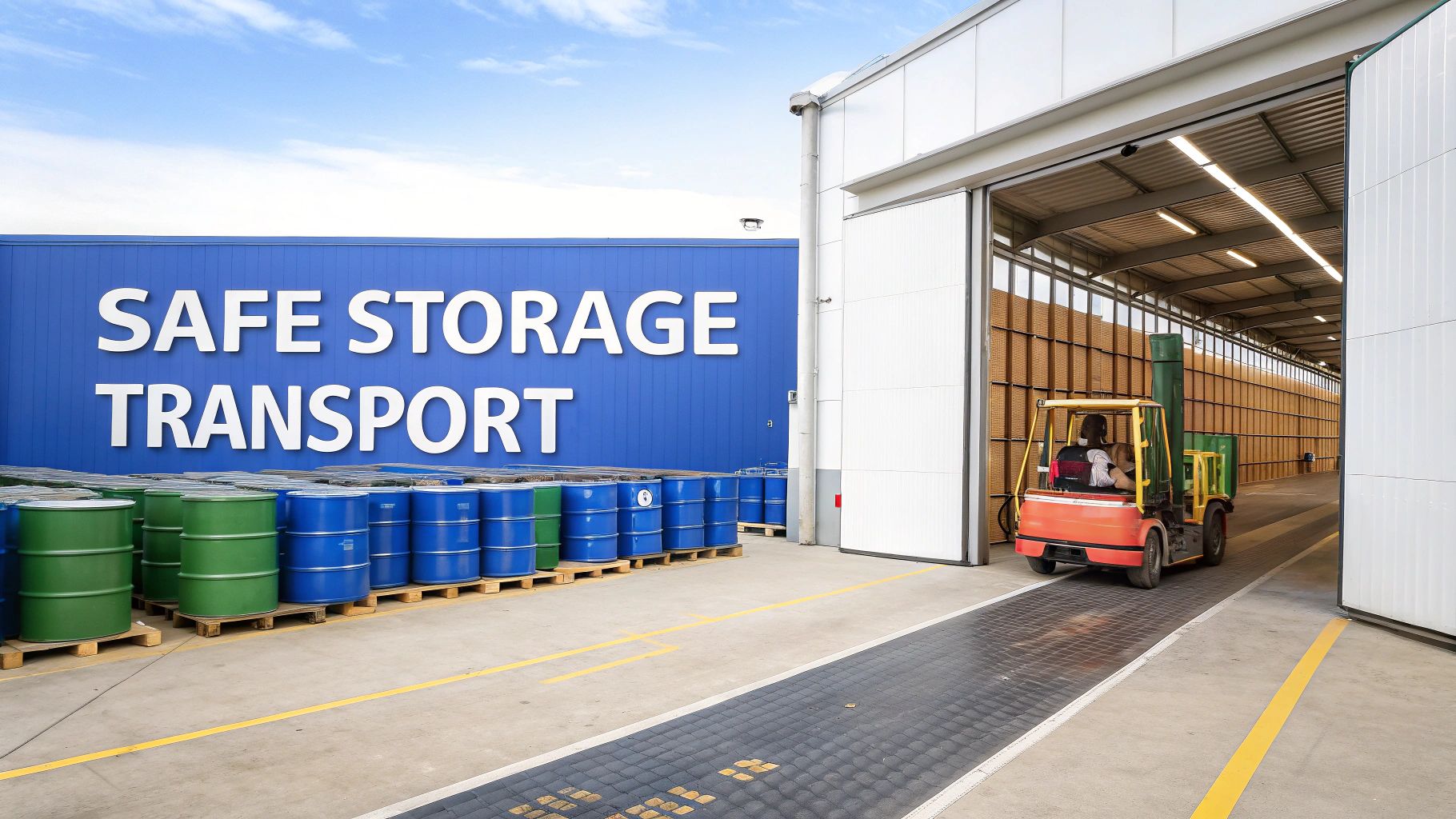
Once you’ve got your waste properly classified and segregated, the next phase kicks in: safely storing it on-site and getting it ready for transport. This is all about physical containment and control. It's the practical, hands-on work of making sure hazardous materials are locked down from the moment they’re created until a licensed carrier takes them away.
Let's be clear: getting this stage right is non-negotiable. Solid protocols protect your team from exposure, stop spills from contaminating the environment, and keep your operations compliant with the strict Belgian and EU regulations. Without a robust system, all your careful classification work can be undone by a single storage mistake or a bit of dodgy paperwork.
Auditing Your Chemical Waste Storage Areas
Think of your designated waste storage areas as the last line of defence on your property. Running regular, thorough audits is crucial to spotting potential problems before they escalate into serious incidents. It’s like a routine health check for the most high-risk zones in your facility.
Before you can even begin, you have to truly grasp the dangers you're dealing with. For a deep dive into managing the specific health and safety risks in chemical manufacturing, from toxic exposure to explosions, this resource is invaluable.
An audit should be a systematic check, not just a quick walk-through. Use a detailed checklist to make sure nothing gets overlooked.
Key Storage Area Audit Points
- Secondary Containment: Do you have it for all liquid waste containers? Spill pallets or bunded areas are a must, and they need to hold at least 110% of the largest container's volume.
- Ventilation: Is the area well-ventilated? You need good airflow to stop hazardous vapours from building up, especially with flammable or volatile organic compounds.
- Incompatibility Checks: Are incompatible waste streams kept far enough apart? Double-check your segregation plan against what’s actually happening on the floor.
- Clear Labelling: Are all containers labelled correctly and clearly? The label must show the contents, hazard pictograms, and the date accumulation started. Faded or wrong labels are a simple but dangerous oversight.
- Accessibility: Is the area free of clutter? You need clear access for inspections and, if the worst happens, for emergency response teams. Fire extinguishers and spill kits must be in plain sight and easy to grab.
Navigating Waste Transport Regulations
When your chemical waste is finally ready to leave your site, your responsibility doesn't end at the gate. As the waste generator, you are accountable under the European Agreement concerning the International Carriage of Dangerous Goods by Road (ADR) for ensuring that waste is correctly prepared for its journey.
This is another moment where the Safety Data Sheet (SDS) proves its worth. Section 14 of the SDS, in particular, provides all the critical transport information you need to meet ADR rules. You can get a much better handle on this by reading our guide on transport classification in an SDS.
Simply handing your waste over to a licensed carrier isn't good enough. You are legally on the hook for providing them with perfectly prepared containers and flawless documentation. They need to know exactly what they're carrying and the risks involved.
The process involves a few key steps, and each one has to be executed perfectly.
- Correct Packaging: Waste must be in UN-approved packaging that’s suitable for the material inside. The container has to be in good shape, with no leaks or damage.
- Proper Shipping Name: You have to use the official name designated by transport regulations, which you'll find in the SDS. Using a generic trade name is a compliance failure, plain and simple.
- Accurate Labelling and Placarding: The package needs to be marked with the right UN number and hazard class labels. This is how you communicate the specific dangers to everyone down the logistics chain.
- Flawless Documentation: The transport document (or consignment note) has to be filled out with total accuracy. This means getting the UN number, proper shipping name, hazard class, and packing group spot on.
The scale of this challenge across Europe is massive. In 2022, Belgium exported 62.7 kg of hazardous waste per inhabitant, placing it among the top EU countries and showing just how intense the industrial activity is here. This is part of a wider EU trend where 9.0 million tonnes of hazardous waste were exported, with most of it destined for recovery, not disposal—a core principle Belgium follows to meet its environmental targets. This really underscores how vital precise, compliant transport protocols are to the bigger picture of chemical waste management.
Using Digital Tools to Automate Compliance
Let's be honest: managing chemical waste manually is often a chaotic mess. It’s a world of dusty binders, sprawling spreadsheets that only one person understands, and a lot of crossing your fingers, hoping everyone is following the rules. This old-school approach isn't just inefficient; it’s a compliance nightmare waiting to happen, where one typo or a misplaced bit of paper can lead to serious trouble.
Thankfully, there's a much better way. Moving to a central digital platform can turn that fragmented, manual grind into a single, cohesive system. This isn’t just about getting rid of paper—it's about creating one definitive source for all your chemical data, making compliance a systematic part of your operation instead of a constant battle.
This screenshot shows how a modern platform can present complex chemical safety data in a clear, accessible dashboard.
The real shift here is moving from constantly hunting for information to having it proactively managed and right at your fingertips when you need it.
A Typical Automated Workflow
Picture this: a new chemical arrives on-site. In a manual system, that single delivery triggers a long chain of tedious tasks. With an automated platform, the whole process is done in minutes, not hours.
- Instant SDS Processing: The new Safety Data Sheet is uploaded. The system’s AI immediately pulls out all the crucial data—hazard classifications, PPE requirements, physical properties, and transport codes. No more manual data entry.
- Automated Hazard Flagging: The platform instantly checks the chemical’s ingredients against regulatory lists like REACH and CLP. It automatically flags any restricted substances or warns you if it’s incompatible with other chemicals already in your inventory.
- Smart Waste Stream Generation: Based on that data, the system suggests the correct waste classification. It can then generate the right GHS/CLP-compliant labels for your waste containers, complete with the correct pictograms and safety statements. This eliminates guesswork and ensures every label is perfect.
By automating these core steps, you build a complete, auditable digital trail for every chemical, from the moment it enters your site to the moment its waste departs. This drastically cuts down the risk of human error, which, let's face it, is usually the weakest link in the compliance chain.
This automated approach connects the dots. Information from the SDS flows directly into your storage, handling, and waste procedures without anyone having to re-type or double-check it.
The Tangible Business Outcomes
Ditching the manual methods for a digital system delivers some serious, measurable benefits that are about much more than convenience. It fundamentally changes how you handle risk and keeps your operations in line with constantly changing regulations. For a deeper dive, our guide to choosing the right SDS management software breaks down the essential features to look for.
The key advantages really boil down to this:
- Reduced Administrative Burden: Your HSE team can stop chasing paperwork and wrestling with spreadsheets. This frees them up to focus on what really matters, like improving training and conducting on-the-ground risk assessments.
- Lower Compliance Risk: Automated regulatory checks mean you're always current. If a rule changes or a substance gets added to a watch list, the system alerts you straight away. No more getting caught out by a change you missed.
- Total Compliance Confidence: When the auditors show up, you’re ready. With a complete digital record of every action, you can easily prove due diligence and pull up the exact documentation the regulators need, right when they ask for it.
Here’s a look at how the day-to-day tasks stack up when you compare the old way with a modern platform.
Manual vs. Automated Chemical Waste Management Workflows
| Task | Manual Method (Spreadsheets & Binders) | Automated Platform (NextSDS) |
|---|---|---|
| New Chemical Arrival | Manually find and print the SDS. Read through it to identify hazards. Update multiple spreadsheets. | Upload the SDS. The platform automatically extracts all key data in seconds. |
| Waste Classification | Someone has to interpret the SDS data and cross-reference it with waste regulations. High potential for error. | The system analyses the chemical profile and suggests the correct waste code based on regulations. |
| Label Generation | Manually create labels, hoping the right pictograms and hazard statements are included. | Automatically generates fully compliant GHS/CLP labels with one click. |
| Inventory Tracking | Relies on manual updates to a central spreadsheet. Often out of date and prone to typos. | Real-time inventory is updated automatically as chemicals are used and waste is generated. |
| Audit Preparation | A frantic scramble to find paper records, training logs, and waste manifests from various files and binders. | All documentation is centralised. Generate a complete audit trail report for any chemical in minutes. |
The difference is clear. One workflow is built on manual effort and risk, while the other is built on accuracy and efficiency.
Ultimately, using digital tools for chemical waste management means swapping uncertainty for control. It gives you the data, automation, and oversight needed to move from a reactive, paper-chasing system to a proactive, data-driven strategy that protects your people, your business, and the environment.
Building Effective Training and Emergency Response Plans
You can have the best processes and the latest digital tools, but at the end of the day, your people are the most important part of your chemical safety programme. When it comes to managing chemical waste, a solid training plan isn't just about ticking a compliance box—it's the foundation of a safety culture that truly protects your team and your business.
Great training goes beyond just showing someone a checklist. It's about building a real understanding of the "why" behind every step. When an employee genuinely understands that mixing two specific waste streams could release a toxic gas, they're going to be far more careful about segregation. It becomes second nature.
This kind of knowledge empowers your team to make smart, safe decisions on the fly. You can find more practical tips for building this proactive mindset in our guide to improving chemical safety in the workplace.
Core Components of a Training Programme
Think of your training programme as an ongoing conversation, not a one-time lecture. It needs to cover all the essential skills for handling hazardous materials safely, right from the moment a substance becomes waste to its final preparation for disposal.
Your curriculum absolutely must include:
- Hazard Communication (HazCom): Everyone needs to be fluent in the language of chemical safety. This means being able to read and instantly understand Safety Data Sheets (SDS) and GHS/CLP labels to identify risks and precautions.
- Correct PPE Usage: It’s not enough to just hand out gear. Training must cover what Personal Protective Equipment to wear, how to put it on correctly, how to take it off safely, and how to look after it. Improper use can make PPE completely ineffective.
- Proper Waste Handling Procedures: This is where the practical, hands-on training comes in. Your team needs to be confident in safely transferring waste, applying the correct labels, and moving containers to designated storage areas.
Preparing for the Worst: A Chemical Spill Response Plan
No matter how tight your procedures are, you have to plan for the unexpected. A clear, actionable chemical spill response plan is non-negotiable. When a spill happens, there’s no time to flick through a manual—every second is critical, and your team must act decisively.
Your response plan should be a simple, step-by-step guide that anyone can follow under pressure. The aim is to control the situation fast, protect people, and limit the environmental damage.
Your plan needs to break down the critical steps:
- Immediate Actions (First 60 Seconds): Alert everyone nearby and evacuate the immediate area if there's any doubt about safety.
- Assessment and Identification: If it's safe to do so, identify the spilled substance by checking the container label or SDS.
- Containment: Get the spill kit out. Use absorbent socks or booms to create a barrier and stop the spill from spreading further.
- Clean-up: Follow the specific clean-up instructions laid out in the chemical’s SDS. Different chemicals require different approaches.
- Decontamination and Disposal: Clean all contaminated surfaces and equipment. Remember, the used clean-up materials are now hazardous waste themselves and must be disposed of correctly.
- Reporting: Document the incident according to your company's internal policy and any local or national regulatory requirements.
Modern digital tools can give your team a real edge here. Systems with dedicated emergency management system features help with coordinating a response, tracking resources, and keeping communication lines clear. Simple tech like QR-coded safety cards, scannable with any mobile phone, can give first responders instant access to critical hazard and first-aid information right at the scene.
Frequently Asked Questions
Even with the best-laid plans, questions always pop up on the ground. Here are some quick, practical answers to common issues that Belgian HSE managers run into, tackling some of the specific scenarios you’re likely to face.
How Do I Dispose of Empty Chemical Containers in Belgium?
An empty container that held a hazardous chemical is still considered hazardous waste until you can prove it’s not. Think of it as guilty until proven innocent. The right way to handle it depends on what was inside—your first port of call should always be the product’s SDS—but it usually involves a thorough triple-rinsing process to get it clean.
Here in Belgium, your regional waste regulations will have the final say. If you can confirm the container is fully decontaminated, you must remove or completely black out all labels before it can join your regular non-hazardous waste. If it’s impossible to decontaminate, it has to be managed and collected by a licensed carrier, just like any other hazardous waste you produce.
What Is the Difference Between a Waste Code and a UN Number?
It's easy to mix these up, but they have two very different jobs. The simplest way to remember it is: one is for disposal, and the other is for transport.
- Waste Code: This is its European Waste Catalogue (EWC) code. It’s what you use to classify waste for tracking, reporting, and ultimately, disposal. It tells the waste facility exactly what they’re dealing with and how to treat it.
- UN Number: This is a four-digit number specifically for transporting dangerous goods under rules like the ADR. Its job is to ensure safety on the road by flagging the substance’s hazards—like flammability or toxicity—for carriers and emergency responders.
So, your chemical waste will have both: a waste code for its final destination and a UN number for its journey to get there.
How Often Should We Review Our Chemical Waste Management Plan?
Your plan needs to be a living document, not something filed away and forgotten. As a rule of thumb, you should give it a full, top-to-bottom review at least annually. This ensures it stays in step with your current operations and any regulatory changes.
That said, some events can’t wait for the annual review. Waiting a year could leave your facility exposed to serious risk.
You need to update your plan immediately if:
- You make a big operational change, like bringing new chemicals on-site or starting a process that generates a new type of waste.
- You have a chemical-related incident, spill, or even a near-miss. These are clear signs that there might be a gap in your procedures.
- There’s a major regulatory update, for instance, if a substance you use gets added to the REACH SVHC list.
Keeping on top of chemical safety and compliance is a complex job, but it doesn't have to be a constant manual effort. NextSDS can take the place of outdated spreadsheets with a single, automated platform that covers everything from SDS management and regulatory screening to waste classification and emergency prep. To see how you can build a safer, more efficient workplace, check out the NextSDS website.