

When a chemical incident occurs, you don’t have time to search for a phone number. Knowing the right one to call is the first, most crucial step in managing the situation safely.
The main CHEMTREC emergency phone number for anyone in the US, Canada, or the US Virgin Islands is 1-800-424-9300. For international incidents, the number to dial is +1 703-741-5970.
Quick Access to CHEMTREC Emergency Phone Numbers
In a hazmat situation, seconds feel like minutes. Having the correct emergency contact details on hand makes all the difference, cutting down response times and helping to control the risks. That’s precisely why CHEMTREC has set up a network of regional numbers—it ensures faster, clearer communication when it matters most.
Take Belgium, for instance. The dedicated CHEMTREC emergency phone number there is +32 2 808 32 37. This isn't just a redirect; it's a direct line to experts who can provide immediate support in French, Flemish, and German. This local number connects callers straight to responders who are available 24/7, ready to handle everything from spills to exposures. You can find a comprehensive list of CHEMTREC's in-country dial numbers to see how this extensive global network functions.
To make things even easier, here’s a quick-reference table with the key CHEMTREC contacts. Keep it handy so your team can act decisively.
CHEMTREC Emergency Contact Numbers at a Glance
| Region / Purpose | Phone Number | Key Information |
|---|---|---|
| Global Operations | +1 703-741-5970 | The primary number for all international callers outside of North America. |
| USA & Canada | 1-800-424-9300 | This is the toll-free, 24/7 emergency line for the United States and Canada. |
| Belgium | +32 2 808 32 37 | Provides localised support in French, Flemish, and German for incidents in Belgium. |
Having these numbers clearly displayed in your workplace and saved in your emergency systems is a non-negotiable part of a robust chemical safety plan.
Understanding CHEMTREC's Role in Chemical Safety
It's one thing to have the CHEMTREC emergency number on hand, but to truly appreciate its value, you need to understand the organisation behind it. CHEMTREC isn't just a call centre; it's a global, 24/7 information resource that has been at the forefront of managing hazardous material incidents for over 50 years.
Think of them as the indispensable link connecting shippers, carriers, emergency responders, and chemical specialists. Their core mission is simple but critical: provide immediate, expert advice when a chemical emergency strikes. This isn't just about reading from a script; CHEMTREC’s highly trained specialists offer real, actionable guidance to help you control and mitigate risks on the ground.
What Constitutes an Incident
CHEMTREC is built to handle a massive spectrum of events, from relatively minor spills in a lab to full-blown transportation disasters involving dangerous goods. Their support is incredibly versatile.
- Transportation Incidents: This is a classic scenario. They provide vital information to first responders at the scene of a road, rail, or sea accident where hazardous materials are present.
- Workplace Spills or Exposures: They guide on-site teams through containment procedures and immediate first aid measures following an accidental release or exposure.
- Regulatory Support: Beyond emergencies, they can offer information to help ensure your handling and shipping documents are compliant, which is a massive part of proactive chemical safety in the workplace.
CHEMTREC serves as a critical lifeline, connecting the people on the scene of an incident with toxicologists, medical professionals, and other experts who can provide detailed, substance-specific advice.
By putting callers in touch with the right expertise, CHEMTREC helps turn a potentially chaotic event into a managed response. This protects not just people but the environment, too, making sure your team is prepared for any eventuality.
When Exactly Should You Call CHEMTREC?
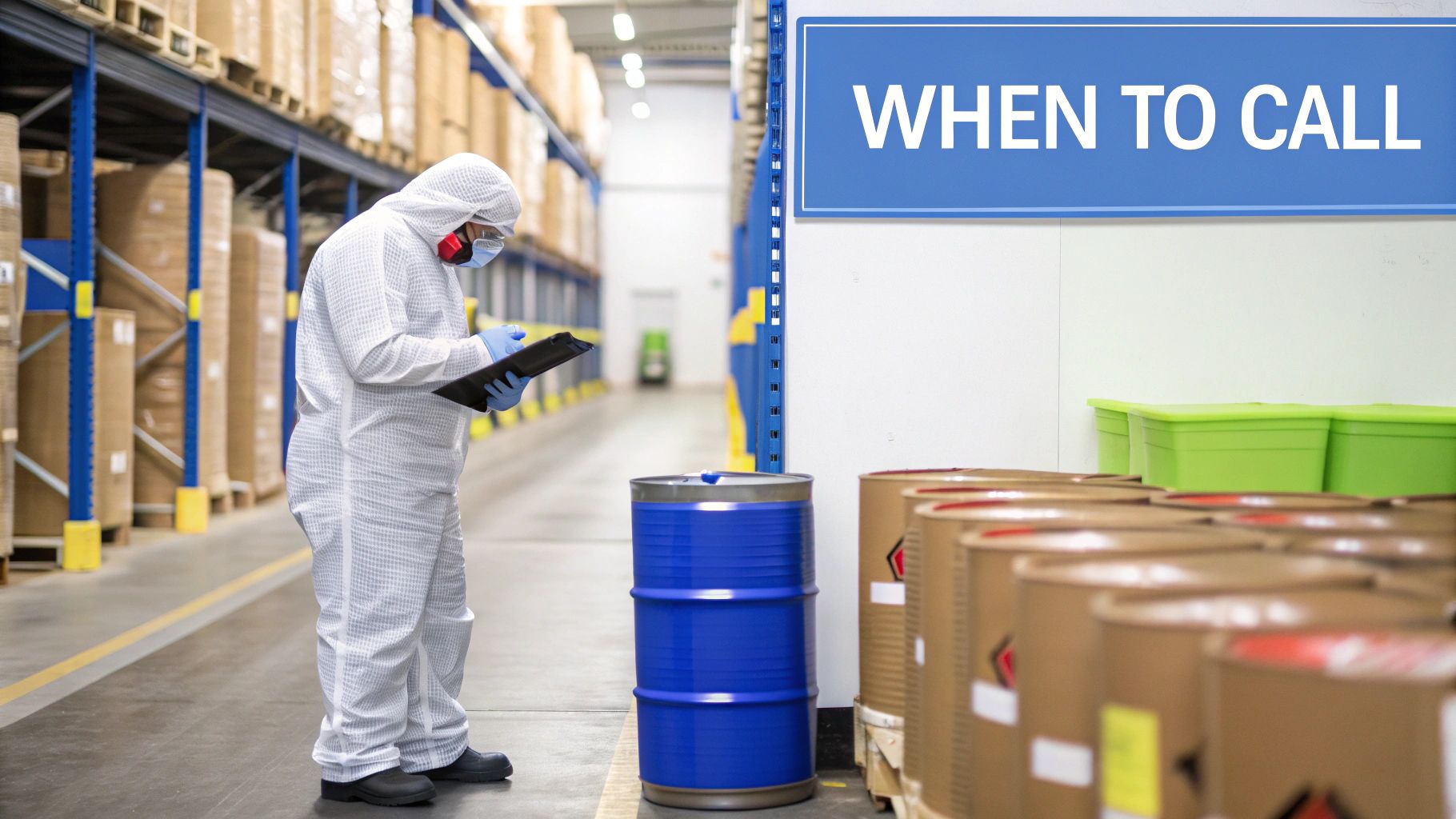
Having the CHEMTREC emergency phone number is one thing, but knowing the right time to use it is just as crucial. In the middle of an emergency, hesitation can be dangerous. The rule of thumb is simple: a call is needed whenever there's an unplanned or uncontrolled release of a hazardous material that could threaten people, property, or the environment.
This isn't just for major industrial disasters. Even a seemingly small incident can spiral without the right expert advice. By empowering your team to recognise the triggers, you ensure a fast, informed, and compliant response every time.
Clear Scenarios for Making the Call
When an incident happens, there's no time for second-guessing. Providing clear guidelines to your team is essential for a swift and effective response. You should get on the phone with CHEMTREC immediately in any of these situations:
- Chemical Spills or Leaks: Any accidental release from a container, no matter the size. Think of a punctured drum of solvent on the warehouse floor or a weeping valve on a chemical tote during transport.
- Fires Involving Hazardous Materials: Any fire where chemicals are stored or used. Their involvement can create toxic fumes, explosions, or other complex hazards that firefighters need to be aware of.
- Unexpected Chemical Reactions: This is when substances start reacting in an uncontrolled way, maybe producing heat, gas, or a dangerous build-up of pressure.
- Exposure Incidents: If a worker gets exposed to a hazardous chemical—whether they've inhaled it, got it on their skin, or ingested it—and you need immediate toxicological information for first aid or medical teams.
- Transportation Accidents: Any road or rail accident involving a vehicle carrying hazardous materials. It's vital to call even if a leak hasn't happened yet, as the potential is still there.
By clearly defining these scenarios, you remove the guesswork. Every employee knows when to act, helping to minimise the risks and kickstart a coordinated response.
What to Report During an Emergency Call
When you ring the CHEMTREC emergency number, the information you give the specialist directly affects how quickly and effectively they can help. In a stressful situation, it’s easy to get flustered, but having the right details ready can turn a moment of chaos into a structured, manageable response.
Your main job is to give them a clear, accurate picture of what's happening. This lets the CHEMTREC team provide the right guidance and get the necessary technical experts on the line without delay.
Key Information to Have Ready
Before you even pick up the phone, try to get these essential details together. You can usually find most of this on the product's Safety Data Sheet (SDS) or a digital safety card.
- Your Contact Details: Start with your name, a callback number, and the organisation you’re with.
- Location of the Incident: Be precise. Give a full address, including the city and county. If you’re on a motorway, provide the road name, direction of travel, and the nearest mile marker or exit.
- Chemical Details: The product name is a must. If you have it, the manufacturer’s name and the CAS number are incredibly helpful.
- Description of the Situation: Explain what’s happened. Is it a spill? A fire? A leak from a container, or has someone been exposed?
- Quantity of Material: Give your best estimate of how much of the substance has been released.
- Injuries or Exposures: Crucially, report if anyone has been hurt or come into contact with the chemical. This is vital for guiding first aid and advising on the correct personal protective equipment.
CHEMTREC’s dedicated regional numbers, like the one for Belgium (+32 2 808 32 37), are designed to make this process smoother. They can auto-detect local languages and cut down connection times by as much as 30%, ensuring that critical information gets through fast, even when you're under pressure.
Integrating CHEMTREC into Your Safety Systems
Having the CHEMTREC number jotted down on a noticeboard simply isn’t enough. For it to be effective, it needs to be woven into the fabric of your daily safety culture. The aim is to shift this crucial contact from a static piece of information to an active, life-saving tool that every employee can find in a heartbeat.
Modern safety platforms are designed to do just this, embedding the number directly into digital workflows. Imagine an employee scanning a QR code on a chemical drum—their phone should immediately bring up a safety card with a one-touch dial button for CHEMTREC. It’s about removing the panic of searching for a number when every second counts.
Making the Number Actionable
Embedding emergency contacts into your safety systems ensures everyone, from lab technicians to logistics staff, has the same immediate access. Here are some key places to integrate it:
- Digital Safety Data Sheets (SDSs): You should automatically populate Section 1 of every SDS with the correct CHEMTREC number. This not only helps with compliance but also creates a consistent, easy-to-find contact point.
- Mobile Safety Cards: Generate QR-code accessible cards for containers and specific work areas. These cards must feature a prominent, clickable CHEMTREC number.
- Standard Operating Procedures (SOPs): Write the number and clear calling instructions directly into your documented emergency response procedures.
This process flow shows the simple, yet vital, steps to take when you need to report an incident.
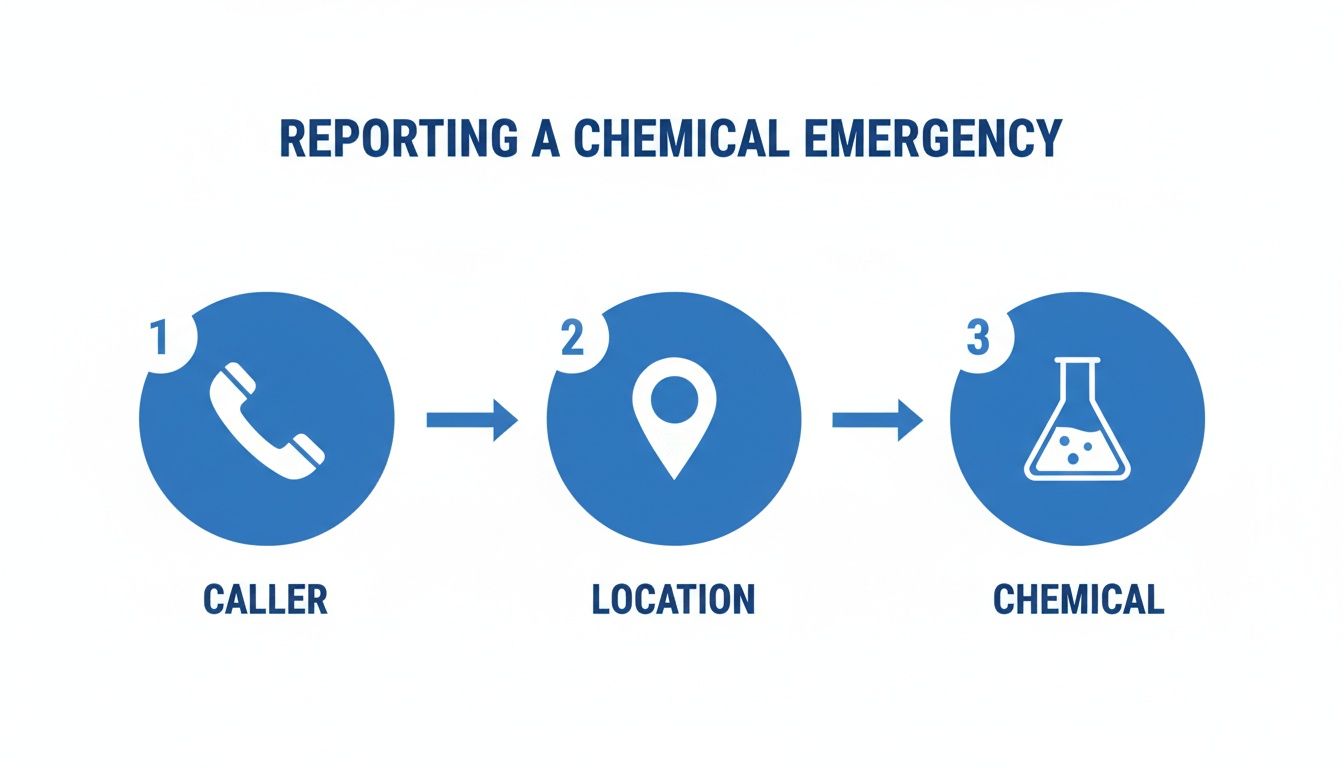
As the graphic shows, providing clear, accurate information on your location and the chemical involved is just as important as making the call itself. Using robust SDS management software can automate the placement of this vital information across all your safety documents, ensuring it's always there when needed.
Thinking beyond chemical incidents, a truly proactive safety plan integrates multiple communication tools. Understanding the critical role of communication in health and safety reinforces why having an accessible contact like CHEMTREC is so indispensable. This kind of seamless integration is what transforms safety protocols from a manual on a shelf into an immediate, real-world response system.
Why You Should Register with CHEMTREC
Anyone can ring the CHEMTREC emergency number during an incident, which is a fantastic public service. However, officially registering your organisation takes you from being a one-off caller to a fully-prepared safety partner. Think of a subscription not just as a service, but as a solid investment in your compliance and emergency readiness.
For any company that ships or handles hazardous materials, registering with CHEMTREC is often a non-negotiable legal requirement.
Once registered, you're authorised to put the CHEMTREC emergency phone number on your shipping documents, Safety Data Sheets (SDSs), and product labels. This is a must-have under a whole raft of global and national regulations, including ADR for road transport in Europe, IATA for air freight, and IMDG for maritime shipping. Without it, you’re looking at shipments being delayed, fined, or flat-out rejected, which can cause chaos in your supply chain.
More Than Just a Number on a Form
A subscription gives you so much more than just a phone number for your paperwork. It unlocks a whole suite of benefits that genuinely strengthen your safety procedures and make meeting your regulatory duties that much easier.
Companies that register get access to some key advantages:
- Unlimited 24/7 Response Support: Your teams can call on emergency specialists anytime, day or night, for any incident involving your products, no matter where it happens in the world.
- Detailed Incident Reporting: After an incident, CHEMTREC provides thorough reports that are invaluable for fulfilling your own internal and external reporting obligations.
- Global Regulatory Compliance: A single registration helps you tick the emergency contact box for multiple international transport rules, simplifying the complex world of global logistics.
Registering isn't just about buying a phone number. It's about securing a partnership with a global leader in chemical emergency response, giving you peace of mind that you have expert backing whenever and wherever you need it.
Your Guide to International CHEMTREC Numbers
If your operations stretch across borders, you know that a single, one-size-fits-all emergency number just won't cut it. That's why CHEMTREC maintains a global network of dedicated, in-country phone numbers. It’s a simple but vital system that ensures expert help is only ever a local call away, no matter where an incident happens.
This localised approach is a game-changer during a crisis. Dialling a local number sidesteps the delays and connection problems that can plague international calls – issues you absolutely can't afford when time is critical. More importantly, it slashes response times by putting you straight through to specialists who speak the local language and understand the regional context.
Why Local Numbers Make All the Difference
When you're dealing with a chemical incident, the last thing you need is a bad phone connection or a language barrier. Here’s why using the right regional number is so important:
- Quicker Connection: In-country lines get you past the international exchanges, connecting you to an expert much faster.
- Native Language Support: Local numbers are your direct line to teams who are fluent in the languages spoken in that region. The Belgian number, for instance, offers support in French, Flemish, and German.
- On-the-Ground Expertise: The responders on the other end know the local emergency services, the national regulations, and the specific logistical challenges of the area. This means the guidance you get is immediately practical and relevant.
For anyone managing an international supply chain, having these numbers readily available is a cornerstone of a robust safety plan. The table below lists CHEMTREC's dedicated numbers for key global regions, giving you the tools to build a truly international safety net for your shipments.
Your CHEMTREC Questions Answered
When you're dealing with hazardous materials, knowing exactly what to do in an emergency is crucial. Let's clear up some of the most common questions people have about using CHEMTREC.
Can Anyone Call The CHEMTREC Emergency Number?
Yes, anyone can—and should—call CHEMTREC during a genuine hazardous materials incident. Whether you're a first responder, an employee, or a member of the public who's witnessed a spill, the line is open for immediate, expert advice.
There’s an important distinction for businesses, though. If you plan to list the CHEMTREC number on your Safety Data Sheets (SDSs) or shipping documents, your organisation must be officially registered. This isn't just a formality; it's a legal requirement in many regions, proving you have a professional emergency response plan in place.
Is There A Fee For Calling CHEMTREC In An Emergency?
No, calling CHEMTREC for help during an actual emergency is completely free of charge. The service is set up as a public lifeline, so cost should never be a barrier to getting critical help when you need it most.
The costs come in with the registration and subscription services. These are what allow a company to legally use the phone number for compliance purposes and unlock other services, like detailed incident reporting and help with global regulations.
Should I Still Call The Local Emergency Services?
Absolutely, and they should be your first call. CHEMTREC is a powerful resource, but it doesn't replace the need to contact your local fire brigade, police, or ambulance service. Always dial your local emergency number first (for example, 112 in Belgium) to get immediate, hands-on help to the scene.
CHEMTREC serves as a vital information hub, feeding technical expertise and chemical data to the first responders once they've arrived. They are a specialist support team, not a substitute for local emergency crews.
Think of it like this: local emergency services handle the physical incident on the ground, while CHEMTREC provides the specialised chemical knowledge to help them do it safely and effectively.
Here at NextSDS, we make sure these critical safety steps are built right into your daily operations. Our system automatically adds the correct emergency contact numbers to your digital SDSs and mobile safety cards, giving every team member the information they need, right at their fingertips. Find out how we can help you build a smarter, faster safety response system at https://nextsds.com.