

If you've ever needed to figure out whether a chemical is safe to handle in a specific work scenario—without setting up complex and expensive air monitoring equipment—then you've stumbled upon the exact problem the ECETOC TRA was built to solve. Think of it as a highly sophisticated, science-backed calculator for chemical risk.
What Is the ECETOC TRA and Why Does It Matter?

The ECETOC Targeted Risk Assessment (TRA) tool, developed by the European Centre for Ecotoxicology and Toxicology of Chemicals, calculates the risk of exposure from chemicals for workers, consumers and the environment. It gives us a way to predict potential exposure levels without taking direct physical measurements.
For Health, Safety, and Environment (HSE) professionals, this is a game-changer. It provides a reliable, scientifically-grounded first look at potential risks by using a set of standard parameters and cautious assumptions, sidestepping the need for initial resource-intensive sampling.
To give you a clearer picture, let's break down its core parts.
ECETOC TRA at a Glance: Key Components
The table below summarises the main modules of the ECETOC TRA, outlining what each part does and who typically uses it.
| Component | Function | Primary User Group |
|---|---|---|
| Worker Exposure Model | Estimates inhalation and dermal exposure for professionals handling chemicals in industrial settings. | HSE Managers, Occupational Hygienists, Chemical Registrants |
| Consumer Exposure Model | Predicts exposure for the general public from using products containing chemical substances (e.g., paints, cleaners). | Product Stewards, Regulatory Affairs Specialists |
| Environmental Model | Calculates environmental concentrations resulting from chemical releases to air, water, and soil. | Environmental Scientists, Ecotoxicologists, REACH Registrants |
Essentially, the TRA bundles these three critical perspectives into a single, integrated tool, making it a comprehensive starting point for any chemical risk assessment.
A Cornerstone of European Chemical Regulation
The ECETOC TRA isn't just a handy tool; it's deeply embedded in European chemical regulations, most notably REACH (Registration, Evaluation, Authorisation and Restriction of Chemicals). Under the REACH framework, any company manufacturing or importing a substance in quantities of 10 tonnes or more per year is required to complete a Chemical Safety Report (CSR).
A huge part of that report involves assessing exposure, and the TRA tool is one of the main methods officially accepted by the European Chemicals Agency (ECHA) for this purpose. Its structured, conservative-by-design approach provides a dependable baseline for demonstrating safe use.
This regulatory stamp of approval is what makes it so powerful. When you use the TRA, you're using a method that authorities recognise and trust. It effectively translates complex workplace scenarios and toxicological data into a straightforward risk conclusion.
How Its "Better Safe Than Sorry" Approach Protects People
The TRA is built on a "tiered" logic, which means it starts with a deliberately conservative, or "worst-case," scenario. This is a core principle of its design and is what guarantees a high margin of safety.
By assuming higher potential exposures right out of the gate, the tool intentionally errs on the side of caution. If this initial, tough screening shows that a risk is adequately controlled, you can have a high degree of confidence that the process is safe.
But what if it flags a potential concern? It doesn't mean you have to shut everything down. Instead, it’s a clear signal that a closer look is needed—perhaps by refining the assessment with more specific data or by putting extra risk management measures in place. This tiered system makes the ECETOC TRA both an accessible entry point for risk assessment and a vital part of any robust chemical safety programme.
Getting to Grips with the Core TRA Methodology
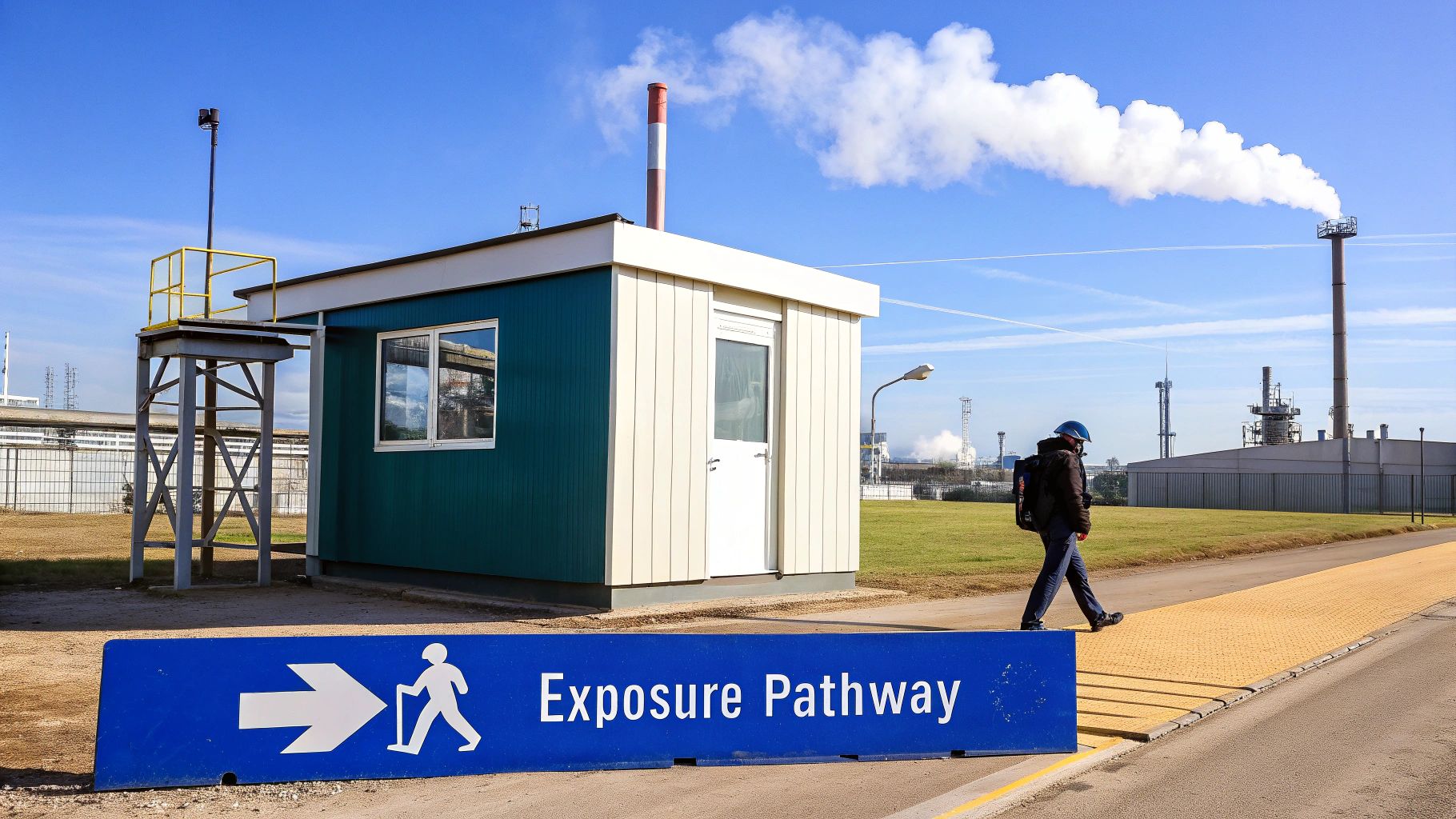
To really see why the ECETOC TRA is so widely used, we need to pop the bonnet and have a look at how it actually works. It’s far from being a mysterious "black box"; the tool’s logic is built on a straightforward and pretty intuitive concept known as the source-receptor pathway.
Think of a painter spraying a car part in a workshop. The "source" is the spray gun atomising the paint. The "receptor" is the worker breathing it in. The "pathway" is simply the air between the two. The TRA's entire purpose is to model this journey to figure out how much of that substance actually reaches the worker.
This model doesn't just pluck numbers out of thin air. It uses specific determinants to build a realistic picture of the exposure scenario. These are the crucial inputs that shape the final risk calculation, turning abstract data into a concrete prediction.
The Key Ingredients of an Exposure Scenario
The TRA juggles several factors to model that source-receptor pathway accurately. The most important ones you’ll need to consider are:
- Substance Properties: How easily does the chemical become airborne? For liquids, we’re talking about volatility – how readily it evaporates. For solids, it’s all about dustiness. A highly volatile solvent like acetone presents a very different inhalation risk compared to a low-dust solid pellet.
- Process Conditions: How is the substance actually being used? Things like the operating temperature, how long the task takes, and whether it’s happening indoors or outdoors can dramatically change the potential for exposure.
- Risk Management Measures (RMMs): What have you got in place to control the risk? This is where you account for engineering controls like Local Exhaust Ventilation (LEV), which nips contaminants in the bud at the source, and any Personal Protective Equipment (PPE) your team is using, like gloves or respirators.
By pulling these elements together, the ECETOC TRA tool pieces together a detailed picture of a specific work task. To make sure this process is consistent, it uses a clever system of codes and descriptors.
Learning to Speak the TRA's Language
To bring a bit of order to the chaos of countless industrial scenarios, the ECETOC TRA uses a standardised vocabulary. These descriptors categorise activities in a way the model can understand, making sure that similar tasks are assessed in the same way, every single time.
At its heart, the TRA is a translator. It converts complex, real-world activities into a language of standardised codes. This system is what allows the tool to apply its pre-calculated exposure models to your specific situation, giving you a consistent and repeatable assessment.
This is where three foundational concepts come into play:
- Process Categories (PROCs): These are essentially shorthand codes for specific work activities. For example, PROC 8a describes the "Transfer of substance or mixture (charging/discharging) at non-dedicated facilities"—a very common task. Getting the PROC right is probably the single most critical step.
- Use Descriptors: This system adds a bit more context, describing how a chemical is used throughout its life. It helps to define the market sector (like industrial coatings) and the type of product it ends up in (like paints).
- Environmental Release Categories (ERCs): These codes focus on estimating the potential release of a substance into the wider environment (air, water, and soil) during a particular use. For instance, ERC 4 relates to the "Use of non-reactive processing aid at industrial site (no inclusion into or onto article)."
Once you’ve entered these standardised inputs, they get crunched by the model's engine. The tool calculates an estimated exposure level and then compares it to a known safe level, like a Derived No-Effect Level (DNEL).
This comparison gives you the single most important output: the Risk Characterisation Ratio (RCR). If the RCR is below 1.0, the risk is considered to be adequately controlled. But if it’s above 1.0, it’s a red flag that you need to take action.
While the ECETOC TRA is a powerful Tier 1 tool, for a deeper dive into controlling airborne hazards, you can learn more about exposure monitoring with our guide to the EMKG model.
Mastering Your Inputs and Interpreting the Results
Moving from theory to practice with the ECETOC TRA comes down to two key things: getting your input data right and truly understanding what the results are telling you. The quality of any risk assessment is only as good as the information you feed it.
It’s a bit like baking a cake. You can have the best recipe in the world, but if you use salt instead of sugar, the result is going to be a disaster. The same logic applies here. An ECETOC TRA assessment is only reliable if it's built on accurate, solid data. This is where your Safety Data Sheets (SDSs) become your most important resource.
Gathering the Essentials from Your Safety Data Sheets
Think of yourself as a detective. The SDS is your case file, holding all the clues you need to define a substance’s hazards and figure out a safe exposure threshold. While you should always review the entire SDS, a few sections are absolutely critical for a TRA assessment.
Here’s a quick checklist of what to look for and where to find it:
- Section 1: Identification: Grab the substance name and CAS number to make sure you’re assessing the right chemical.
- Section 8: Exposure Controls/Personal Protection: This is the goldmine. It’s where you’ll find the Derived No-Effect Level (DNEL), which is the cornerstone of your assessment. The DNEL represents the exposure level that workers should not go above.
- Section 9: Physical and Chemical Properties: Here, you need to find the vapour pressure or boiling point to gauge the substance's volatility. If you're dealing with a solid, you'll need to judge its dustiness—is it a fine powder or more like solid granules?
- Section 11: Toxicological Information: This section gives you the context, outlining the routes of exposure (inhalation, skin contact) and specific health risks.
Without a doubt, the DNEL is the most vital piece of information you'll pull from the SDS. It acts as the safety benchmark. The TRA calculates a predicted exposure and then compares it directly against this DNEL. If you want to dive deeper into these safety values, our guide on the differences between DNELs and Occupational Exposure Limits (OELs) is a great place to start.
The Bottom Line: Understanding the Risk Characterisation Ratio
Once you’ve plugged in all your data—substance properties, the correct Process Category (PROC) for the task, and any safety controls you have in place—the ECETOC TRA tool does its magic. It boils everything down to a single, powerful number: the Risk Characterisation Ratio (RCR).
This ratio is the final verdict. It’s a simple calculation that tells you everything you need to know.
RCR = Predicted Exposure Concentration (PEC) / Derived No-Effect Level (DNEL)
What the RCR means is very straightforward:
- RCR < 1: Success! The risk is considered adequately controlled. Your estimated exposure is safely below the DNEL, meaning your current work practices and safety measures are doing their job.
- RCR > 1: This is a red flag. The risk is not adequately controlled. The model predicts that exposure could exceed the safe limit, putting workers at risk. This isn't a reason to panic, but it is a clear signal that you need to take action.
An RCR over one simply means your initial, conservative assessment has found a potential problem that needs solving.
What to Do When Your RCR is Over 1.0
If your first run gives you an RCR above 1.0, your next job is to refine the assessment. You need to either adjust your inputs to better reflect the reality of the task or model the effect of adding more robust safety controls. This back-and-forth process is the heart of good risk management.
Here are the usual steps to take:
- Check Your Inputs Again: Are you certain you chose the right PROC? Is the duration of exposure correct? A simple mistake here can make a huge difference, and correcting it might be all you need to get the RCR below 1.0.
- Introduce Risk Management Measures (RMMs): Model what happens when you add engineering controls like Local Exhaust Ventilation (LEV). The TRA tool has built-in values for how effective different RMMs are.
- Add Personal Protective Equipment (PPE): Factor in the use of appropriate PPE, like respirators or the right kind of gloves. The TRA will adjust the exposure estimate based on the protection factor of the equipment you specify.
The stakes are high. In the European Union, a major manufacturing hub, the production of chemicals classified as hazardous to health hit 167 million tonnes in 2023. While this figure is down from previous years, it highlights the enormous scale of chemical handling that depends on diligent risk assessment. Mastering the TRA isn’t just about ticking a box for compliance; it's a fundamental skill for keeping people safe in a complex industrial environment. Properly interpreting the TRA often means getting comfortable with scientific data; exploring strategies for reading scientific papers can provide a real advantage.
Walking Through a Real-World TRA Assessment
Theory is one thing, but to really get a feel for how the ECETOC TRA works in practice, let's walk through a common workplace scenario from start to finish. This is where we see abstract numbers from a Safety Data Sheet (SDS) turn into a concrete, actionable safety conclusion.
Let's picture a typical industrial task: a worker is manually mixing a batch of paint. The job involves pouring a solvent—in this case, Toluene—from a large drum into a smaller mixing vessel. Our job is to figure out if this task is safe under the current setup.
The whole process boils down to a logical workflow, starting with gathering the right data and ending with a clear risk result.
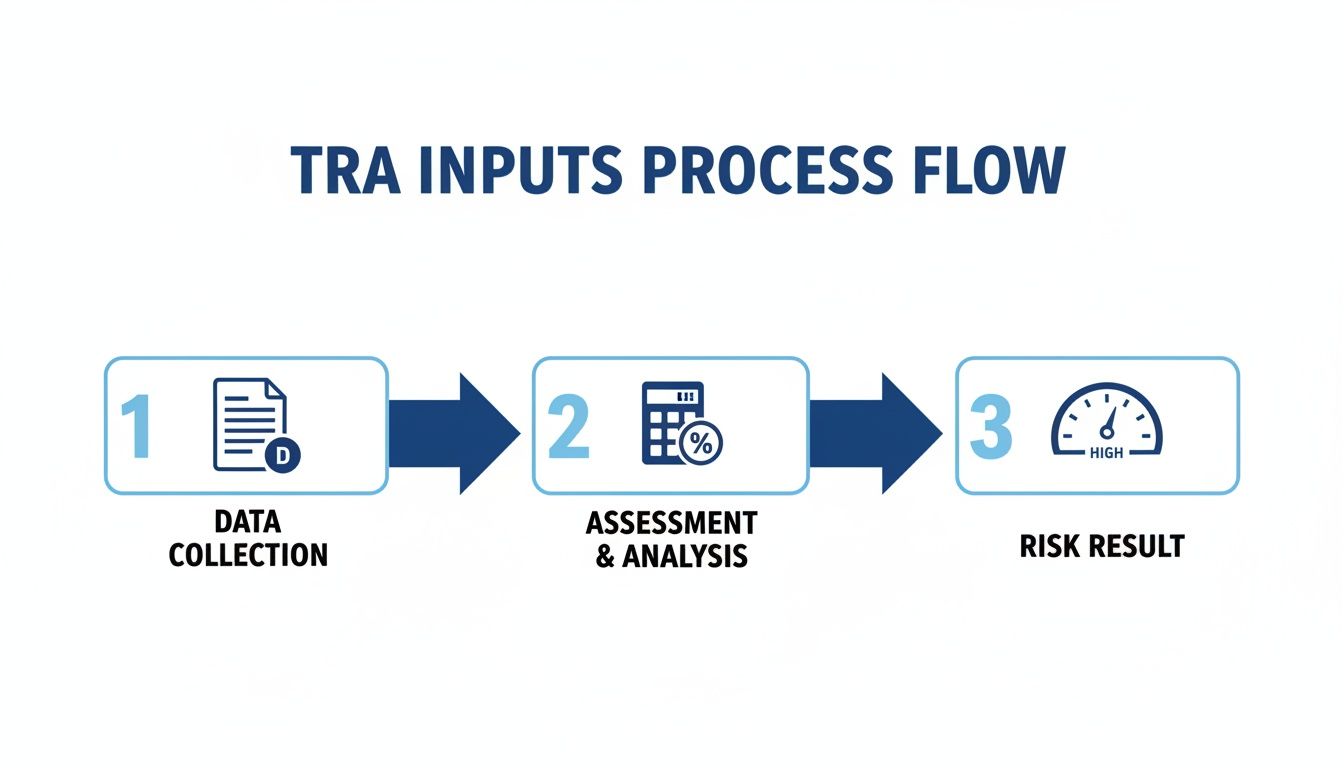
As you can see, the quality of your final result is completely dependent on the quality of the information you put in at the beginning. Get that right, and you're already halfway there.
Scenario 1: Controlled Conditions with Ventilation
First things first, we need to pull together our key data points. Most of what we need will be in the Toluene SDS, combined with what we know about the actual workplace.
- Substance Identification: We’re working with Toluene (CAS No. 108-88-3).
- Hazard Data: A quick look at Section 8 of the SDS gives us the long-term inhalation Derived No-Effect Level (DNEL). For Toluene, it’s 192 mg/m³. This is our safety benchmark—the level of exposure we need to stay below.
- Physical Properties: Over in Section 9, we find the vapour pressure is around 3.8 kPa at 25°C. This tells the tool that we're dealing with a highly volatile substance.
With our numbers ready, we can start plugging the scenario into the ECETOC TRA tool itself.
- Process Category (PROC): The task involves transferring a liquid between containers in a general-purpose area, not a fully contained, dedicated system. This lines up perfectly with PROC 8a, which covers "Transfer of substance or mixture (charging/discharging) at non-dedicated facilities."
- Operational Conditions: It's an indoor job that takes about one hour per shift.
- Risk Management Measures (RMMs): The mixing area has Local Exhaust Ventilation (LEV) installed, and we’ve confirmed it’s switched on and working properly.
Once we enter these parameters, the TRA crunches the numbers to predict the worker's exposure and compares it against our safety benchmark.
The tool estimates a Predicted Exposure Concentration (PEC) of 96 mg/m³. It then calculates the Risk Characterisation Ratio (RCR) like this: RCR = 96 mg/m³ (PEC) / 192 mg/m³ (DNEL) = 0.5.
Because the RCR is 0.5—well below the threshold of 1.0—the assessment concludes the risk is adequately controlled. The LEV is clearly doing its job, keeping the worker’s exposure safely within limits.
Scenario 2: Uncontrolled Conditions Without Ventilation
Now for the interesting part. What happens if a crucial piece of safety equipment fails? This is where the ECETOC TRA really shows its worth, letting us model the impact of a process failure before anyone gets hurt.
We’ll keep every single input from the first scenario the same, except for one critical change: the LEV system is out of order.
- Process Category (PROC): Stays the same, PROC 8a.
- Operational Conditions: Still indoors, still for one hour.
- Risk Management Measures (RMMs): We now change this setting to reflect that there is no LEV.
That one change completely flips the result. The tool, knowing that a highly volatile substance is being handled without any engineering controls, gives a much higher exposure estimate.
The new PEC skyrockets to 384 mg/m³. This leads to a very different RCR calculation: RCR = 384 mg/m³ (PEC) / 192 mg/m³ (DNEL) = 2.0.
An RCR of 2.0 is double the safe limit. It’s a massive red flag that tells us the risk is not adequately controlled. This immediate, quantitative result proves that doing this job without proper ventilation poses a serious health risk.
Comparing the Two Scenarios
This simple side-by-side comparison gets right to the heart of what the ECETOC TRA does. It's not just a box-ticking exercise for an initial assessment; it's a dynamic tool for testing how effective your safety measures really are.
| Parameter | Scenario 1 (With LEV) | Scenario 2 (Without LEV) |
|---|---|---|
| Risk Management Measure | Local Exhaust Ventilation | None |
| Predicted Exposure (PEC) | 96 mg/m³ | 384 mg/m³ |
| Risk Characterisation Ratio (RCR) | 0.5 (Safe) | 2.0 (Unsafe) |
This worked example shows exactly how the tool can help you justify spending on new engineering controls, reinforce why safety procedures must be followed, or run "what-if" analyses before changing a process. By turning real-world conditions into a simple RCR number, it gives safety professionals the hard data they need to make decisions that protect people’s health.
Common Pitfalls and How to Avoid Them
The ECETOC TRA tool is a fantastic starting point for risk screening, and its widespread acceptance is a major plus. But like any model, it’s not perfect. Getting the most out of it means understanding its quirks—both the good and the bad. This way, you can lean on its strengths while dodging the common mistakes that trip people up.
One of its biggest advantages is that it's recognised by the European Chemicals Agency (ECHA), which makes it a go-to for REACH compliance. However, the tool is deliberately built to be conservative. Think of it as having a "better safe than sorry" attitude, which sometimes means it can overestimate the risk. This might point you towards expensive control measures that a more in-depth look would show aren't really necessary.
This conservative nature is a feature, not a flaw, but you have to know how to read the results. It makes the TRA a powerful screening tool that flags potential problems, but you shouldn't treat its initial output as the final, absolute truth.
Overlooking the Importance of PROC Codes
A classic, and pretty serious, mistake is picking the wrong Process Category (PROC) code. This is arguably one of the most critical inputs you'll make, as each code comes with a built-in exposure potential based on the type of activity it describes.
If you choose a PROC for a wide-open process when your team is actually using a semi-closed system, you're going to get a wildly inflated exposure estimate. It's an easy mistake to make but one that completely skews the results.
How to Avoid It: Don't rush this step. Sit down with the official PROC descriptions and carefully match your real-world task to the best-fit code. Think about containment, the scale of the job, and what's actually happening on the ground. When in doubt, it's always worth getting a second opinion from an occupational hygienist to make sure your choice holds up.
Misjudging Risk Management Measures
Another common trap is being too optimistic about the effectiveness of Risk Management Measures (RMMs), especially Personal Protective Equipment (PPE). The ECETOC TRA has specific efficiency ratings for controls like Local Exhaust Ventilation (LEV) and different kinds of PPE.
It’s tempting to tick the PPE box and assume the risk is handled. But the tool demands a realistic assessment. The real-world effectiveness of a respirator, for instance, hinges on correct selection, a proper fit test, and workers using it consistently. Claiming 90% efficiency for a mask that doesn't seal properly is a recipe for dangerously underestimating the real exposure.
Failing to Refine High-Risk Assessments
Getting a Risk Characterisation Ratio (RCR) over 1.0 isn't a dead end—it's a sign that you need to dig deeper. A huge mistake is to see that number, stop, and either panic or do nothing.
Think of a high RCR as a prompt to start investigating:
- Double-Check Your Inputs: Are you sure the task duration is right? Is the substance volatility entered correctly? A small typo can have a big impact.
- Model Realistic Controls: Play with the inputs. What happens to the RCR if you add LEV? What if you specify a better grade of chemical-resistant gloves?
- Gather More Data: If the TRA model still points to a high risk even after your refinements, it's probably time to escalate. This could mean using a more advanced tool or, better yet, getting real-world data through exposure monitoring.
Staying on top of these details is crucial in a constantly shifting regulatory world. For example, ECHA's 2025 'Key Areas of Regulatory Challenge' report signals ongoing changes for sectors like Belgium's chemical industry. The SVHC list now includes 250 substances, and keeping your assessments up-to-date isn't just a good idea—it's essential for staying compliant. You can read more about these updates in the full ECHA report.
Taming the TRA: How Modern EHS Platforms Can Help
While the ECETOC TRA is a powerful tool, actually using it can feel like a throwback to a different era. The classic approach—working with spreadsheets and manually digging through stacks of Safety Data Sheets (SDSs)—is a major bottleneck for any busy safety professional.
Think about it. You need to find CAS numbers, DNELs, and hazard statements for hundreds, maybe thousands, of chemicals. It’s not just slow and tedious work; it's also a minefield for human error. One mistyped digit or an overlooked revision date is all it takes to throw off your entire assessment, leaving you with a false sense of security and a hidden compliance gap.
This old-school method just doesn't scale. Every time a regulation changes or a supplier sends a new SDS, you're forced to start the whole painstaking process all over again. It’s a reactive cycle that keeps you buried in paperwork instead of focusing on what matters: managing risk.
Getting Out of the Weeds of Manual Data Entry
This is exactly where modern Environment, Health, and Safety (EHS) platforms change the game. They shift risk assessment from a static, document-based chore into a living, interconnected system for your chemical safety data.
Imagine an EHS platform that can actually read an SDS. When you upload a new sheet, the system doesn’t just file it away. It acts like a digital assistant, automatically scanning the document and pulling out all the critical data points you need for your ECETOC TRA assessment.
This kind of automation delivers on three fronts:
- Speed: It cuts down data collection from hours to minutes. This frees you up to focus on the bigger picture—analysing the results and implementing the right control measures.
- Accuracy: By taking manual transcription out of the equation, the risk of data entry mistakes plummets. Your assessments are built on solid ground from the start.
- Consistency: Every assessment is built from the same validated, standardised data foundation, making your entire process more reliable.
This leap from manual data entry to automated inputs is the difference between a reactive compliance chore and a proactive risk management programme. It forges a real-time link between your chemical inventory and your safety assessments.
Building an Integrated Risk Management System
A truly modern EHS platform doesn't stop at just filling in the blanks. It builds a complete, seamless workflow around the ECETOC TRA. Once the data is pulled from an SDS, the system can cross-check it against internal and external regulatory lists, flagging any restricted substances or inconsistencies before they become a real problem.
What’s more, it can set up automated alerts. If a regulatory body updates a substance classification or a supplier issues a revised SDS with a new DNEL, you get a notification instantly. This proactive monitoring ensures your risk assessments are always living documents, reflecting the absolute latest safety information and creating a robust audit trail for compliance.
This is more important than ever as regulations evolve. For instance, Belgium is getting ready for the unified EU Chemicals Data Platform, which is set to launch by 2 January 2029. This initiative will pull data from agencies like ECHA and EU-OSHA into one place, a huge development for teams trying to validate supplier SDSs. You can read more about this upcoming EU Chemicals Data Platform on chemradar.com.
By integrating the ECETOC TRA into a central platform like NextSDS, you're finally breaking free from isolated spreadsheets and creating a dynamic safety system. You can explore more about these integrated risk and safety solutions on our blog. This approach makes sure your risk insights aren't just calculated once and forgotten, but are continuously updated to drive smarter, safer decisions across the whole organisation.
Common Questions About the ECETOC TRA
Getting to grips with chemical risk assessment tools often throws up a few questions. Let's tackle some of the most frequent queries about the ECETOC TRA to give you the confidence you need to use it effectively.
What’s the Difference Between ECETOC TRA and Stoffenmanager?
The main difference really comes down to detail and purpose. Think of the ECETOC TRA as your first line of defence – a Tier 1 screening tool. It’s built for broad, conservative assessments, especially under REACH, giving you a quick "better safe than sorry" verdict based on fairly standard inputs.
Stoffenmanager®, in contrast, is a more sophisticated Tier 2 model. It digs deeper, demanding more specific details about your actual workplace conditions to generate a more realistic (and often less conservative) exposure estimate. A common workflow is to use the TRA for your initial screening; if it flags a potential concern, you might then use Stoffenmanager to get a more refined, situation-specific picture.
When Do I Need to Run a New TRA Assessment?
Your TRA assessment isn't a one-off task you can file away and forget. It should be a living document that reflects the reality of your operations. You'll need to revisit and update it whenever something significant changes.
Key triggers for a fresh assessment include:
- Changes to the Process: You've altered the amount of a substance used, adjusted the process temperature, or changed how long a task takes.
- Introducing New Chemicals: A new substance is brought into the workplace.
- Shifts in Safety Controls: Perhaps a local exhaust ventilation system is modified, or the type of PPE provided is changed.
- Updated Hazard Information: You receive a new Safety Data Sheet (SDS) for a substance with a different hazard classification or a revised DNEL.
Can I Use the ECETOC TRA for Consumer Products?
Yes, you can. The ECETOC TRA isn't just for workplace exposure; it has a dedicated, integrated model designed specifically for assessing consumer products.
This part of the tool looks at risk from a completely different angle. Instead of workplace controls, it focuses on typical consumer behaviours. It considers things like how often someone might use a product, the amount they'd apply, and whether it’s sprayed or wiped on. This allows you to estimate potential exposure and confirm that the product is safe for public use.
Tired of juggling spreadsheets and chasing down updated safety data sheets? See how NextSDS can automate your SDS management and connect directly with your risk assessment workflows. Discover a smarter approach to chemical safety.