

Trying to keep your workplace safe without knowing which hazard to tackle first is like trying to find your way in the dark. It’s overwhelming and, frankly, dangerous. The Fine & Kinney method is the tool that turns the lights on, providing a clear, quantitative way to estimate risks in chemical risk assessments, moving you from guesswork to a structured, informed process.
What Is the Fine and Kinney Method?
At its heart, the Fine & Kinney method provides a straightforward and repeatable framework for quantitative risk estimation. Instead of relying on gut feelings, it uses a simple formula to assign a numerical risk score to workplace hazards, allowing you to directly compare different dangers.
This method boils down to three key factors:
- Consequence (C): How severe would the outcome be if an incident actually happened?
- Exposure (E): How often are people actually exposed to this particular hazard?
- Probability (P): What are the chances that an accident will occur during that exposure?
You give each of these elements a numerical value, multiply them together, and you get a single risk score. For HSE managers, especially those conducting chemical risk assessments, this is a game-changer. It provides a logical way to rank a long list of potential chemical hazards and decide where to channel your time, money, and effort for the greatest impact. A solid grasp of chemical safety in the workplace is the essential starting point for using this method effectively.
The real power of the Fine & Kinney method lies in its ability to turn abstract dangers into a clear, actionable priority list. It helps organisations shift from constantly fighting fires to proactively preventing them in the first place.
This structured evaluation ensures the most critical threats get the immediate attention they deserve. It gives you the hard data needed to justify safety investments and proves you're doing your due diligence to protect your team. This simple calculation turns complex safety challenges into a manageable roadmap for improvement, building a safer workplace for everyone.
Breaking Down the Three Core Factors
To really get to grips with the Fine & Kinney method for quantitative risk estimation, you need to understand the three ingredients that go into its risk calculation. Think of them as the legs of a stool – if you don't consider all three properly, your final assessment won't be stable. The entire system is built on how these three pillars interact.
First up is Consequence (C). This is the "what if" factor. It forces you to ask a blunt but necessary question: if this hazard is realised, how bad could it get? We're not talking about a single outcome here, but the worst credible one. The consequences could be anything from a minor first-aid issue to a catastrophic event causing multiple fatalities or serious environmental harm. Your job is to honestly evaluate the potential severity of the damage.
Exposure and Probability
Next, we look at Exposure (E). This factor is all about frequency. How often are people actually in the danger zone, interacting with the hazard? A task that only happens once a year during a planned shutdown, like inspecting the inside of a sealed tank, is going to score very low on exposure. On the other hand, a routine activity performed every shift, like handling a corrosive chemical, means the exposure is constant and the score will be much higher.
Finally, we have Probability (P). This is where things get a bit more detailed. Exposure tells us how often someone is at risk, but Probability asks, how likely is it that something will go wrong during that time? To figure this out, you need to look at everything from your existing safety controls and staff training to the condition of the equipment and any near-miss data you have. Is the procedure straightforward with built-in safeguards, or is it complex and easy for someone to make a mistake?
By separating Exposure from Probability, the Fine & Kinney method gives you a much richer picture of risk than a simple likelihood-versus-severity matrix. It brilliantly highlights how even a low-probability event can become a major concern if people are exposed to it all the time.
Picture this: an operator in a chemical plant has to take manual samples from a pressurised line. The Consequence of a failure could be severe chemical burns, giving it a high score. If they do this every single hour, Exposure is also incredibly high. And if the valve they use is old and known to be stiff, the Probability of a spray release goes way up. Just by looking at those three factors, you can immediately see how urgent the situation is.
Before we move on, it’s helpful to see how these factors are scored. While different organisations might tweak the specifics for their own chemical risk assessments, the general framework remains the same. This table gives a clear reference for the typical values used.
Reference Guide for Fine & Kinney Scoring
| Factor | Score | Description |
|---|---|---|
| Consequence | 1 | Minor injury (e.g., scratches, bruises) with no lost time. |
| 5 | Injury resulting in lost work days. | |
| 15 | Serious injury, permanent disability. | |
| 40 | One fatality. | |
| 100 | Catastrophe with multiple fatalities. | |
| Exposure | 0.5 | Very rarely (less than once per year). |
| 1 | Rarely (a few times per year). | |
| 2 | Infrequently (monthly). | |
| 3 | Occasionally (weekly). | |
| 6 | Regularly (daily). | |
| 10 | Constantly (continuous). | |
| Probability | 0.1 | Virtually impossible. |
| 0.5 | Conceivable, but highly unlikely. | |
| 1 | Unlikely, but possible. | |
| 3 | Unusual, but has happened. | |
| 6 | Quite possible and not surprising. | |
| 10 | The most likely and expected result. |
Having this guide handy helps to bring consistency to your assessments, ensuring that different team members are scoring hazards in a comparable way. It’s the key to making the Fine & Kinney method a reliable part of your safety toolkit for quantitative risk estimation.
How to Calculate Your Risk Score
Right, let's get down to the practical side of things. The real strength of the Fine & Kinney method is how it takes your observations and turns them into a straightforward, numerical value. It’s all based on a simple multiplication formula that gives you a tangible risk score.
The core calculation is: Risk Score = Consequence (C) x Exposure (E) x Probability (P). You simply multiply the values you've assigned to those three key factors to get a single, comparable score for any hazard you’re assessing.
This infographic lays out the logical flow of these three crucial risk factors.
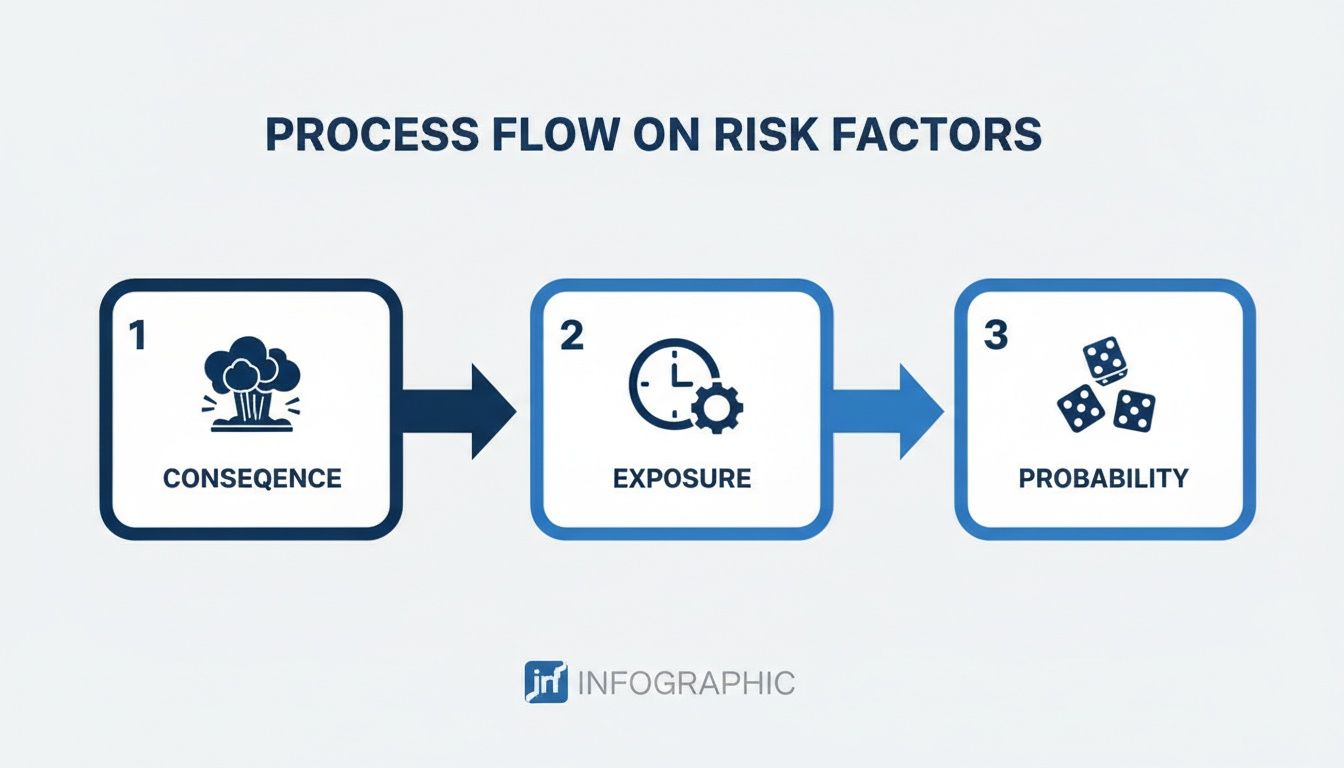
As you can see, a solid risk assessment works through a sequence: first, you figure out how bad an incident could be, then how often someone is near the hazard, and finally, how likely it is that something will actually go wrong.
From Calculation to Action
A number by itself doesn't tell you what to do. That's where an action level table comes in. It's the critical link that translates your score into a clear directive, telling you precisely how urgently you need to intervene.
Let's walk through a common scenario in a chemical risk assessment. Imagine a team member has to handle a corrosive chemical as part of their daily routine.
- Consequence (C): If a significant splash occurred, it could lead to a serious injury and lost time. Looking at the kind of tables we discussed earlier, we might assign a score of 15.
- Exposure (E): The employee does this job every single day, so exposure is frequent. This gives us a score of 6.
- Probability (P): They use the right PPE, and spills are rare, but they have happened in the past. We'll give this a score of 3.
Now, we just multiply them together: 15 (C) x 6 (E) x 3 (P) = 270.
A risk score of 270 isn’t just a number; it’s a clear signal demanding your attention. It quantifies the potential danger, cutting through any guesswork and pointing you directly toward your next steps.
So, what does a score of 270 actually mean? This is when you consult your action level table. A typical framework might look something like this:
- Below 20: Risk is acceptable. No immediate action needed.
- 20-70: Risk is tolerable, but it’s worth keeping an eye on.
- 71-200: A substantial risk. You need to plan corrective action soon.
- 201-400: High risk. This requires urgent attention.
- Above 400: A very high risk. Stop the activity immediately until it’s made safe.
With a score of 270, our example falls squarely into the "High Risk" category. This tells us in no uncertain terms that we need to implement corrective measures right away to protect that employee. You now have a clear, data-driven reason to prioritise this specific task for safety improvements.
Why This Method Is So Important for Growing Industries
As chemical production ramps up around the world, so does the headache of managing safety. In fast-growing markets, trying to track risks with manual spreadsheets is like navigating a motorway with a folded paper map – it’s slow, outdated, and bound to lead to dangerous mistakes. A structured system for quantitative risk estimation like the Fine & Kinney method is essential to keep up.
When chemical volumes rise, so do the potential hazards. It's that simple. Manual tracking just can't cope when you’re juggling thousands of Safety Data Sheets (SDSs) and occupational exposure limits. This is where a standardised approach brings much-needed order, ensuring your safety protocols don't get left behind as your business grows.
Scaling Safety Alongside Production
Take Bangladesh, for instance, where the chemical industry is booming. In just one month, large-scale basic chemical production jumped from 2,896 to 2,991 units. Despite this surge, many of the 300+ chemical companies there still rely on manual systems, which can lead to staggering error rates of 20-30% when it comes to spotting hazards.
This kind of rapid expansion puts a spotlight on the need for airtight SDS management and accurate risk scoring. When you're conducting chemical risk assessments, the Fine & Kinney method becomes a vital tool for weighing up the risks of different materials and their storage, even influencing big decisions like choosing the right chemical storage tank for your facility.
A structured risk assessment framework isn't just about ticking compliance boxes. It's a strategic tool that lets your safety management scale up right alongside production, stopping incidents before they can derail your growth.
By adopting a consistent, proven method, companies can stay in control and make sure safety standards are maintained, no matter how complex the operation gets. It’s about being proactive rather than just reacting to problems. If you're looking to dive deeper into specific frameworks, you might find our guide on the EMKG method for hazardous substance control helpful.
Taking Risk Assessments Digital
The Fine & Kinney method provides a rock-solid foundation for quantitative risk estimation, but pairing it with the right technology is where it really comes alive. Shifting from old-school pen-and-paper assessments to a digital safety platform closes a major gap, turning a one-off safety task into a living, breathing process.

Think about the most time-consuming parts of risk assessment. Software can automate the grunt work, like pulling hazard data straight from Safety Data Sheets (SDSs) and filling out risk templates for you. Suddenly, you have a dynamic risk register that updates itself whenever your chemical inventory changes or new regulations come out.
This is a massive help for procurement and supply chain teams who have to vet imported materials. For instance, in growing markets like Bangladesh, a huge 70% of raw material inputs are brought in from overseas. That makes careful procurement checks absolutely essential, especially when customs data reveals that 25% of imported chemicals failed quality specifications in 2023, leading to serious labelling breaches. Digital tools help you get ahead of this by making supplier checks and validation smoother before those materials even land on your doorstep.
Building a Proactive Safety System
When you embed the Fine & Kinney method into a digital platform, you're no longer just doing a periodic safety check. You're building a continuous management system. This ensures your compliance and safety measures are always up-to-date, not just on the day of an audit.
This is the real power of going digital: it shifts you from reactive to proactive safety management. Instead of just documenting risks after the fact, you create an intelligent system that actively helps you see them coming and get them under control.
It’s also worth looking at how newer solutions like Augmented Reality Safety in the Workplace can add another layer to your safety programmes. These kinds of tools don't replace foundational methods, but they offer fresh ways to train staff and help them visualise hazards on the job.
At the end of the day, blending the structured logic of Fine & Kinney with the speed and efficiency of software creates a much stronger, more resilient safety culture. You can find out more about building a smarter risk assessment framework with modern tools that support this forward-thinking approach.
Frequently Asked Questions
It's only natural to have questions when you're getting to grips with a new system. As teams start using the Fine & Kinney method for their chemical risk assessments, a few common queries tend to pop up. Let's walk through them with some clear, practical answers.
The aim here is to tackle those real-world concerns and make sure the core ideas we've covered really stick, so you can adopt this framework with confidence.
Is the Fine and Kinney Method Completely Objective?
Not entirely, and it's a great question because it gets to the heart of what the method is. Think of it as a semi-quantitative method. It uses a scoring system to bring structure and consistency to your assessments, but the initial scores you give to Consequence, Exposure, and Probability still need your professional judgement.
The real win here isn't about removing human expertise—it's about channelling it. The method provides a standardised process that dramatically cuts down on guesswork and personal bias. This means you can compare risks across different hazards, teams, or even entire sites in a way that’s much more reliable. It provides a quantitative output, but the inputs retain a qualitative element.
Can This Method Be Used in Any Industry?
Absolutely. While it’s a natural fit for chemical risk assessments, its fundamental logic is incredibly versatile. We see it used effectively all over the place, in sectors like:
- Manufacturing and production floors
- Construction and engineering sites
- Hospitals and laboratory settings
- Logistics and warehouse operations
The method really comes into its own in any setting where you have definable, repeatable tasks, making it easier to estimate exposure and probability. For highly complex systems with lots of interconnected parts, like in aerospace or nuclear power, you might want to reach for more specialised quantitative risk estimation tools like FMEA (Failure Mode and Effects Analysis) or a HAZOP (Hazard and Operability Study).
The beauty of the Fine & Kinney method is its simplicity. It gives you a solid, justifiable framework without getting bogged down in endless complexity, which is why it works so well for most industrial settings.
It’s just a really practical and adaptable tool to have in your safety kit.
How Is This Different from a Standard Risk Matrix?
This is a key point. Your typical risk matrix looks at just two things: Likelihood (will it happen?) and Severity (how bad will it be?). The Fine & Kinney method goes a step further by breaking 'Likelihood' into two separate, more concrete factors: Exposure and Probability.
That small change makes a huge difference. It gives you a much clearer, more nuanced picture of the risk.
For instance, a simple matrix might struggle to distinguish between a very dangerous task that’s only done once a year (low exposure) and a less hazardous task that’s done all day, every day (high exposure). They could end up with the same risk score. Fine & Kinney, on the other hand, lets you properly account for the frequency of contact, giving you a far more accurate quantitative risk estimation.
Ready to move beyond manual spreadsheets and enhance your risk assessments? NextSDS integrates powerful frameworks like Fine & Kinney into a streamlined digital platform, helping you manage chemical safety with confidence and precision. Discover how NextSDS can modernise your HSE processes.