

GHS hazard classifications are the rulebook for defining the physical, health, and environmental dangers of chemicals. This system, known as the Globally Harmonized System (GHS), is essentially a universal language for chemical safety. It makes sure that a lab technician in Tokyo, a factory worker in Manchester, and an emergency responder in Toronto all understand the same risks, regardless of where a chemical came from.
Decoding the Universal Language of Chemical Safety

Before the GHS came along, chemical safety was a chaotic mess. It was like trying to have a conversation where everyone speaks a different language. Each country had its own way of classifying dangers, which led to confusing and often contradictory safety advice. A chemical labelled as highly hazardous in one country might not even get a warning in another, creating huge risks for workers and major headaches for international trade.
Establishing a Coherent Framework
The GHS was created to fix this. Think of it as the Rosetta Stone for chemical safety, replacing dozens of confusing local dialects with one clear, logical framework. It establishes a single set of rules for identifying what makes a chemical hazardous and how to communicate those dangers consistently around the world.
This standardised approach is built on a few core elements that all work together:
- Hazard Classes: These are the broad buckets that define the type of danger, like "Flammable Liquids" or "Carcinogenicity".
- Hazard Categories: Within each class, these categories rank the severity of that danger.
- Pictograms: These are simple, instantly recognisable symbols that give you a quick visual heads-up.
- Signal Words: Words like "Danger" or "Warning" are used to immediately communicate the relative level of hazard.
The Impact of Global Harmonisation
Officially adopted by the UN in 2003, the GHS is one of the biggest standardisation projects in the history of chemical safety. It was designed to replace a patchwork of inconsistent national regulations. For companies that make and ship chemicals globally, this single system cut compliance costs by an estimated 15-25% by getting rid of duplicate testing and re-classification.
In the European Union, for instance, the CLP regulation brought full GHS compliance into force by 1 June 2015, impacting over 45,000 registered substances.
By creating a shared foundation for chemical safety, GHS empowers workers, emergency responders, and supply chain managers with a clear, consistent understanding of hazards. It removes ambiguity and ensures that critical safety information is immediately accessible and understandable.
Ultimately, GHS hazard classifications are the backbone of modern chemical safety management. They dictate the information you see on container labels and, in much more detail, within Safety Data Sheets (SDS). You can learn more about how GHS shapes these critical documents in our detailed guide on Safety Data Sheets. With GHS, safety is never lost in translation.
The Three Core GHS Hazard Groups
To get a handle on chemical risks, the GHS sorts every potential danger into three broad, easy-to-understand groups. Think of it like a library. Before you can find a specific book, you need to know which main section to head to—fiction, non-fiction, or reference. The GHS works the same way. It starts by slotting every chemical risk into one of three core groups, giving you a clear starting point.
This structure helps you build a mental map of risk. It also makes it clear that a single chemical can be dangerous in multiple ways. Take acrylic acid, for instance. It’s corrosive (a health hazard) and flammable (a physical hazard), so you need different safety measures to handle each threat. Nailing these basic groupings is the first real step toward a proper risk assessment.
Before we dive into each group, this table gives a quick overview.
Overview of GHS Hazard Groups and Key Examples
This table summarises the three main GHS hazard groups, providing examples of specific hazard classes within each group to illustrate the scope of the system.
| Hazard Group | Description | Example Hazard Classes |
|---|---|---|
| Physical Hazards | Dangers arising from the physical or chemical properties of a substance, often causing immediate harm like fire or explosions. | Flammable Liquids, Explosives, Gases Under Pressure, Self-Reactive Substances |
| Health Hazards | The potential for a substance to cause harm to the human body, either immediately (acute) or over time (chronic). | Acute Toxicity, Carcinogenicity, Skin Corrosion/Irritation, Reproductive Toxicity |
| Environmental Hazards | The risk a substance poses to the natural world, particularly aquatic ecosystems and the atmosphere. | Hazardous to the Aquatic Environment, Hazardous to the Ozone Layer |
Understanding these distinctions is crucial because the required safety protocols for a flammable liquid are completely different from those for a long-term carcinogen.
Physical Hazards
Physical hazards are all about the inherent properties of a substance that can cause immediate, tangible harm to people or property. These are the dangers you can often see or feel—an explosion, a flash fire, or a violent chemical reaction. They represent a direct and often sudden threat.
Think about working with acetone. Its main danger isn't that it’s toxic if you breathe it in for years; it’s that its vapours can ignite with a single spark. That’s a classic physical hazard.
Key examples of physical hazard classes include:
- Explosives: Substances that can cause a sudden, violent release of energy.
- Flammable Liquids, Solids, and Gases: Materials that can easily catch fire and burn.
- Self-Reactive Substances: Thermally unstable materials that can decompose powerfully even without oxygen.
- Oxidising Solids and Liquids: Chemicals that can cause or fuel a fire by releasing oxygen.
- Gases Under Pressure: Compressed, liquefied, or dissolved gases that can explode if heated or if their container is ruptured.
A physical hazard presents an immediate risk of injury or damage from its chemical properties. It’s the ‘what could happen right now’ category, focusing on dangers like fire, explosions, and reactivity.
This focus on immediate physical danger is what sets it apart from the other two groups.
Health Hazards
While physical hazards are about instant events, health hazards describe a substance's ability to harm the human body. These effects can show up straight away (acute) or develop slowly over months or even years of exposure (chronic).
Contrast the immediate danger of acetone’s flammability with the long-term risk of formaldehyde. Formaldehyde is also flammable, but its most sinister health hazard is its classification as a carcinogen—a substance that can cause cancer after prolonged exposure. This slow-burn effect is a perfect example of a health hazard.
The GHS health hazard classes cover a huge range of biological effects:
- Acute Toxicity: How a single exposure can cause adverse health effects.
- Skin Corrosion/Irritation: The potential to cause reversible or irreversible damage to the skin.
- Carcinogenicity: The ability to cause cancer.
- Reproductive Toxicity: The risk of harming fertility or an unborn child.
- Specific Target Organ Toxicity (STOT): Damage to specific organs, like the liver or nervous system, after one or more exposures.
This group is fundamentally about how a chemical messes with our biology, from a simple skin rash to life-altering illnesses.
Environmental Hazards
The third group shifts the focus away from us and onto the well-being of the ecosystem. Environmental hazards classify a substance based on the damage it can inflict on the natural world, especially aquatic life. This is a critical piece of the puzzle for preventing pollution and widespread ecological harm.
Many pesticides, for example, are fantastic at their job but are classified as "Hazardous to the aquatic environment." Why? Because any runoff into a nearby stream can be lethal to fish and other organisms. Their GHS classification ensures they are handled and disposed of in a way that protects our waterways.
This group currently has two main classes:
- Hazardous to the aquatic environment (acute and chronic): The risk of harm to aquatic organisms from either short-term or long-term exposure.
- Hazardous to the ozone layer: Chemicals that can eat away at the stratospheric ozone layer.
The entire framework consists of 29 GHS hazard classes—broken down into 17 physical, 10 health, and 2 environmental hazards—and provides a solid structure now used by over 80 countries. This global standardisation has cut the time for cross-border chemical shipments by 40%, a massive efficiency boost for supply chain teams managing international inventories. You can explore more about GHS harmonisation from the Canadian Centre for Occupational Health and Safety.
Understanding Hazard Severity with Categories
Knowing a chemical is in a certain hazard class—like "Skin Corrosion/Irritation"—is only half the picture. That tells you the type of danger, but not how serious it is. This is where hazard categories come in. They provide a simple numerical scale to rank the level of risk within each class.
Think of it like the star rating for a hotel. A five-star hotel promises a very different experience from a one-star. The GHS uses a similar logic, but with one critical difference you need to remember: for most hazards, Category 1 is the most severe.
This ranking isn't just a technicality; it's a practical tool for quick safety checks. It tells you instantly how carefully you need to handle, store, and transport a substance.
From Minor Irritant to Severe Corrosive
Let's make this real. Consider the "Skin Corrosion/Irritation" class. It's broken down into categories that spell out exactly how much damage a chemical can do to skin.
- Category 1 (Skin Corrosion): This is the worst-case scenario. We're talking about substances like concentrated hydrochloric acid that cause irreversible damage—they literally destroy skin tissue on contact, leading to severe burns and permanent scars.
- Category 2 (Skin Irritation): This category is for chemicals that cause reversible damage. Something like diluted acetic acid might cause redness or a rash, but the skin will heal in time.
- Category 3 (Mild Skin Irritation): This is the lowest level, covering substances that cause only slight, temporary irritation.
With this simple system, a warehouse operator immediately knows that a drum labelled "Skin Corrosion, Category 1" demands far stricter handling protocols—like heavy-duty gloves and aprons—than a container marked "Mild Skin Irritation, Category 3".
The GHS categorical system acts as a built-in severity scale. By assigning a number to the hazard level, it translates complex scientific data into a simple, actionable ranking that anyone can understand.
This numerical approach is what drives the information you see on a chemical’s label, making safety much more intuitive.
How Categories Drive Labelling Decisions
The hazard category is what determines the most prominent warnings on a GHS label. It's the switch that decides whether a product gets a stark warning or a more moderate one, making sure the response fits the risk.
Specifically, the category dictates:
- The Signal Word: A high-severity classification like a Category 1 Flammable Liquid or a Category 1 Acute Toxin will always get the signal word "Danger". A lower-severity classification, like a Category 3, will use the word "Warning".
- The Hazard Statement: The category also defines the exact wording of the hazard statement. For instance, H314 ("Causes severe skin burns and eye damage") is reserved for Category 1 skin corrosives, while H316 ("Causes mild skin irritation") is used for Category 3.
It all fits together into a clear, logical hierarchy. When you see "Danger" on a label, you know you're dealing with something from a high-risk category.
The Importance of Accurate Classification
The GHS system, typically running from Category 1 (most severe) to Category 5 (least severe), was a major shift from older systems like HMIS and NFPA, which used the opposite numbering. This change alone required a huge retraining effort for safety professionals. In fact, data showed that around 73% of chemical suppliers in the EU had to update their Safety Data Sheet templates between 2015 and 2016 just to align with the new CLP regulations.
For laboratory managers in Belgium and across the EU, getting these GHS hazard classifications right is critical. It directly impacts everything from choosing the right protective gear to writing emergency plans. To get a better sense of how these systems stack up, you can read more on the history of hazard communication systems.
Bringing GHS Classifications to Life on Labels and SDS
Abstract rules and numbers are one thing, but safety happens on the factory floor, in the lab, and out in the field. This is where GHS hazard classifications stop being theoretical and become practical, translating risk assessments into clear, unmissable warnings on labels and Safety Data Sheets (SDS). These two documents are the front line of hazard communication, and their content is driven entirely by the classification process.
Think of a GHS-compliant label as the cover of a book—it gives you the most critical plot points at a glance. The SDS, on the other hand, is the full story, packed with every detail a safety professional or emergency responder could possibly need. The label gives you that immediate, visual summary for quick, on-the-spot decisions.
Deconstructing a GHS Compliant Label
A well-designed GHS label is a masterpiece of efficient communication. It uses a smart combination of symbols and text to get complex information across in seconds. Every single element has a job to do, and they all stem from the chemical's final classification.
Here’s what you’ll find and what it means:
- Pictograms: These are the instantly recognisable symbols, like the flame for flammability or the skull and crossbones for acute toxicity. They provide an immediate, non-verbal warning that cuts through language barriers.
- Signal Word: This single word flags the overall severity. "Danger" is reserved for the most severe hazards (like a Category 1 corrosive), while "Warning" points to less severe, but still significant, risks.
- Hazard Statements: These are standardised, no-nonsense phrases that describe the nature of the hazard. A statement like "Fatal if swallowed" (H300) leaves absolutely no room for misinterpretation.
- Precautionary Statements: These are the practical, actionable instructions for safe handling. They cover prevention, response, storage, and disposal (for instance, "Wear protective gloves").
You can see this system in action by just looking at two different chemicals. A bottle of concentrated nitric acid (a Category 1 corrosive) will shout "Danger" and feature the corrosion pictogram. A weaker irritating solution, however, might only say "Warning" and display the exclamation mark pictogram. This gives staff an immediate sense of the relative risk without having to read a manual.
Linking the Label to the Safety Data Sheet
While the label is the quick-glance summary, the Safety Data Sheet is where the classification is documented in full. Specifically, Section 2 of an SDS, titled "Hazards Identification," is where you'll find the complete GHS classification laid out formally.
This section lists every relevant hazard class and category, along with the corresponding signal word, hazard statements, and pictograms. It essentially shows the "working out" behind the label. The label is a direct, practical summary of the detailed safety assessment formalised in the SDS. You can get into the nitty-gritty of formatting with our guide on GHS label requirements.
The hierarchy diagram below does a great job of showing how a hazard class is broken down by category, which then directly dictates the signal word you see on the label.
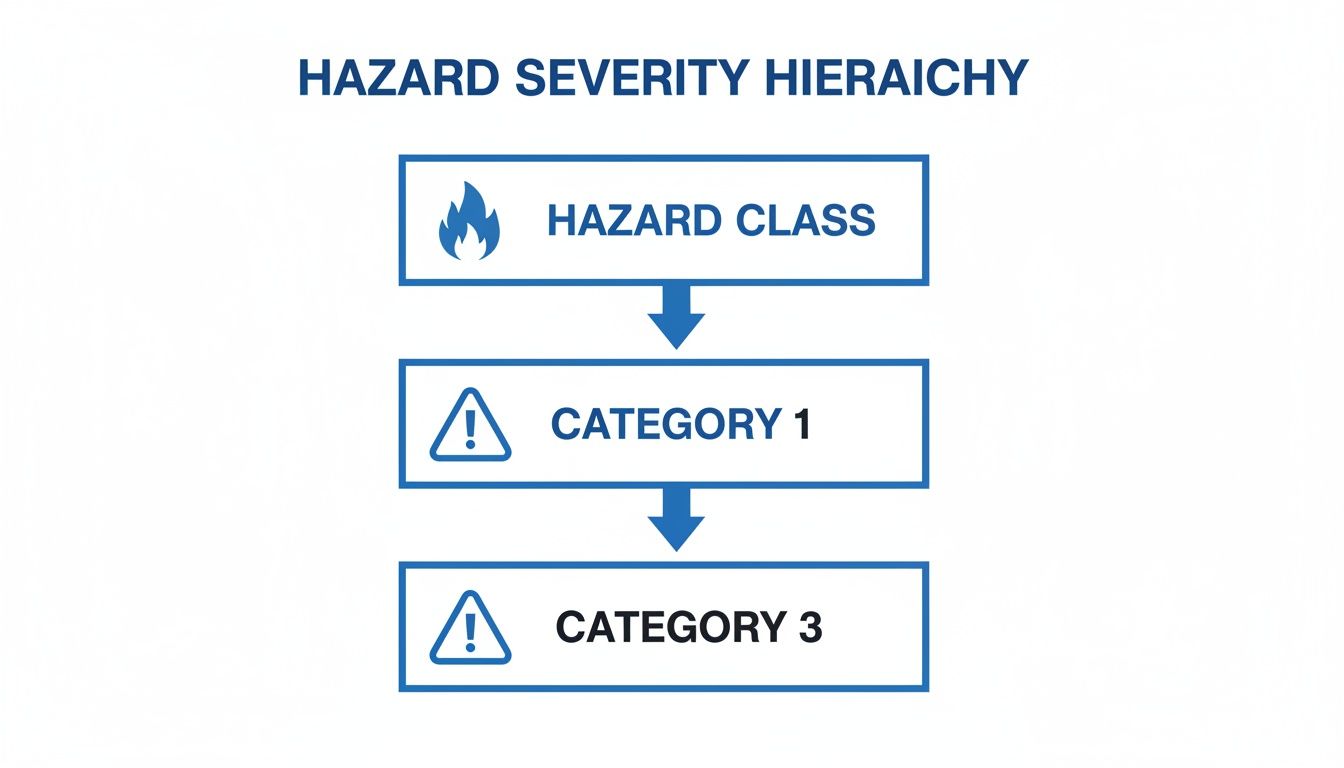
As the diagram shows, a more severe category (Category 1) triggers a stronger signal word ("Danger") than a less severe one. It's that simple.
The Critical Importance of Standardised Phrases
The real power of GHS lies in its standardised language. The system of hazard statements uses specific codes and phrases like H330 ("Fatal if inhaled") or H361 ("Suspected of damaging fertility or the unborn child"). To give you an idea of the scale, the EU’s CLP regulation has implemented 72 unique harmonised hazard statements to ensure total consistency.
This standardisation isn’t just about making things clear; it’s about legal compliance. For procurement and warehouse teams, checking that suppliers have assigned the correct GHS categories is a non-negotiable task.
A miscategorised chemical can lead to the wrong label, inadequate safety measures, and serious regulatory fines. Under EU enforcement actions, penalties for non-compliant shipments can run from €2,000 to €10,000. This is where automated platforms really prove their worth, screening substances against official databases to flag these kinds of discrepancies instantly.
For today's innovative materials, like graphene coatings, getting the hazard classification right is absolutely vital for ensuring user safety and meeting regulatory duties. From the moment a chemical arrives at your facility, its label and SDS provide the foundational knowledge for managing it safely throughout its entire lifecycle.
Right, let’s unpack how the “Globally Harmonised System” isn’t always quite so… well, harmonised. It’s a common point of confusion, and getting it wrong can lead to serious compliance headaches.
How Global GHS Implementations Differ
While the goal of the GHS is to create a universal language for chemical hazards, the reality on the ground is a bit more complicated. Think of the GHS not as a strict, rigid law, but more like a comprehensive menu. Regulatory bodies in different countries can pick and choose which parts they want to put on their own national "plate."
This is officially known as the "building block" approach. Each hazard class and category is a separate block, and a country can decide which blocks to officially adopt into its own regulations. This flexibility was crucial for getting so many countries on board, but it’s also the source of major compliance challenges for any business that operates internationally.
What this means in practice is that a chemical’s official classification—and by extension, its label and Safety Data Sheet—can legally be different from one country to another. For any business with a global supply chain, understanding these regional quirks isn't just a "nice-to-have"; it's absolutely essential for avoiding costly fines and keeping people safe.
A Tale of Two Systems: EU CLP vs. US OSHA
To see this building block approach in action, you don’t have to look any further than two of the world's most influential GHS-based regulations: the European Union's CLP (Classification, Labelling and Packaging) Regulation and the United States' OSHA Hazard Communication Standard (HCS). They both start from the same GHS foundation, but the blocks they’ve chosen to use create some critical differences.
The most glaring distinction is how they handle environmental hazards. The EU’s CLP regulation takes a holistic view, making it mandatory to classify dangers to the ecosystem. OSHA's HCS, on the other hand, is laser-focused on workplace safety and doesn't include environmental hazards in its scope at all.
This means a substance toxic to aquatic life will need an environmental hazard pictogram and specific warnings on its label in France, Spain, or any EU member state. In the United States, those warnings aren't required. It’s the exact same chemical, but the regulatory obligations are miles apart.
This single difference is a perfect example of why a product that’s fully compliant in the US isn't automatically ready for the EU market.
Key Differences Between EU CLP and US OSHA HCS
A comparative look at how two major regulatory bodies implement the GHS framework, highlighting critical differences for compliance.
The split doesn't just stop at environmental classifications. There are also subtle but important variations in how some health hazard categories are defined and applied. The table below breaks down the most critical distinctions that compliance teams need to have on their radar.
| Feature | EU CLP Regulation | US OSHA HCS |
|---|---|---|
| Environmental Hazards | Mandatory. Includes "Hazardous to the aquatic environment" (acute and chronic) and "Hazardous to the ozone layer." | Not included. OSHA’s jurisdiction is limited to workplace hazards, so environmental classifications are omitted. |
| Flammable Gases | Includes an additional category for pyrophoric gases (Category 1B). | Does not distinguish pyrophoric gases as a separate category within flammable gases. |
| Aspiration Hazard | Includes Category 2 for substances that may be harmful if swallowed and enter airways. | Only includes the more severe Category 1, which covers substances that may be fatal if swallowed and enter airways. |
| Unclassified Hazards | Does not have a specific category for hazards not otherwise classified. | Includes the category "Hazards Not Otherwise Classified (HNOC)" to cover novel or unlisted risks. |
These variations might seem small, but they can have a direct impact on everything from the pictograms on your labels to the content of your safety training. For instance, the difference in aspiration hazard categories means a chemical might require a health hazard pictogram in the EU but not in the US.
The environmental hazard classification is a massive point of divergence. Under the EU’s CLP regulation, all four aquatic toxicity categories are fully implemented. The result? Approximately 22% of all chemicals registered under REACH are classified as hazardous to the aquatic environment, all of which demand specific warnings.
You can learn more about these global compliance gaps and what they mean for multinational teams by exploring this definitive guide on Compliance & Risks. Getting a firm grip on these GHS hazard classifications and their regional nuances is the foundation of a robust and compliant chemical management programme.
Getting to Grips with GHS Compliance in Your Workflow

Trying to manage GHS hazard classifications by hand is a bit like juggling with open bottles of acid. It's a high-stakes game where one slip-up can have serious consequences. You’re trying to interpret dense classification criteria while also keeping track of the subtle but crucial differences between global systems like the EU’s CLP and OSHA’s HazCom in the US.
The whole process is not just time-consuming; it’s a minefield of potential errors that can leave your organisation wide open to compliance risks.
The daily grind of it is relentless. Procurement teams are left trying to figure out if a supplier’s Safety Data Sheet is even accurate. EHS managers burn hours cross-checking chemicals against regulatory watchlists that seem to change every other week. The moment a new chemical arrives or an auditor walks through the door, it’s all hands on deck to create compliant GHS labels, causing bottlenecks and inviting mistakes. It’s an inefficient, reactive loop that simply can't last.
From Manual Headaches to Automated Peace of Mind
The good news is that you don't have to stay stuck in this cycle. Modern software can pull you out of the manual quicksand, turning GHS compliance from a reactive panic into a proactive, automated part of your daily operations. Forget the spreadsheets and sticky notes; these digital systems give you a central, intelligent hub for your entire chemical safety programme.
Think about it: a system that automatically checks every single chemical in your inventory against global regulatory lists like REACH and CLP. That’s what automation brings to the table.
What Does This Look Like in Practice?
So, what can this kind of system actually do for you? Here are the game-changers:
- Instant SDS Validation: The moment a supplier SDS comes in, the system can automatically check it for completeness and accuracy, flagging any missing details or out-of-date classifications right away.
- Automated Regulatory Screening: Your chemical inventory is constantly monitored against thousands of regulatory lists. You get real-time alerts if a substance is suddenly restricted or its classification changes.
- On-Demand Label Generation: Need a label? Just a few clicks and you can print a fully compliant GHS label for any container, complete with the correct pictograms, signal words, and hazard statements.
The Real-World Payoff
For EHS managers and procurement teams, the impact is huge. Automation dramatically cuts down the risk of non-compliance and the hefty fines that come with it. More than that, it frees up your skilled people from hours of mind-numbing admin, letting them focus on what really matters—like improving workplace safety through proper risk assessments and training.
The biggest win here is confidence. With an automated system, you can be sure your chemical management isn't just compliant today, but that it will stay that way as regulations inevitably change.
This switch gives your organisation one reliable source of truth for all chemical data. It means everyone, from the person unloading a lorry to the scientist in the lab, has immediate access to the right safety information. For a closer look at how GHS classifications and SDSs work together, check out our guide to GHS and SDS. Tools like NextSDS are designed specifically to deliver this automated assurance, making the complexities of chemical compliance far more manageable.
Common Questions About GHS Classifications
Getting to grips with GHS hazard classifications often brings up a few practical questions. Let's tackle some of the most common ones that EHS managers and procurement teams run into, clearing up the confusion to help keep your operations compliant.
What’s the Difference Between a Hazard Class and a Hazard Category?
Think of it like this: the hazard class tells you the type of danger, while the hazard category tells you its level. The class is the "what," and the category is the "how bad."
For instance, "Flammable Liquids" is a hazard class—it describes the general nature of the physical risk. But within that class, you have Categories 1 through 4, which tell you just how flammable the liquid is. Category 1 is the most severe, meaning it can ignite very easily.
Can One Chemical Have Multiple GHS Classifications?
Absolutely. In fact, it's very common for a single substance to pose several different risks. This is because GHS looks at physical, health, and environmental hazards independently of one another.
Isopropyl Alcohol is a perfect real-world example. It's classified as a Flammable Liquid (a physical hazard), but it also causes Serious Eye Irritation (a health hazard). Because of this, its label and SDS have to reflect all its classifications, which is why you’ll often see multiple pictograms on a single container.
A solid chemical safety programme hinges on identifying and managing every single potential hazard a substance presents. Assuming a chemical has only one primary risk is a common and dangerous mistake.
Is a GHS-Compliant Product in the US Automatically Compliant in the EU?
No, not necessarily. This is a critical point for any company operating internationally. While both the US (via OSHA) and the EU (via CLP) are built on the GHS framework, they didn't adopt all the same "building blocks."
The biggest difference is that the EU's CLP regulation includes mandatory environmental hazard classifications, like "Hazardous to the aquatic environment." OSHA in the US, on the other hand, doesn't require these environmental classifications. This means an SDS and label that are perfectly compliant in the United States might need significant changes to be legal for the European Union market.
Trying to manage these global nuances and check every SDS by hand is a huge task. NextSDS can replace that manual work with an automated system that validates supplier data, screens chemicals against global regulations, and generates compliant labels whenever you need them. Find out how you can achieve effortless compliance at https://nextsds.com.