

GHS label requirements are the bedrock of modern chemical safety, creating a universal language to make sure hazards are understood clearly, no matter the industry or country. These rules are non-negotiable, requiring six key elements like pictograms and hazard statements on every label to keep workers safe.
Why GHS Label Requirements Are So Crucial
Think about what it would be like if every chemical container told a different safety story. A skull-and-crossbones symbol might mean "deadly poison" in one place but simply "harmful if swallowed" somewhere else. This was the chaotic and dangerous reality before the Globally Harmonized System (GHS) came along. Inconsistent warnings bred confusion, leading directly to accidents and injuries that were entirely preventable.
The GHS wasn't just another bureaucratic hoop to jump through. It was developed as a life-saving tool, a common language for chemical hazards. By standardising how we classify and communicate these dangers, the system ensures that a worker in Brussels gets the same clear, understandable safety information as a worker in Boston.
The Foundation of Workplace Safety
At its heart, the GHS is built on a simple but profound idea: everyone has the right to understand the risks of the chemicals they work with. This principle is put into practice through the mandatory elements you see on every GHS label. You can think of them as the basic grammar of chemical safety, all working together to give you a complete, at-a-glance safety profile.
For a deeper dive into how these labels connect with their detailed documentation, you can learn more about GHS and Safety Data Sheets in our comprehensive guide.
GHS harmonises hazard communication so that the inherent dangers of a chemical are understood by everyone, everywhere. It replaces ambiguity with clarity, turning every label into a reliable tool for accident prevention.
This structured system takes the guesswork out of handling hazardous materials. It empowers employees to make smart decisions on the spot, whether that’s choosing the right personal protective equipment (PPE) or knowing exactly what to do in a first-aid emergency.
Mastering these GHS label requirements isn't just about ticking a compliance box; it’s a fundamental duty for any organisation that's serious about protecting its people. Without this universal standard, global trade would be snarled by conflicting rules, and more importantly, workers would face needless risks every day. The GHS provides the clarity and consistency needed to keep workplaces safe and supply chains running smoothly.
The Six Mandatory Elements of a Compliant GHS Label
Think of a GHS label as a chemical's passport. Every section provides crucial information that ensures its safe handling and journey through the supply chain. Just like a passport has specific fields for a name, photo, and nationality, a compliant GHS label is built from six mandatory elements. These components don't just exist in isolation; they work together to create an immediate, clear picture of a substance's risks and how to manage them.
Getting to grips with these six parts is the first, and most important, step in mastering GHS compliance. They aren't just suggestions on a checklist. They're the fundamental building blocks of a global system designed to prevent accidents, protect workers, and save lives. Let's break down each element.
Product Identifier and Supplier Information
First up, every label must clearly display a Product Identifier. This is the chemical’s name, code number, or batch number—whatever identifier the manufacturer uses. The crucial part here is consistency; this identifier must perfectly match the one used on the product’s corresponding Safety Data Sheet (SDS). This creates an unbreakable link between the container in your hands and the detailed safety information in the binder or database.
Just as critical is the Supplier Information. This section needs to include the name, address, and telephone number of the chemical manufacturer, importer, or other responsible party. In an emergency, this isn't just administrative data; it’s a direct lifeline to the people who know the product best and can provide critical guidance when seconds count.
This concept map shows how GHS labels are central to ensuring worker safety, aiding in accident prevention, and promoting a universal standard across industries.
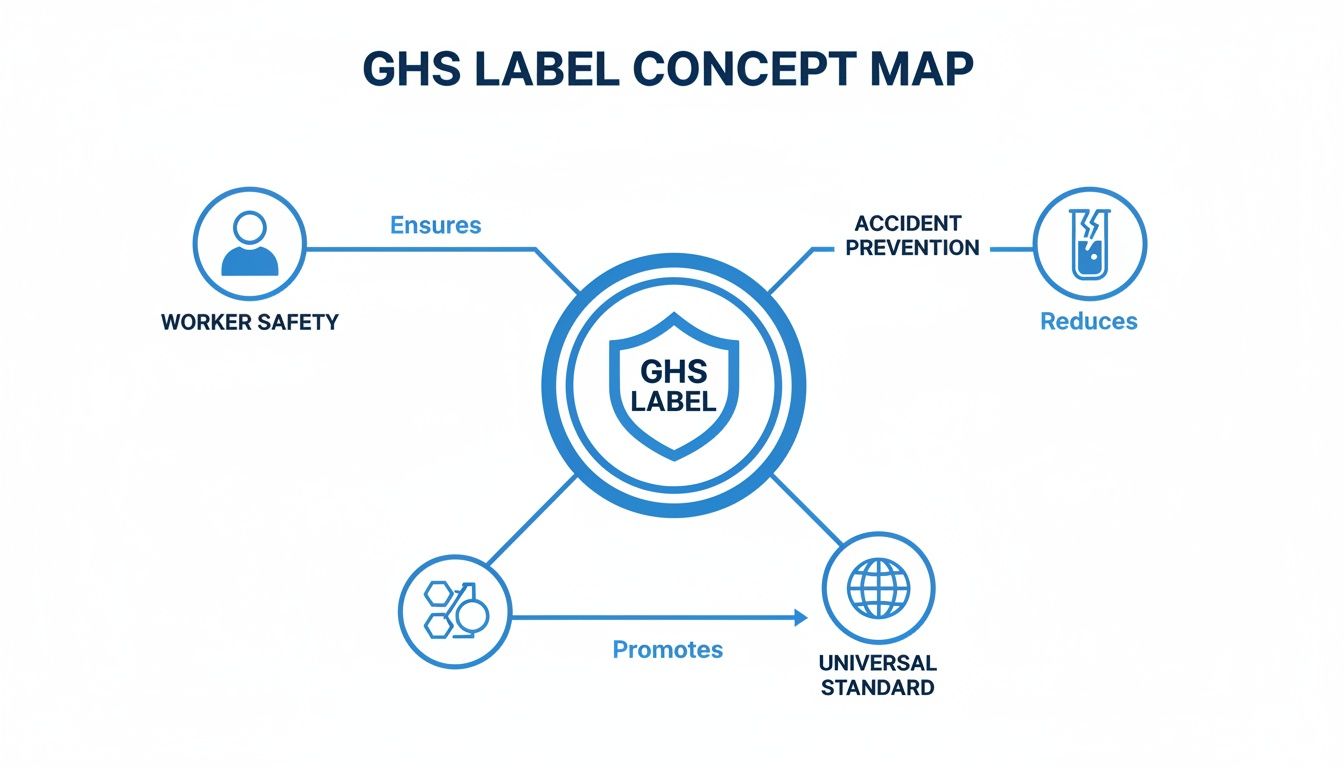 As you can see, each function is interconnected, with the GHS label acting as the hub of a comprehensive safety strategy.
Signal Word and Hazard Statements
Next, we have the elements that shout the loudest about the risk level. The Signal Word is a single, prominent word that grabs your attention and tells you the relative severity of the hazard at a glance. There are only two options:
- Danger: Used for the most severe hazards.
- Warning: Used for less severe hazards.
It’s a simple distinction, but a powerful one. "Danger" signals a much higher, more immediate risk that demands extra caution. A key rule is that only one signal word ever appears on the label—the one that corresponds to the most severe hazard class of the chemical.
Right alongside the signal word, you’ll find the Hazard Statements. These are standardised phrases assigned to a specific hazard class and category, describing the exact nature of the risk. For instance, a statement might read, "Causes serious eye damage" or "Flammable liquid and vapour." They get straight to the point, telling you precisely what the danger is.
The real power of the GHS lies in the standardisation of these phrases. A chemical produced in Germany will have the exact same hazard statement for a specific risk as one produced in Japan, completely removing ambiguity and the potential for misinterpretation.
This consistency is the bedrock of the entire system.
Precautionary Statements and Pictograms
While hazard statements tell you what the risk is, Precautionary Statements tell you what to do about it. These are practical, actionable phrases recommending measures to minimise or prevent harm from exposure, improper storage, or incorrect handling. They’re neatly broken down into four types:
- Prevention: "Wear protective gloves."
- Response: "If on skin: Wash with plenty of water."
- Storage: "Store in a well-ventilated place."
- Disposal: "Dispose of contents/container in accordance with local regulations."
Finally, we have the Pictograms. These are arguably the most recognisable part of a GHS label—the diamond-shaped symbols with a red border that convey specific hazard information instantly, even across language barriers. A flame symbol immediately signals a fire hazard, while the skull and crossbones is an unmistakable sign of acute toxicity.
To bring it all together, here’s a quick overview of how these six core components function on a label.
The Six Core GHS Label Components at a Glance
| Label Element | Purpose | Example |
|---|---|---|
| Product Identifier | Uniquely identifies the substance and links it to the SDS. | "Acetone, Batch #A4511" |
| Supplier Information | Provides contact details for the responsible party in an emergency. | "ABC Chemicals, 123 Industrial Way, Anytown, UK, +44 1234 567890" |
| Signal Word | Indicates the relative level of hazard severity. | "Danger" or "Warning" |
| Hazard Statements | Describes the nature of the chemical's hazards. | "Highly flammable liquid and vapour." |
| Precautionary Statements | Recommends measures for safe handling, storage, and disposal. | "Keep away from heat/sparks/open flames." |
| Pictograms | Provides a quick, visual representation of the primary hazards. | Flame Symbol (for flammability), Skull and Crossbones (for acute toxicity) |
These six elements—Product Identifier, Supplier Information, Signal Word, Hazard Statements, Precautionary Statements, and Pictograms—form the complete, universal language of GHS. Each piece is essential, and together, they ensure that anyone, anywhere, can quickly understand a chemical’s risks and know exactly how to stay safe.
How GHS Label Rules Vary Across the Globe
While the Globally Harmonised System (GHS) gives us a universal playbook for chemical safety, it’s not a single, rigid law. It’s more like a foundational recipe that different countries adapt to their own tastes. Each region takes the GHS framework and weaves it into its own legislation, creating a patchwork of similar, yet distinct, GHS label requirements across the world.
This is precisely why managing international chemical safety gets so complicated. For businesses in Belgium operating under the European Union’s rules, getting a handle on these differences is non-negotiable for both importing and exporting. A label that’s perfectly compliant in one country could be a red flag in another.
Europe vs The United States: A Key Comparison
The two most prominent GHS systems you'll encounter are the EU's Classification, Labelling and Packaging (CLP) Regulation and the United States' Hazard Communication Standard (HCS), which is managed by OSHA. They both stem from the same GHS root, but they've grown into slightly different branches.
- Hazard Categories: You'll find that CLP sometimes includes hazard categories that HCS doesn't, and vice versa. This can lead to a situation where a chemical is officially classified as hazardous in Europe but not in the US, triggering different label warnings.
- Supplemental Information: The EU often requires extra, region-specific details on labels that aren't mandatory under OSHA's rules. This includes unique EU-specific hazard statements (known as EUH phrases) that add another layer of warning.
- Enforcement: The way rules are enforced, from inspections to penalties, varies significantly between regulatory bodies in the EU and OSHA in the US.
These nuances are a perfect example of why a one-size-fits-all label rarely works. To really get to grips with GHS, you have to understand the different types of hazards it covers. For a solid foundation, learning the nine classes of dangerous goods is a great starting point for categorising hazardous materials.
A Living Standard with Global Variations
The GHS isn't set in stone. The United Nations updates it every two years, turning it into a living, breathing standard. From there, individual countries and regions decide which revision to adopt, creating a landscape where neighbouring countries might be operating on completely different versions. This staggered adoption is a huge headache for global companies.
The core principle of GHS is harmonisation, but its implementation is a journey, not a destination. Regulatory divergence means that constant vigilance and adaptation are required for international compliance.
To date, GHS has been adopted by roughly 67 countries, each at its own pace. Australia, for instance, officially moved to GHS Revision 7 on 1 January 2023, following a two-year transition period. These timelines show that regulators give companies breathing room to update their systems, redesign labels, and retrain staff. For organisations in Belgium, tracking these timelines is crucial because suppliers from other parts of the world might be working under older GHS revisions, directly affecting the compliance of any goods you import.
This complex and ever-shifting regulatory environment highlights a critical truth for modern business. Trying to manually keep track of all these global variations is not just impractical—it's incredibly risky. An automated system that stays on top of international GHS label requirements has moved from being a nice-to-have to an absolute necessity for staying compliant and ensuring safety across borders.
Tackling Common GHS Labelling Challenges
Knowing the rules is one thing, but actually putting them into practice in a busy workplace is a whole different ball game. Even the most diligent professionals get tripped up by real-world hurdles that go beyond just memorising the six label elements. From tiny test tubes to a multilingual workforce, effective GHS labelling demands practical, clever solutions.
The real skill is bridging that gap between theory and execution. It means finding straightforward answers to tricky situations, ensuring every single chemical container, whatever its size or destination, clearly communicates its hazards. Let’s break down some of the most common challenges and how to solve them.
What About Small Containers?
One of the biggest headaches in GHS labelling has to be the small container. How on earth do you fit all six required elements onto a tiny vial or ampoule without the text shrinking to an unreadable size? Direct printing is often out of the question, yet you still have to comply.
Thankfully, the regulations offer some sensible workarounds. These methods make sure all the critical safety information stays with the container, even when you're working with minimal surface area. You’ve got a few options:
- Fold-out or concertina-style labels: These clever labels expand to show all the GHS information but keep a small footprint on the container itself.
- Tie-on tags: A sturdy tag with the full GHS label can be securely looped around the neck of the bottle or container.
- Over-wrapping: If you have a box of small vials, the outer packaging can carry the full GHS label, so long as the inner containers aren't meant to be removed and used individually without it.
The golden rule is that the complete hazard information must be right there and easy to access when someone needs it. For more ideas, you can dive into our in-depth look at secondary container labelling best practices.
Making Sure Labels Stick Around
A GHS label is completely useless if it peels off, fades in the sun, or is hidden on the bottom of a drum. The rules are clear: labels must stay firmly fixed and readable for the entire life of the chemical container. This means they need to survive whatever the workplace throws at them, including chemical splashes, sunlight, rain, and just general wear and tear.
Think about the journey of a chemical drum. It might sit outside for months, get transported on a lorry, and be knocked about in a warehouse. The label material and adhesive have to be tough enough to handle all that. Where you put the label matters, too; it has to be prominently displayed right where people can see it easily.
A compliant label isn't just about having the right information. It's about making sure that information is visible and legible when it counts. Durability and placement aren't optional extras—they are fundamental GHS requirements.
Dealing with Different Languages
In a diverse workplace or when shipping goods internationally, language barriers can pose a serious safety risk. While the GHS framework itself doesn't demand specific languages, local authorities almost always do. In the European Union, for example, labels must be written in the official language of the country where the product is being sold.
For many businesses, this means creating multi-language labels to ensure every single worker can understand the hazard warnings and safety advice. This is especially crucial for companies operating across Europe or in multilingual countries like Belgium. Planning ahead for multiple languages isn't just good practice; it's a vital step in building a safety culture that includes everyone.
Automating GHS Compliance to Eliminate Human Error
Relying on manual processes to create GHS labels is like walking a tightrope without a safety net. It's not just slow and painstaking; it opens the door to human error. A forgotten pictogram or an old hazard statement isn't just a simple mistake—it can lead to serious workplace incidents and hefty regulatory fines. The only way to get ahead is to ditch the spreadsheets and embrace automation.
Think of an automated software platform as the brain of your hazard communication programme. Instead of someone manually typing in data, these systems pull information directly from your Safety Data Sheets (SDSs). This creates a direct, unbroken link, ensuring every single label has the correct pictograms, statements, and identifiers, every time.
The Power of Automated Accuracy
The real magic of automation is how it slashes the risk of errors. Imagine a supplier updates an SDS or a regulation changes. In a manual system, you're counting on someone to catch that update, track down every container of that product, and then meticulously create and apply new labels. It’s a process riddled with potential slip-ups.
An automated system, on the other hand, flags these changes instantly. It connects the dots between your SDS library and your label printing, so a change in a chemical's classification is immediately pushed to its label. Pairing this software with the right hardware, like dedicated label printer machines, makes the entire workflow seamless.
For organisations in Belgium, this isn't just a nice-to-have; it's a legal necessity. The EU's CLP Regulation, which is the European implementation of GHS, is strictly enforced. As Belgium operates fully under these rules, HSE managers must ensure every chemical label on site meets these exacting standards without fail.
Automation transforms GHS compliance from a reactive, high-risk task into a proactive, reliable process. It provides the peace of mind that comes from knowing your labels are always accurate and defensible during an inspection.
Modern software, like NextSDS, uses the data right from your SDS to populate label templates automatically, ticking every GHS requirement box.
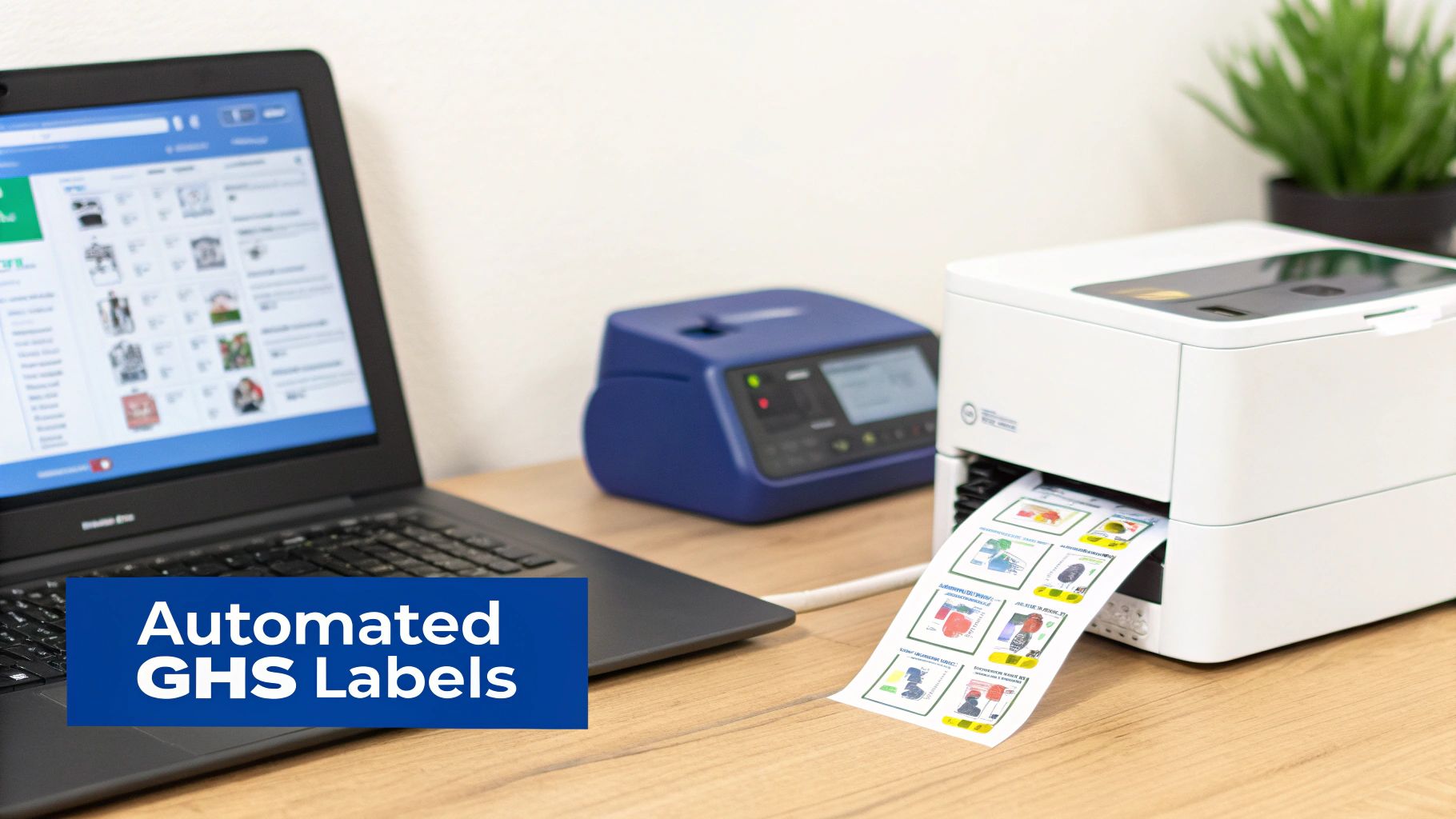
This centralises control, empowering your team to print compliant labels for any chemical in your inventory whenever they need them. It takes the guesswork out of the equation and guarantees consistency across your entire facility.
A Few Common GHS Labelling Questions Answered
Even when you've got a handle on the GHS rules, some practical questions always seem to pop up during the day-to-day grind. The standards are incredibly detailed, and it's easy to get tripped up by specific scenarios. To help clear things up, we’ve put together some straightforward answers to the questions we hear most often.
Getting these details right isn't just about ticking a compliance box; it's about making sure your team has the information they need to work safely. Let's tackle some of these common points of confusion.
What’s the Difference Between a Hazard and a Precautionary Statement?
Think of it like this: a hazard statement is the warning sign, while a precautionary statement is the escape plan.
The hazard statement tells you what the danger is, plain and simple. For instance, "Causes serious eye irritation." It’s a direct, standardised phrase describing the chemical's specific risk.
The precautionary statement, on the other hand, tells you how to avoid that danger. Following our example, the instruction would be something like, "Wear eye protection." One identifies the problem; the other tells you how to stay safe from it.
Can I Just Use a Black and White Printer for GHS Pictograms?
For the most part, no. One of the non-negotiable GHS label requirements is that the diamond-shaped border on a pictogram must be red. That red border is a critical visual cue, designed to grab your attention instantly and signal danger.
There is one small exception. You can print in black and white if you're using pre-printed label stock that already has blank red diamonds on it. But if you’re printing labels on demand from scratch, a colour printer is an absolute must to stay compliant.
What Do I Do if a Chemical’s Classification Changes?
Chemical classifications aren't set in stone. New data and research can lead to updates from regulatory bodies. When a chemical’s hazard classification changes, you are legally required to update both its Safety Data Sheet (SDS) and its GHS label to reflect the new information. This is where understanding what a Safety Data Sheet is and its direct link to the label becomes so important.
Regulators usually provide a grace period for updating labels on products already out in the supply chain. However, for any new products you label after the change, the update needs to happen as soon as possible. This is exactly why automated labelling systems are so helpful—they can flag these regulatory changes and make the whole relabelling process much less of a headache.
When a hazard classification is updated, it's a non-negotiable requirement to align both the SDS and the GHS label with the new data. Failure to do so can result in non-compliance and, more importantly, put workers at risk by providing them with outdated safety information.
Do Secondary Containers Like Spray Bottles Need a Full GHS Label?
Absolutely. Any time a chemical is transferred from its original packaging into a secondary container—like a spray bottle, jug, or beaker—that new container must be labelled. Safety information can't get lost in translation.
While the exact rules can differ slightly between jurisdictions, the best practice is to include, at a minimum, the product identifier (the chemical's name) and the key hazards. You can do this with the right pictograms or by writing out the hazard information. The safest and most compliant approach is to apply either a full GHS label or a simplified workplace label that clearly shows the product name, pictograms, and signal word. This ensures every single person who handles it knows exactly what they're dealing with.
At NextSDS, we replace manual guesswork with automated precision. Our platform pulls data directly from your SDS library to generate perfectly compliant GHS labels every time, keeping you ahead of regulatory changes and ensuring workplace safety. Discover how you can eliminate errors and save time by visiting https://nextsds.com.