

Think of a GHS label as a universal safety manual for a chemical, condensed into six essential parts. To get it right, every label needs to include the Product Identifier, a Signal Word, Pictograms, Hazard and Precautionary Statements, and the Supplier’s ID. It's a system designed to work like international road signs—instantly recognizable and understood, no matter where you are in the world. This clarity is what helps prevent accidents and keeps global trade flowing.
Why GHS Labeling Is a Non-Negotiable for Workplace Safety
At its heart, the Globally Harmonized System (GHS) was created to put an end to the dangerous guesswork that came with chemical handling. Before GHS, one country might label a substance "toxic" while another called it "harmful." For workers handling products from a global supply chain, this inconsistency was a recipe for disaster.
GHS isn't just about ticking a box on a compliance form; it’s a practical framework built to protect people and the environment.
A Universal Language for Chemical Hazards
Imagine driving in a foreign country where the stop signs looked different on every corner. It would be chaotic and incredibly risky. That's the problem GHS solves for chemical safety, creating a single set of visual cues that everyone understands. The logic behind it aligns with general safety warning signage principles—clarity and consistency save lives.
By establishing this shared vocabulary, GHS accomplishes three critical goals:
- Keeps Workers Safe: When an employee sees a familiar pictogram and a clear hazard statement, they know exactly what they’re dealing with and how to protect themselves. There’s no ambiguity.
- Simplifies Global Trade: A single, harmonized standard breaks down international trade barriers. Products can move from one country to another without the need for expensive and time-consuming relabeling.
- Aids Emergency Responders: In a crisis like a spill or exposure, first responders can identify the hazards in seconds and take the right action, which can make all the difference when time is critical.
The Steep Price of Getting It Wrong
Ignoring GHS labeling rules comes with serious consequences that go far beyond the immediate safety risks. In 2023 alone, OSHA cited a staggering 3,213 Hazard Communication (HazCom) violations in the United States. That's a 19% jump from the year before, with potential fines climbing past $50 million.
This sharp increase sends a clear message: regulators are cracking down, and they view GHS compliance as a fundamental pillar of workplace safety. To get a better handle on what these standards mean for your day-to-day operations, take a look at our complete https://nextsds.com/blog/ghs-compliance-guide-sds-standards/. The system is here to turn a once-complex puzzle of country-specific rules into a clear, actionable global strategy.
The Six Core Elements of a Compliant GHS Label
Think of a GHS label as a chemical's passport. It tells a standardized, universal story about its identity and potential dangers. To meet GHS labeling requirements, every label must contain six specific elements that work together, giving safety professionals, first responders, and employees critical information at a single glance.
Mastering these components isn't just about compliance; it's about building a fundamentally safer workplace.
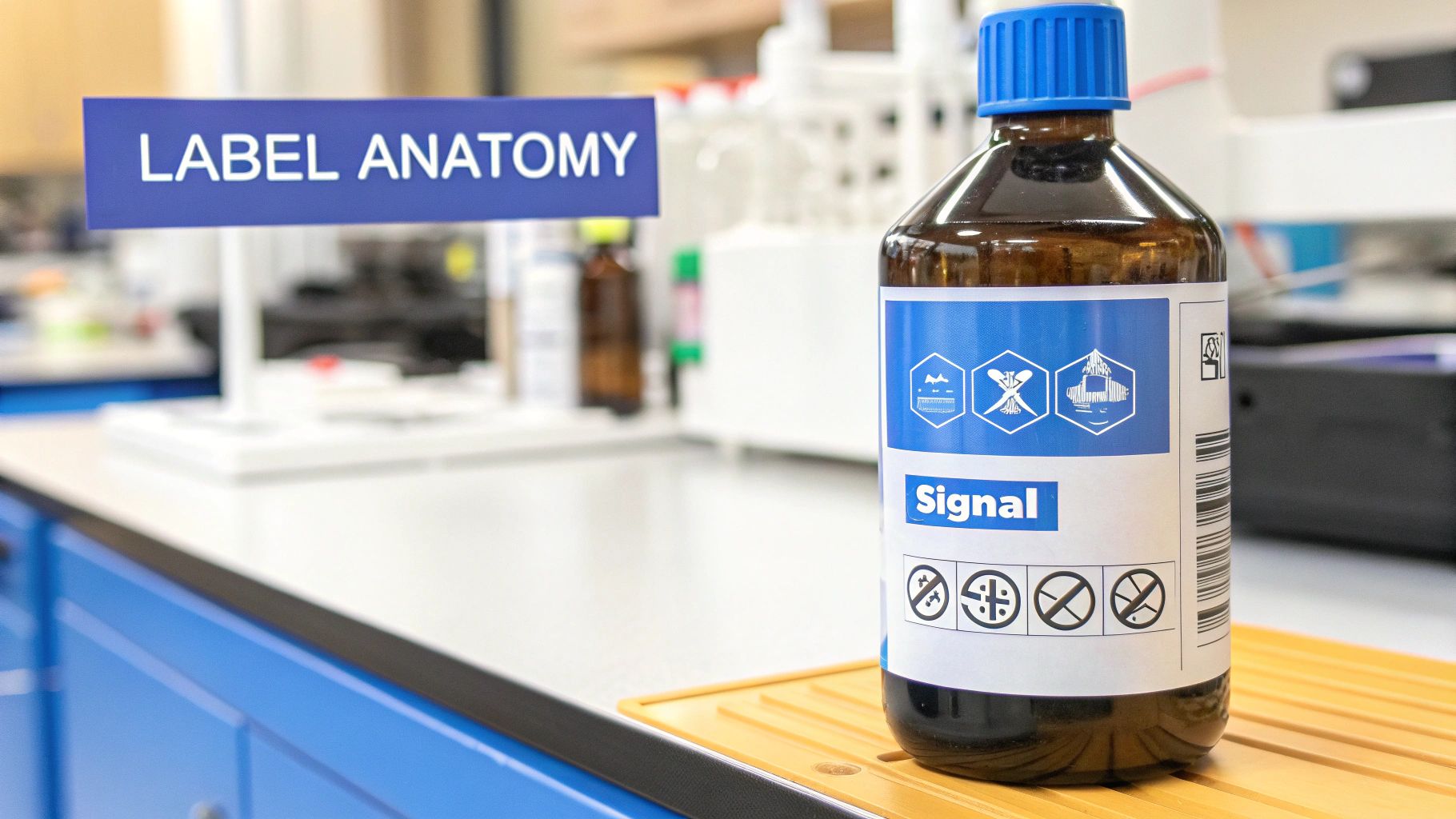
These six pieces form a complete hazard profile, moving far beyond a simple product name. Let's break down the anatomy of a compliant GHS label, piece by piece.
1. Product Identifier
First up is the Product Identifier. This is the official name or number of the chemical, and it must perfectly match what's listed on the product's Safety Data Sheet (SDS). This creates an unbreakable link between the container in your hand and the detailed safety document that supports it.
This isn't a suggestion—it's a hard rule. The identifier could be a chemical name (like Acetone), a code, or a batch number. For mixtures, you'll often see a trade name alongside the names of the hazardous ingredients. This element is the foundation; without it, all other hazard communication falls apart. To really grasp this connection, you should understand what is a safety data sheet and its central role in GHS.
2. Signal Word
A Signal Word is a single, powerful word that instantly communicates the relative severity of the hazard. Its sole purpose is to grab your attention and give a quick risk assessment. The GHS system only uses two:
- Danger: Reserved for the most severe hazards. When you see this word, it signals a high risk of harm and demands your full attention and caution.
- Warning: Used for less severe, but still potentially harmful, hazards. It's a clear alert to be careful, even if the immediate risk is lower.
You'll only ever see one signal word on a label. If a chemical poses multiple threats, the label will always use the word for the most serious one. Danger always trumps Warning.
3. Hazard Pictograms
The visual heart of any GHS label is the set of Hazard Pictograms. These are standardized symbols inside a red-bordered diamond, designed to cut through language barriers and communicate specific dangers instantly. Each of the nine pictograms represents a distinct hazard class, from physical risks like flammability to health risks like carcinogenicity.
These symbols are what make the GHS system so effective globally. They provide a rapid-fire visual summary of the primary dangers, making them one of the most powerful tools for immediate hazard recognition.
Before we dive into the pictograms, it's crucial to understand what they represent. Each symbol is a shortcut to understanding a specific type of risk.
GHS Pictograms and Their Meanings
A visual guide to the nine primary GHS pictograms, explaining the specific hazard each symbol represents for quick identification in the workplace.
| Pictogram (Visual) | Hazard Class | Meaning and Examples |
|---|---|---|
| Flame (flame symbol) | Flammables | Indicates fire hazards from flammable gases, aerosols, liquids, or solids. |
| Flame Over Circle (flame over circle) | Oxidizers | Represents chemicals that can cause or contribute to the combustion of other materials. |
| Exploding Bomb (exploding bomb) | Explosives | For substances that may explode, including self-reactives and organic peroxides. |
| Gas Cylinder (gas cylinder) | Gases Under Pressure | Signifies gases stored under pressure that may explode if heated. |
| Corrosion (corrosion symbol) | Corrosives | Indicates materials that cause severe skin burns, eye damage, or corrode metals. |
| Skull and Crossbones (skull and crossbones) | Acute Toxicity (Fatal or Toxic) | Represents chemicals that can cause death or severe toxicity if swallowed, inhaled, or in contact with skin. |
| Health Hazard (exclamation mark) | Irritant, Skin Sensitizer | Used for irritants (skin and eye), skin sensitizers, and other less severe hazards. |
| Health Hazard (person exploding) | Carcinogen, Mutagen | A serious, long-term health hazard for carcinogens, mutagens, and reproductive toxicity. |
| Environment (dead tree and fish) | Aquatic Toxicity | Indicates hazards to the aquatic environment. Note: This is not mandatory in all jurisdictions, like the US. |
Learning to recognize these symbols on sight is a key skill for anyone working with hazardous materials. They are your first and best warning of the dangers inside a container.
4. Hazard and Precautionary Statements
While pictograms show you the hazard, these statements tell you what it is and how to stay safe. They are standardized phrases assigned to specific hazard classes.
- Hazard Statements (H-codes): These describe the nature and degree of the hazard. For example, "Causes serious eye damage" or "Fatal if swallowed."
- Precautionary Statements (P-codes): These are your instructions. They describe how to minimize or prevent harm, covering prevention, response, storage, and disposal. For instance, "Wear protective gloves" or "Store in a well-ventilated place."
These phrases provide the actionable guidance that pictograms alone can't. They are the instructional manual for safe handling and emergency response.
5. Supplier Identification
Every GHS label must clearly state who is responsible for the chemical. The Supplier Identification section must include the name, address, and telephone number of the manufacturer, importer, or other responsible party.
This detail establishes a clear line of accountability. If there's an emergency or an employee needs more information, they know exactly who to call. It ensures there's always a direct link back to the source.
Navigating Global Differences in GHS Rules
You'd think a system called the "Globally Harmonized System" would be, well, harmonized. But if you’re shipping chemicals internationally, you know the reality is a lot messier. It’s less of a single, rigid law and more of a foundational blueprint. Each country takes that blueprint and builds its own regulatory house, adding unique architectural flourishes and enforcing slightly different building codes.
This is exactly why a label that’s perfectly compliant in the United States might get you into hot water in the European Union or Asia. For any business with a global footprint, understanding these variations in GHS labeling requirements isn't just a good idea—it’s crucial for avoiding costly fines, customs delays, and blocked shipments.
So where does this disconnect come from? The core issue is that GHS itself isn’t legally binding. It’s a set of recommendations from the United Nations. Countries then adopt these recommendations into their own national laws, and that adoption process is where things start to diverge.
The GHS Revision Rollercoaster
One of the biggest headaches for global compliance is keeping track of which "revision" of the GHS a country is using. The UN periodically updates the system to refine hazard classifications and add new concepts. The problem is, countries adopt these new versions on their own timelines, creating a confusing patchwork of regulations.
This is what’s known as the "building block" approach. A country can pick and choose which parts (or "blocks") of the GHS it wants to implement.
Here’s a quick look at the moving targets:
- United States (OSHA HCS): For a long time, the U.S. was aligned with GHS Revision 3. Now, OSHA has finalized its move to Revision 7, but with compliance deadlines stretching into 2026 and beyond. This creates a tricky transition period where different standards can coexist.
- European Union (CLP Regulation): The EU’s CLP Regulation is a much more dynamic system. It’s frequently updated to stay in sync with the latest GHS revisions and often gets ahead of other regions by adopting new hazard classes.
- Canada (WHMIS): Our neighbors to the north have also updated their Workplace Hazardous Materials Information System (WHMIS) to align with GHS Revision 7. This brings them closer to the U.S. but doesn’t eliminate all the Canada-specific quirks.
What this means in practice is that a Safety Data Sheet (SDS) and label based on Revision 3 could be completely non-compliant in a country that has already mandated Revision 7. And these aren't minor tweaks—later revisions often introduce entirely new hazard categories or change how chemicals are classified.
Country-Specific Nuances and Unique Requirements
On top of the revision differences, many jurisdictions bolt on their own specific rules. These local requirements are often the biggest compliance traps for even the most careful global suppliers.
Take Australia, for example. The country fully transitioned to GHS Revision 7 on January 1, 2023, a hard deadline that required all manufacturers and importers to reclassify and relabel their products. This wasn’t a small update; it brought in new categories for things like chemicals under pressure and desensitized explosives. You can get more details on what this shift meant for global suppliers at h2compliance.com.
This is a perfect illustration of why a one-size-fits-all label is a myth.
Another classic example is the European Union's CLP Regulation, which is known for its rigor. The EU has introduced its own unique hazard classes for substances that are endocrine disruptors or have persistent, bioaccumulative, and toxic (PBT) properties. These categories don't even exist in the base UN GHS model yet.
Because of these EU-specific rules, a product you sell in Europe might need extra pictograms or hazard statements that aren't required anywhere else on the planet.
Comparing Key Jurisdictions
Let's break down how these differences play out in the real world. This isn't just an academic exercise; it has a direct impact on how your logistics and safety teams operate every day.
| Feature | United States (OSHA HCS) | European Union (CLP) | Other Regions (Examples) |
|---|---|---|---|
| GHS Revision | Transitioning to Rev. 7 (compliance 2026+) | Aligned with Rev. 8 and beyond | Varies widely; Canada (Rev. 7), China (Rev. 8) |
| Environmental Hazards | Not mandatory. The "Environment" pictogram isn't enforced by OSHA for workplaces. | Mandatory. Labels must include pictograms for aquatic toxicity. | Varies; mandatory in many Asian and South American countries. |
| Unique Hazard Classes | Does not have unique national hazard classes. | Includes classes for Endocrine Disruptors and PBT/vPvB substances. | Some countries add specific classifications for local concerns. |
| Language Requirements | English is required. | Must be in the official language(s) of the EU member state where sold. | Often requires the national language (e.g., Japanese in Japan). |
This table only scratches the surface. Imagine shipping a product from a factory in Texas to a customer in France. You’d need to translate the label, add the environmental pictogram if the chemical is hazardous to aquatic life, and double-check that it doesn't fall under any of the EU's unique hazard classes.
Now, multiply that complexity by thousands of products and dozens of countries. The takeaway is simple: global GHS compliance demands a localized strategy, not a generalized one. You have to nail down the specific GHS labeling requirements for every single country where you do business.
Your Step-By-Step GHS Implementation Plan
Knowing the GHS labeling rules is one thing; actually building a compliant program that works in the real world is another challenge entirely. To get from theory to practice, you need a structured plan that turns regulatory language into repeatable, everyday workflows.
Think of it like building a house. You can’t just start putting up walls without a solid foundation. For GHS compliance, that foundation is a rock-solid understanding of every single chemical on your site.
Step 1: Conduct a Thorough Chemical Inventory
Before you can label a single thing, you need to know exactly what you have. A complete chemical inventory is the bedrock of your entire GHS program. This isn't just about counting bottles on a shelf—it’s about creating a master list of every hazardous substance in your workplace.
For each chemical, make sure you document:
- Product Name: The identifier on the container.
- Manufacturer/Supplier: Who you got it from.
- Location: Where it’s stored and used.
- Quantity: How much you usually keep on hand.
This first sweep often uncovers chemicals that have been tucked away and forgotten, giving you a complete, honest picture of your hazard landscape. Building clear, actionable guidelines is crucial here. A great way to do this is by creating Standard Operating Procedures (SOPs) to ensure everyone follows the same process for inventory management and labeling.
Step 2: Obtain and Verify Safety Data Sheets
If your chemical inventory is the map, then Safety Data Sheets (SDSs) are the legends that make it all make sense. You must get a current, GHS-compliant SDS for every chemical on your inventory list. The SDS is your source of truth for hazard classification and all the information you need to create a compliant label.
Don't just collect them—verify them. Make sure each SDS is up-to-date and actually matches the product you have in-house. Suppliers change, and new hazard data emerges, which can make older SDSs obsolete and dangerous to rely on.
Step 3: Classify Hazards and Extract Label Data
With your verified SDSs ready, you can get to the core of the work: hazard classification. Section 2 of the SDS is your go-to resource. It explicitly lists the product’s hazard classification, pictograms, signal word, and all the required hazard and precautionary statements.
Your job is to systematically pull this information for each chemical. While modern SDS management software can automate a lot of this data extraction, the goal is the same: get the six essential GHS label elements directly from the SDS. This ensures your labels are based on the manufacturer’s official assessment, not guesswork.
This process isn't a one-and-done task. Regulations are always evolving. For instance, the European Union's Delegated Regulation (EU) 2023/707 introduced new hazard classes for endocrine disruptors. This means companies have to stay on their toes and adapt their classifications.
Step 4: Design and Print Compliant Labels
Now it’s time to turn that data into a physical label. Your design must clearly show all six required GHS elements in a way that’s easy to read. This applies to two main types of containers you’ll encounter:
- Primary Containers: These are the containers you receive directly from the supplier. They should already be compliant, but you have to be ready to relabel them if the original is damaged, unreadable, or incorrect.
- Secondary Containers: Think spray bottles, transfer jugs, or any workplace container you fill yourself. These must be labeled with either a full GHS label or a compliant workplace label that clearly identifies the chemical and its specific hazards.
The flowchart below shows how GHS rules flow across different regions, which really drives home the need for an adaptable labeling system.
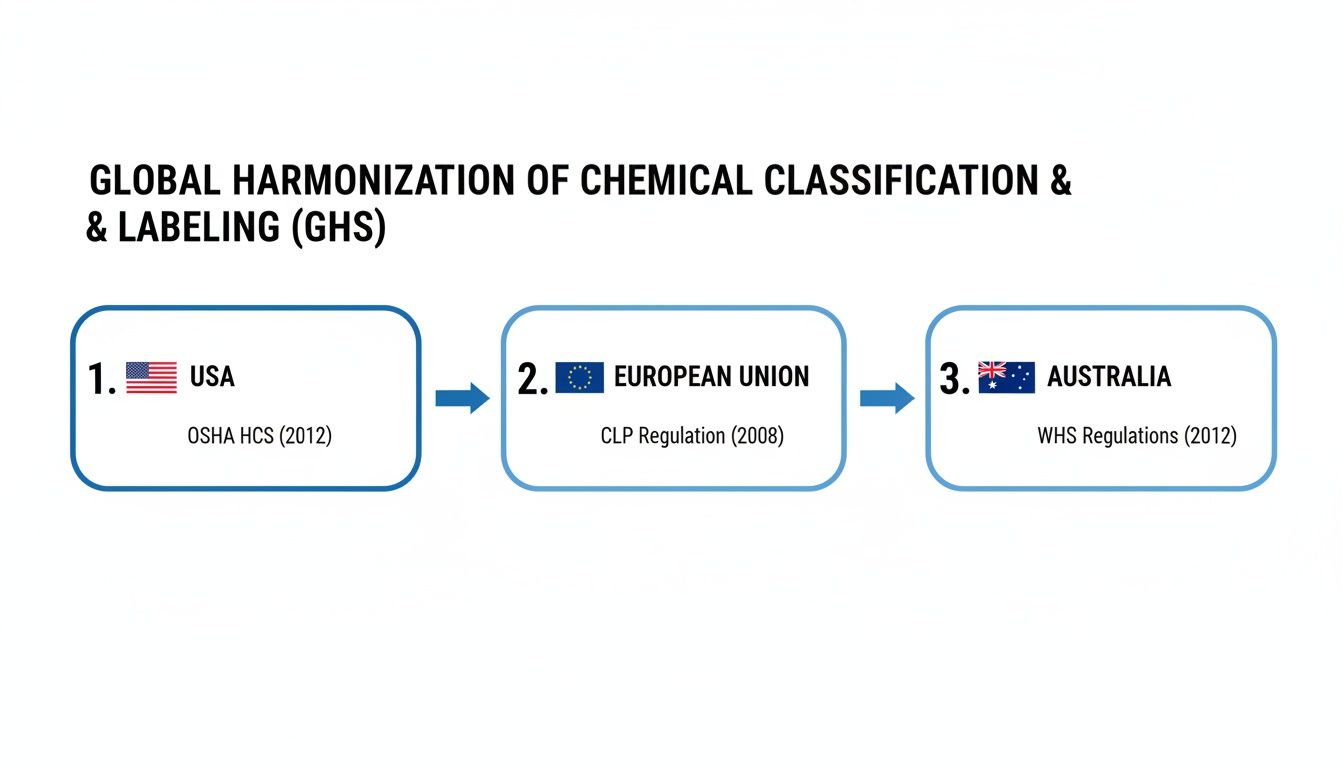
As you can see, while the goal is harmony, the path to compliance looks a little different depending on where you are, so paying attention to local rules is key.
Step 5: Train Your Team and Integrate Into Workflows
A perfectly designed label is useless if your team can't understand it. The final—and arguably most important—step is training. Every employee who handles hazardous chemicals needs to know how to read and understand GHS labels and SDSs.
They have to know what the pictograms mean, the difference between "Danger" and "Warning," and where to find critical safety information in an emergency.
Finally, weave this process into your daily operations. Make GHS labeling a mandatory step when new chemicals arrive, a checklist item for safety audits, and a core part of your overall hazard communication program. When compliance becomes a habit instead of an afterthought, you've succeeded.
Common GHS Labeling Mistakes to Avoid
Even with the best intentions, it's easy to get tripped up by the details of GHS labeling requirements. Small mistakes can snowball into big compliance headaches, but knowing the common pitfalls is half the battle in keeping your workplace safe and audit-ready.
Most of the time, these errors aren't about a lack of knowledge. They're about small gaps in day-to-day processes. Think about a busy receiving dock accepting a shipment without a quick label check, or an employee grabbing an old spray bottle and not thinking twice about its faded, illegible marking. These are the moments where compliance starts to drift.
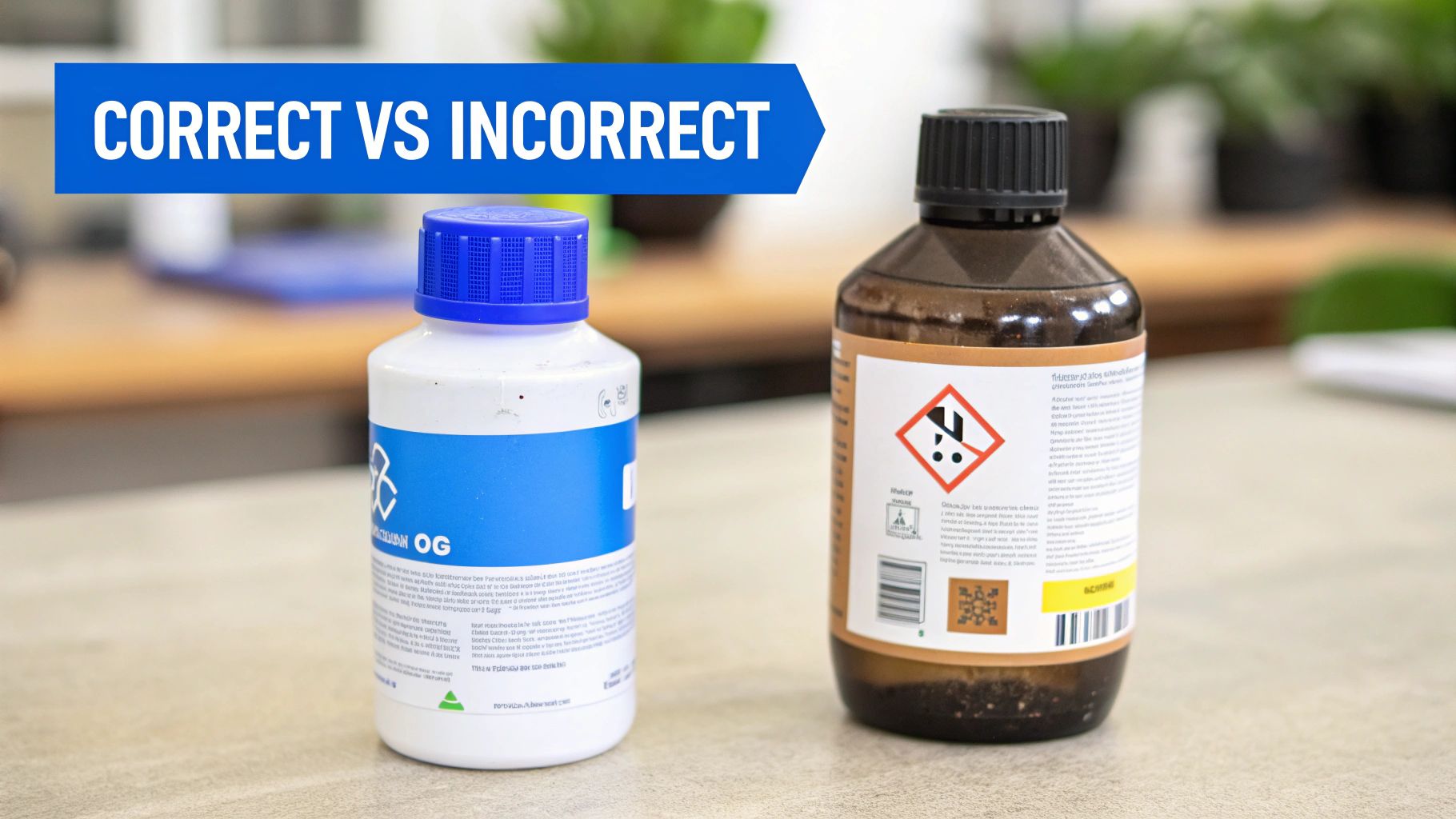
Overlooking Secondary Container Labeling
One of the most common—and dangerous—oversights is failing to properly label secondary containers. This is what happens when you pour a chemical from its original drum or tote into a smaller jug or spray bottle for everyday use.
An unmarked spray bottle is a ticking time bomb. Someone could easily mistake it for something else, mix it with a dangerous chemical, or have no idea how to respond in an emergency. The potential for serious injury is real.
Regulators like OSHA are crystal clear on this. If the person who filled that secondary container doesn't use it all up within their shift, it must have a label. At a bare minimum, that label needs to identify the chemical and spell out its specific hazards.
Relying on Outdated Safety Data Sheets
Another classic mistake is generating labels from an old Safety Data Sheet (SDS). An SDS isn't a "one-and-done" document. Suppliers are required to update them whenever new hazard information comes to light.
If you're working off an old SDS, your labels could be flat-out wrong—showing incorrect pictograms, missing key hazard statements, or listing outdated first-aid measures. This usually happens when there's no solid system for managing SDS updates. A new version might get filed away, but the old one stays in rotation, creating a dangerous disconnect between the data sheet and the container itself.
Common GHS Labeling Errors and Fixes
To help you catch these issues before they become problems, let's look at some of the most frequent errors I've seen and how to address them:
Mistake 1: Missing Supplier Information
- The Problem: The label is missing the name, address, and phone number of the manufacturer or supplier. This information is critical—it’s how you get expert help in an emergency.
- How to Fix It: Double-check that the supplier identification is always complete and readable. While not always strictly required for secondary containers, it's a best practice to include it anyway.
Mistake 2: Incorrect or Missing Pictograms
- The Problem: Using the wrong pictogram, leaving one off entirely, or using old, pre-GHS symbols. A classic example is using the exclamation mark when GHS precedence rules clearly call for the skull and crossbones.
- How to Fix It: Always check your work against Section 2 of the most current SDS. That section tells you exactly which pictograms are required for that chemical. No guesswork needed.
Mistake 3: Using Non-Durable Labels
- The Problem: A standard paper label just won't cut it in an industrial setting. It'll get torn, smudged by chemicals, or ruined by moisture in a heartbeat. And an illegible label is the same as no label at all.
- How to Fix It: Invest in the right tools for the job. Use durable, chemical-resistant label stock and a printing system built to handle industrial environments. That label needs to last as long as the container does.
Future-Proofing Compliance with Smart Systems
In a world of ever-changing regulations, trying to manage GHS labeling requirements with manual spreadsheets is like navigating a busy highway with a hand-drawn map. It's not just slow; it's an open invitation for human error and a surefire way to fall out of compliance. With the sheer volume of chemicals, constant supplier updates, and varying rules across jurisdictions, manual tracking is simply a recipe for disaster.
This kind of reactive approach—where you wait for an audit or, worse, an incident to find a problem—just doesn't cut it anymore. The future of compliance isn't about scrambling to keep up; it's about being prepared for what's next.
Embracing Integrated Compliance Platforms
Smart companies are shifting toward integrated systems that directly connect Safety Data Sheet (SDS) management with automated label generation. This creates a single, reliable source of truth, closing the dangerous gap that often exists between safety documents and the actual labels on your containers.
Think about it: a platform that uses intelligent automation to scan a new SDS the moment it arrives. It instantly pulls the product identifier, pictograms, and hazard statements, making them immediately ready for on-demand label printing. No more manual data entry means you slash the risk of typos and other costly mistakes. Our in-depth guide to SDS management software walks through how these systems can completely overhaul your hazard communication program.
This move transforms compliance from a reactive, administrative headache into a proactive, strategic advantage. Your team stops hunting for information and starts focusing on what really matters—implementing safety protocols and genuinely reducing workplace risk.
Proactive Monitoring and Dynamic Updates
The real game-changer with these systems is their ability to monitor for changes and adapt on the fly. Regulations evolve, and so do chemical formulations. A modern platform actively scans for regulatory updates and flags when a supplier's SDS is outdated or a new hazard classification impacts a chemical you use.
This proactive power is what truly future-proofs your operations. Just look at the benefits:
- Automated Alerts: Get notified the moment a chemical in your inventory is added to a major watch list like REACH or SVHC.
- On-Demand Printing: Print fully compliant labels for any jurisdiction with a single click, complete with the right language and regional pictograms.
- Mobile Accessibility: Equip your labels with QR codes, giving employees instant access to detailed safety info, PPE requirements, and emergency procedures right on their phones.
By automating the tedious, high-stakes work of tracking and updating, these platforms empower your safety professionals to focus on more valuable work. You can be confident that from the second a chemical hits your loading dock to the day it's disposed of, its hazard information is accurate, accessible, and completely compliant.
Got Questions About GHS Labels? We’ve Got Answers.
Even the most seasoned safety managers run into tricky situations when it comes to GHS labeling. It’s one thing to understand the rules in theory, but applying them on the floor can bring up some common—and critical—questions.
Let's clear up a few of the most frequent points of confusion before they turn into compliance headaches.
Are GHS Labels the Same as Shipping Labels?
This is a big one. It's easy to see a label on a drum and assume it covers everything, but GHS labels and shipping labels serve two completely different purposes.
A GHS label is all about workplace safety. Think of it as the chemical’s on-site "ID card," telling employees how to handle it safely right here, right now, under OSHA’s rules. It’s got the pictograms, signal words, and hazard statements needed for day-to-day use.
A shipping label, however, is for transport. It’s regulated by the Department of Transportation (DOT) and is designed to keep everyone safe while the chemical is on the move. You’ll see things like UN numbers on these. Often, a single package needs both labels to be fully compliant.
Do I Really Need to Label That Spray Bottle?
Absolutely. Labeling secondary containers isn't just a good idea; it's a hard-and-fast rule. Any time you transfer a chemical from its original container into something else—like a spray bottle or a smaller jug—it needs a GHS label.
The only exception is if the person who made the transfer is going to use it all immediately and won't be leaving it unattended.
Think about it: an unlabeled spray bottle sitting on a workbench is an accident waiting to happen. The next person who picks it up has no idea if it’s water or a corrosive acid. This simple labeling step prevents dangerous mix-ups.
How Often Do I Need to Update GHS Labels?
You need to update your GHS labels as soon as you learn about new, significant hazard information for a chemical. This update is almost always triggered when you receive a revised Safety Data Sheet (SDS) from your supplier.
Manufacturers and importers generally have six months to get their labels updated once they become aware of new hazard data. For you as the employer, the clock starts when that new SDS lands in your inbox. Your workplace labels need to reflect the most current information to keep your team safe and your facility compliant.
Tired of juggling spreadsheets and manually tracking SDS updates? At NextSDS, we built an all-in-one chemical safety platform to handle it for you. Our system keeps your SDS library current, flags regulatory changes automatically, and lets you print compliant GHS labels in just a few clicks. See how NextSDS can simplify your compliance workflow.