

At its heart, OSHA's Safety Data Sheet (SDS) requirements are all about one thing: giving employers a clear, standard way to share information about the hazardous chemicals in their workplace. The SDS is the tool for the job – think of it as a detailed instruction manual for handling, storage, and emergency response.
Why OSHA Ties HazCom and SDSs Together
Imagine the Hazard Communication Standard (HCS) – outlined in 29 CFR 1910.1200 – as the complete rulebook for chemical safety. If that's the rulebook, then the Safety Data Sheet is its most important chapter. The whole point of the HCS is to make sure chemical hazards are properly identified and that this crucial information gets passed down the line to both employers and their teams on the ground.
The standard establishes a fundamental "right to know" for every single worker. It's not enough to just slap a warning label on a drum; employees need access to detailed information that explains what those warnings actually mean for their health and safety day-to-day.
The Blueprint for a Safer Workplace
This is where the SDS steps in as the primary tool for getting it right. It’s the standardised vehicle for delivering the critical safety details mandated by the HCS. You can't have one without the other; their relationship is direct and unbreakable:
- The HCS is the law: It sets the rules and goals for communicating chemical safety.
- The SDS is the method: It's the specific, GHS-aligned format the law requires to meet those goals.
The whole point of OSHA's SDS requirements is to prevent incidents before they happen. Arming workers with this knowledge helps shift your safety culture from being reactive to being proactive and protective.
Getting this connection is the key. Fulfilling your OSHA obligations isn't just about collecting documents in a binder somewhere. It's about building a living, breathing communication system that actively keeps your team safe. Every single section of an SDS, from hazard identification to first-aid measures, is a direct answer to a requirement in the Hazard Communication Standard. If you want to dive deeper into the document itself, you can explore our detailed guide on what a safety data sheet is and why it's so important.
More Than Just a Piece of Paper
It helps to see the HCS as the "why" and the SDS as the "how." As an employer, your duty isn't just to have an SDS for every hazardous chemical on site. Your real obligation—both legally and ethically—is to make sure the information in those documents is understood, accessible, and actually used to make the work environment safer for everyone.
From the person on the loading dock to the technician in the lab, this standard ensures everyone has what they need to go home safe at the end of the day.
The Mandatory 16-Section SDS Format Explained
Think of a Safety Data Sheet less like a dry compliance form and more like a detailed user manual for a chemical. To make sure everyone, everywhere, can read that manual, OSHA demands a strict, 16-section format. This standardisation is a huge deal—it means a safety manager in Manchester and a lab technician in Brussels can find the exact same piece of critical information in the exact same spot, every single time.
This consistent structure is the core of the Globally Harmonised System (GHS), which OSHA's Hazard Communication Standard is built upon. It works by organising what can be very complex chemical data into logical, easy-to-find blocks. For businesses, this transforms the SDS from a regulatory headache into a practical, life-saving tool for day-to-day work and emergency planning.
This diagram shows you exactly where the SDS fits into the bigger picture of OSHA's safety rules, flowing directly from the Hazard Communication Standard itself.
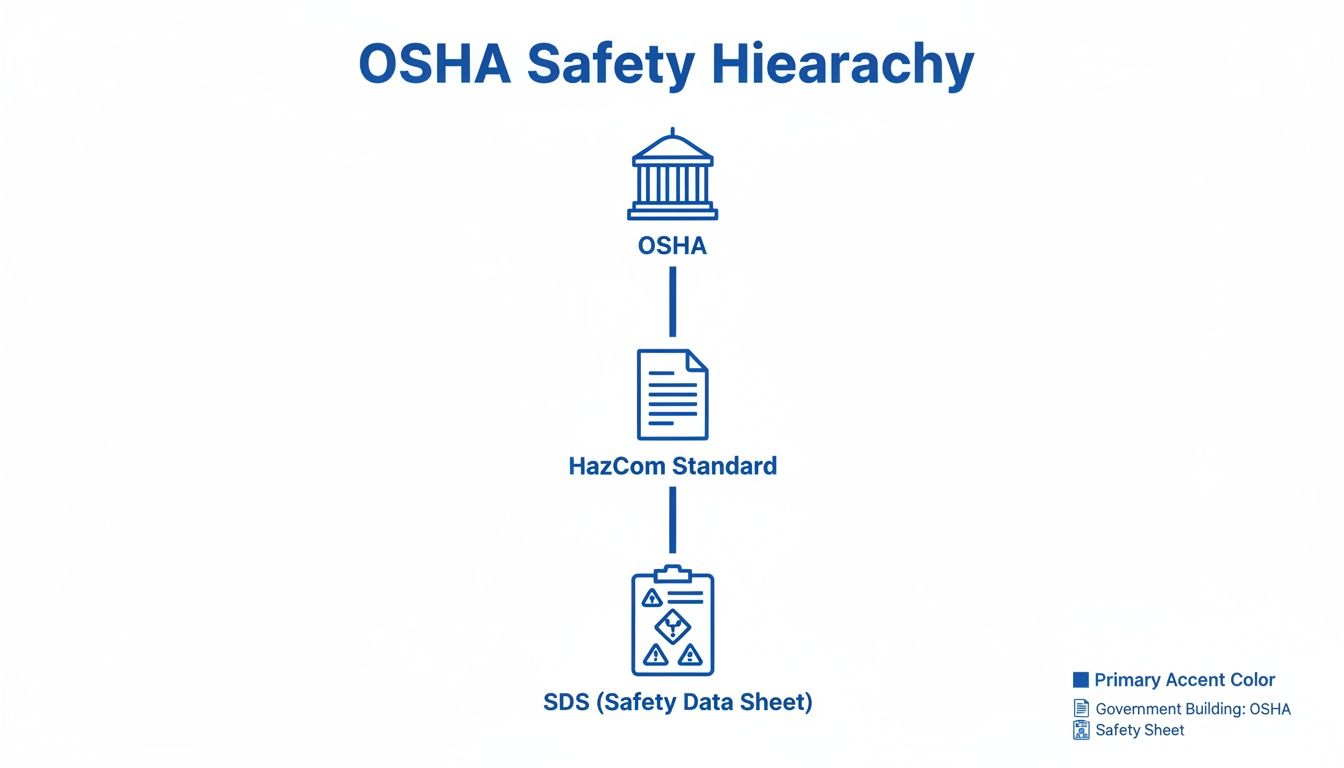
As you can see, the SDS is the ultimate, practical output of the entire regulatory system—it’s how essential safety information gets into the hands of the people who need it most.
Navigating the Enforceable vs. Non-Mandatory Sections
Now, here’s a crucial distinction that trips a lot of people up. While the GHS format has 16 sections, OSHA only actively enforces certain parts. Understanding this helps you focus your compliance efforts where they count.
OSHA holds employers accountable for the information in Sections 1 through 11 and Section 16. These are the sections that contain the most immediate, hands-on information for protecting your team, covering everything from chemical identification and first aid to safe handling and storage.
Think of it this way: OSHA’s enforcement muscle is focused on the details that directly impact workplace safety and emergency response. This includes how to identify a chemical, understand its dangers, react to an exposure, and handle it safely on a daily basis.
On the other hand, Sections 12 through 15 are considered non-mandatory by OSHA. Why? Because these sections cover ecological impacts, disposal, transport, and other regulatory details that typically fall under the authority of other agencies, like the Environmental Protection Agency (EPA) or the Department of Transportation (DOT).
Just because OSHA doesn't enforce them doesn't mean you can ignore them. These sections are still essential for good chemical management and are often required by international partners. Including them ensures your SDS is globally compliant and gives a full picture of the chemical's lifecycle.
A Detailed Tour of Each SDS Section
To really get a handle on OSHA SDS requirements, you need to know what each section is for. Every part answers a specific question that an employee or first responder might have in a real-world situation. Let's walk through them.
The table below breaks down the purpose and content of each of the 16 sections of a compliant SDS. It’s a great quick-reference guide.
Breakdown of the 16 Required SDS Sections
| Section Number | Section Title | Required Information |
|---|---|---|
| 1 | Identification | This is the "who, what, and why": the product name, manufacturer contact details, and what the chemical is used for. |
| 2 | Hazard(s) Identification | The at-a-glance danger summary. It lists all hazards using GHS classifications, signal words, pictograms, and hazard statements. |
| 3 | Composition/Information on Ingredients | The recipe. It lists all hazardous ingredients, their concentration ranges, and their unique Chemical Abstracts Service (CAS) numbers. |
| 4 | First-Aid Measures | Your emergency playbook. Provides detailed instructions for immediate medical care if someone is exposed. |
| 5 | Fire-Fighting Measures | What to do if it burns. It outlines the right way to put out a fire, specific fire-related chemical hazards, and necessary protective gear. |
| 6 | Accidental Release Measures | The clean-up plan. Gives step-by-step instructions for containing and cleaning up a spill or leak safely. |
| 7 | Handling and Storage | Day-to-day safety rules. It specifies precautions for safe handling and the right conditions for safe storage, including incompatibilities. |
| 8 | Exposure Controls/Personal Protection | How to protect your people. It lists OSHA's Permissible Exposure Limits (PELs) and recommends specific Personal Protective Equipment (PPE). |
| 9 | Physical and Chemical Properties | The chemical’s vital stats: its appearance, odour, pH, flash point, and other key characteristics. |
| 10 | Stability and Reactivity | How it behaves. Describes the chemical's stability and lists conditions or materials to avoid that could cause a dangerous reaction. |
| 11 | Toxicological Information | The health risks. It provides data on the likely routes of exposure (skin, inhalation) and the health effects of the chemical. |
| 12 | Ecological Information (Non-Mandatory) | The environmental impact. It covers how the chemical affects the environment, from its toxicity to aquatic life to how long it persists. |
| 13 | Disposal Considerations (Non-Mandatory) | How to get rid of it responsibly. It describes proper disposal methods and any relevant waste handling regulations. |
| 14 | Transport Information (Non-Mandatory) | Shipping rules. Includes the classification information needed for transport, like the UN number. |
| 15 | Regulatory Information (Non-Mandatory) | The legal fine print. It cites specific safety, health, and environmental regulations that aren't mentioned elsewhere. |
| 16 | Other Information | The catch-all section. It must include the date of the last revision and can contain other useful details. |
This systematic structure ensures that no matter what chemical you're dealing with, you know exactly where to look for the information you need. Knowing that PPE recommendations are always in Section 8 or that first-aid measures are always in Section 4 can save precious seconds during an incident. This predictability is the whole point—and the core strength—of the GHS format.
Employer and Supplier Responsibilities Under HazCom
Getting OSHA SDS requirements right isn't a job for just one person. It's a shared responsibility that travels with a chemical from the manufacturer all the way to the end-user. Think of it as a baton pass in a relay race for safety information; each runner has a specific job, and if one person fumbles, the whole team is affected.
The race starts with the chemical suppliers—the manufacturers, importers, and distributors. They're the ones who create the safety information in the first place. Under the Hazard Communication Standard, their fundamental duty is to figure out the dangers of the chemicals they make or bring into the country, classify those hazards correctly, and then capture that information in a compliant Safety Data Sheet and on the product label.
This first step is everything. If the supplier doesn't provide an accurate and complete SDS, it's virtually impossible for anyone down the line to do their part correctly.
The Supplier's Core Duties
Suppliers have a clear mandate: every hazardous chemical they ship must come with a GHS-compliant, 16-section SDS. This is non-negotiable. Their key tasks include:
- Hazard Classification: Doing the legwork to thoroughly assess a product and identify all of its physical and health hazards.
- SDS Authoring: Writing a detailed and accurate 16-section SDS that correctly reflects their hazard findings.
- Labelling: Creating container labels that perfectly match the information in Section 2 of the SDS, including the required pictograms and signal words.
- Distribution: Making sure the customer receives the SDS with their first shipment and any time the document is significantly updated.
An SDS isn't a "set it and forget it" document. If a supplier uncovers significant new information about a chemical's hazards, OSHA gives them three months to update the SDS and label and get that new version out to their customers.
The Employer's Critical Downstream Role
The moment a chemical arrives at your facility, the baton is in your hands. As the employer, you are the final, crucial link in the safety chain. Your job is to take the information the supplier gave you and make it real for your team—to put it into your employees' hands in a way they can easily understand and use.
You aren't expected to write the SDSs from scratch. But you are absolutely responsible for getting them, keeping them organised, and making sure your team can access them without any hassle. Your role is to build a complete safety programme around the data you receive. This means:
- Maintaining a complete SDS library for every single hazardous chemical used in your workplace.
- Ensuring SDSs are readily accessible to employees on all work shifts, with no barriers.
- Training employees on how to actually read and interpret the SDSs for the specific chemicals they work with.
- Developing a written Hazard Communication Plan that outlines exactly how your company meets all these requirements.
This division of labour makes the system work. Your duties are different from a supplier’s, but they are just as vital for keeping your workplace safe and compliant. To dive deeper, check out our guide on achieving full Safety Data Sheet compliance.
This system isn't just a US-based idea. In the European Union, regulations like REACH and CLP also make SDSs mandatory. A key difference, however, is that while OSHA doesn't enforce sections 12-15, the EU requires all 16 sections to be fully completed. They also mandate that SDSs must be provided in the official language of the member state where the product is sold. For instance, recent audits in Germany found 15% of SDSs had language violations, leading to hefty fines. You can find more on this in an excellent breakdown on navigating SDS requirements across regions on experienhealthsciences.com.
Managing Your SDS Library for Instant Access and Updates
Having a Safety Data Sheet for every hazardous chemical is only the first step. The real test of your Hazard Communication Programme is how you manage that collection of documents. OSHA's rules are perfectly clear on this: your SDS library must be organised so that any employee, on any shift, can get to it without delay or obstruction.
Think of your SDS library less like a dusty archive and more like a frontline emergency response tool. If a worker gets a chemical splashed in their eye, they don’t have time to wait for a supervisor to unlock a cabinet or hunt down a password. The information in Section 4 (First-Aid Measures) needs to be in their hands in seconds, not minutes.
This is why the concept of "readily accessible" is so central to OSHA's requirements. It means there should be zero barriers between a worker and the safety information they need.

Digital systems make this immediate access a reality, organising vast libraries so any SDS is searchable and instantly viewable on a tablet or computer right on the factory floor.
The Pitfalls of Paper Binders
For decades, the humble three-ring binder was the go-to for SDS management. While it can be technically compliant if set up just right, this old-school method is riddled with practical problems in any modern workplace.
Picture a site with three separate departments and multiple shifts. A single binder stashed in the main office just doesn't work. It creates an immediate access barrier for anyone working in a different area or after standard business hours.
Here are the common headaches that come with binder systems:
- Version Control Nightmares: When a supplier sends you an updated SDS, you’re stuck with the manual task of tracking down and replacing every single outdated copy across the facility. It's far too easy for an old version to get left behind, creating a serious compliance risk.
- Physical Accessibility Hurdles: A binder can't be in two places at once. This makes it impossible to guarantee immediate access for teams spread across a large plant, a sprawling construction site, or multiple buildings.
- Damage and Loss: Paper gets ruined by water, dirt, and general wear and tear. Pages go missing, and sometimes entire binders get misplaced, leaving a critical gap in your safety programme.
The Three-Month Update Mandate
Beyond simply providing access, OSHA SDS requirements include a strict timeline for keeping your information current. When a supplier gives you a new or significantly updated SDS—maybe because new hazard information has been found—you must replace the old one in your library as soon as practicably possible.
The rule of thumb is clear: suppliers must update an SDS within three months of becoming aware of significant new hazard information. As the employer, your job is to get that new information into your library and training programmes without delay.
This is where digital systems offer a massive advantage. Manually tracking revision dates and swapping out pages for hundreds of chemicals is a logistical nightmare. A digital platform automates this entire process. When a new SDS is uploaded, it instantly replaces the old one everywhere, ensuring every employee has the most up-to-date data. Our guide on the benefits of SDS management software explains exactly how this technology can automate your compliance.
Modernising Your SDS Library
Moving from binders to a digital system is the single most effective way to meet OSHA’s demands for both access and updates. A centralised, cloud-based platform ensures that every employee, from the loading dock to the laboratory, can pull up the exact same, current SDS on a computer, tablet, or even their phone.
This approach solves the core challenges of old-fashioned methods:
- Instant, Universal Access: Any authorised employee can look up an SDS in seconds, from anywhere on-site. No more searching for a physical binder.
- Automated Updates: Version control is handled for you. The latest document from the supplier is always the one available to your team.
- Enhanced Usability: Digital libraries are searchable. Workers can find the specific information they need in moments, without flipping through hundreds of pages.
By embracing a modern management strategy, you transform your SDS library from a passive compliance chore into a dynamic, life-saving resource that actively protects your workforce.
Training Your Team to Understand and Use SDSs
An organised, up-to-date SDS library is a fantastic safety asset, but it’s only as good as your team’s ability to use it. Under the Hazard Communication Standard, employee training isn't just a good idea—it’s a mandatory, enforceable part of your OSHA SDS requirements. Think of it as the final, critical step that brings all that safety information to life.
Simply pointing to the SDS binder or a digital kiosk and calling it a day just doesn’t cut it. Real compliance means equipping your team with the skills to confidently find, read, and understand an SDS. More importantly, they need to know how to use that information to protect themselves during their daily tasks and, crucially, in an emergency. Effective training transforms a static document into a dynamic tool for self-preservation.
Without it, even the most meticulously managed SDS library is just a collection of unread files. Your goal should be to build a programme that fosters a confident, safety-conscious workforce.

Core Components of an Effective Training Programme
OSHA gives you flexibility in how you train, but it's very clear on what you must cover. Training needs to happen when an employee is first assigned to a role and again whenever a new chemical hazard is introduced into their work area. It's an ongoing process, not a one-time event.
A solid training session must cover the details of your specific Hazard Communication Programme and the chemicals actually present in your workplace. Key topics must include:
- How to Find the SDS Library: Be specific. Explain the exact location and method for accessing SDSs, whether it's a physical binder in the shift supervisor's office or a dedicated terminal on the shop floor.
- Reading and Interpreting an SDS: Go beyond just listing the 16 sections. Show your team how to pinpoint critical information, like PPE requirements in Section 8, first-aid measures in Section 4, and spill response procedures in Section 6.
- Understanding GHS Labels and Pictograms: Every worker must be able to recognise the hazard pictograms at a glance and know what signal words like "Danger" and "Warning" mean for their immediate safety.
- Emergency Procedures: Walk through the exact steps to take in case of a spill, exposure, or other emergency, directly linking these actions back to the information found in the relevant SDS.
A generic safety meeting won't satisfy OSHA. The training must be specific to the hazards your employees will actually encounter. The single most effective way to make the training relevant and memorable is to use the SDSs for chemicals you have on-site.
Making the Training Stick
The difference between a merely compliant training programme and a truly effective one comes down to engagement. If you want the information to be retained and put into practice, you need to move beyond PowerPoint slides and checklists. The secret is to make it practical and hands-on.
Consider trying these proven techniques to improve retention and build real-world competence:
- Use Your Own Chemicals: Ditch the generic examples. Grab the actual SDS for a common chemical in your facility, like a cleaning solvent or a machine lubricant. Go through it as a group, connecting the information directly to the containers and tasks employees see every single day.
- Conduct Hands-On Drills: Run a mock spill scenario. Challenge employees to locate the correct SDS, identify the necessary PPE from Section 8, and describe the clean-up steps from Section 6. This kind of practical application builds muscle memory.
- Hold "SDS Scavenger Hunts": Create a simple worksheet with questions like, "What is the flash point of Toluene?" or "What first aid is needed for skin contact with Isopropyl Alcohol?" Have teams use your SDS library to race to find the answers.
This approach shifts training from passive listening to active problem-solving. It empowers your employees, ensuring they not only meet OSHA SDS requirements but also have the confidence to use this vital tool to keep themselves and their colleagues safe.
Your Actionable Checklist for Full OSHA SDS Compliance
Theory is one thing, but on-the-ground action is what truly keeps people safe and your organisation compliant. Think of this checklist as a practical self-audit tool, breaking down everything we've covered into clear, manageable steps. It’s built for EHS managers and procurement teams to walk through their Hazard Communication Programme, spot any weak links, and fix them before they become a problem.
Let's use this guide to methodically check every part of your process, from the initial chemical inventory right through to your employee training logs. This isn't just about ticking boxes; it's about building confidence that your programme is robust, effective, and actively protecting your team.
Step 1: Inventory and SDS Collection
You can't manage what you don't measure. The absolute bedrock of a solid HazCom programme is a complete and accurate understanding of every hazardous chemical on your premises.
- Go on a "Wall-to-Wall" Hunt: Physically walk through every single corner of your facility—workstations, storage closets, maintenance sheds, you name it. Create a master list of every product that falls under the hazardous chemical definition.
- Play the Matching Game: For every single item on that list, you must have a corresponding, up-to-date, 16-section GHS-compliant Safety Data Sheet. No exceptions.
- Chase Down Missing and Old SDSs: If you find a product with a missing SDS or an outdated MSDS, your first job is to contact the supplier and request the latest version. Crucially, keep a record of these requests; it demonstrates your due diligence.
Step 2: Accessibility and Library Management
Having a perfect collection of SDSs is useless if your team can't get to them when it matters most. OSHA's "readily accessible" standard is a big deal and a frequent tripwire during inspections.
Think of your SDS library like a fire extinguisher. It has to be immediately available to anyone who needs it, at any moment, without having to ask for a key or hunt down a supervisor.
- Test for "No-Barrier" Access: Can every employee, on every shift, pull up any SDS they need without any roadblocks? For digital systems, that means no forgotten passwords or locked terminals. For binders, it means they're in common, unlocked areas.
- Nail Down Your Update Workflow: Who is responsible for adding new SDSs and archiving old ones? You need a clear, documented process. When a supplier sends an updated sheet, it needs to get into the main library without delay.
- Plan for When the Power Goes Out: If you rely on a digital system, you must have a backup plan for outages or network failures. This could be as simple as printed copies for your highest-risk chemicals or a dedicated laptop with the files saved locally.
A strong SDS programme doesn't exist in a vacuum. It should be a core component of your broader facility management best practices.
Step 3: Training and Documentation
The final piece of the puzzle is making sure your employees actually understand and can use all this information. An SDS they can't interpret is just a piece of paper.
- Check Your Training Records: Do you have a documented training record on file for every single employee who works with or near hazardous chemicals?
- Audit Your Training Content: Pull out your training materials. Do they clearly explain how to access the SDS library, what the GHS labels and pictograms mean, and how to find specific information (like first-aid measures) within an SDS?
- Schedule Regular Refreshers: HazCom training isn't a one-and-done event. Plan for periodic refresher sessions and always provide immediate training whenever a new chemical hazard is introduced to a work area.
SDS Compliance Self-Audit Checklist
Putting it all together can feel overwhelming. This table provides a structured way to walk through the most critical compliance points, track your status, and assign clear action items to close any gaps you find. It’s a simple tool to turn your compliance goals into a concrete action plan.
| Compliance Checkpoint | Status (Compliant/Non-Compliant/In Progress) | Action Required |
|---|---|---|
| Inventory | ||
| A complete chemical inventory list exists and is current. | ||
| SDS Collection | ||
| A GHS-compliant, 16-section SDS is on file for every chemical. | ||
| A documented process for requesting missing/updated SDSs is in place. | ||
| Accessibility | ||
| All employees can access SDSs without barriers during all shifts. | ||
| A functional backup system is available for digital SDS libraries. | ||
| Maintenance | ||
| A designated person/team is responsible for updating the SDS library. | ||
| Outdated SDSs are archived for at least 30 years. | ||
| Training | ||
| All exposed employees have received initial HazCom training. | ||
| Training records are complete and up-to-date for all staff. | ||
| Training covers SDS access, label elements, and specific hazards. | ||
| A process for refresher/new-hazard training is established. |
By methodically working through this checklist, you can move from hoping you're compliant to knowing you are. This proactive approach not only prepares you for a potential OSHA inspection but, more importantly, fosters a genuinely safer work environment for everyone.
Common Questions on OSHA SDS Requirements
Even with a well-oiled Hazard Communication Programme, certain questions pop up time and time again. These are the tricky, day-to-day scenarios that can leave even seasoned EHS managers scratching their heads. Let's tackle some of the most frequent queries with clear, practical answers.
How Long Do We Need to Keep Safety Data Sheets?
This is a big one, and OSHA is crystal clear about it in 29 CFR 1910.1020. While you only need the current SDS on hand for chemicals actively in use, the real requirement is about long-term exposure records. For any hazardous substance an employee might have been exposed to, you need to keep a record of it for at least 30 years after they leave the company.
That doesn't necessarily mean keeping stacks of old SDSs. It means you must archive either the outdated SDS itself or at least a record identifying the chemical and where and when it was used. Think of it as creating a historical chemical footprint for each employee, which is essential for tracking long-term health.
What Should I Do If a Supplier Sends a Product Without an SDS?
First things first: stop. Do not let that chemical be used until you have the safety information in hand. Your immediate next step is to get on the phone or send an email to the manufacturer or distributor and ask for the SDS.
Crucially, you need to document this request in writing. This creates a paper trail proving you did your part. If they don't send it over in a reasonable timeframe, your responsibility is to report them to your local OSHA Area Office. Having proof of your good-faith efforts to get the SDS is your best defence if an inspector comes knocking.
Can Our Company Use a Fully Digital SDS Management System?
Absolutely. In fact, for most businesses, an electronic system is the only sane way to manage a large and constantly changing SDS library. But simply having a digital binder isn't enough; you have to meet a few critical conditions.
OSHA's core principle here is "unfettered access." This means employees must be able to get to an SDS immediately, on their own, during their work shift. They shouldn't have to hunt down a supervisor, ask for a password, or navigate a clunky system.
You also need a solid backup plan. What happens if the power goes out or the network crashes? You must have a way to access SDSs in an emergency, whether that’s printed copies for your highest-risk chemicals or a dedicated laptop with an offline copy of your library. Finally, training is non-negotiable. Every employee needs to know exactly how to find what they need in the digital system, fast.
Is an Old Material Safety Data Sheet (MSDS) Still Compliant?
No, not anymore. The cutoff date for switching from the old Material Safety Data Sheet (MSDS) format to the modern, 16-section Safety Data Sheet (SDS) was 1 June 2015.
If you still have an old-style MSDS for a chemical you're using today, it’s out of date and out of compliance. You need to contact the supplier right away and request an updated, GHS-compliant SDS to satisfy current OSHA SDS requirements.
Juggling these complex rules doesn't have to be a constant headache. NextSDS offers a comprehensive platform designed to automate your SDS library, track regulatory updates, and give your team instant access to critical safety information. You can streamline your compliance efforts and build a safer workplace. To see how it works, find out more at https://nextsds.com.