

At its heart, a safety data sheet database is your single, central hub for managing all critical chemical safety information. It’s the modern answer to those old, dusty binders and scattered spreadsheets, replacing them with a smart, searchable, and always-on system designed to keep you compliant and your team safe.
From Filing Cabinets to Cloud Compliance

It wasn’t that long ago that chemical safety management was a constant struggle. Picture the scene: an HSE manager’s office, overflowing with binders stuffed with hundreds, if not thousands, of Safety Data Sheets (SDSs). Meanwhile, procurement teams were stuck in a never-ending cycle of chasing down suppliers for the latest documents, which often arrived as blurry faxes or inconsistent PDFs.
This manual, paper-based approach was riddled with risk. If an emergency struck, finding the right SDS meant a frantic scramble through pages, losing precious time when every second is critical. The looming danger of relying on an outdated document—with the wrong first-aid advice or PPE requirements—created a huge compliance and safety headache.
The Shift to a Smart Chemical Library
A modern safety data sheet database completely flips the script. It’s best to think of it not just as a digital filing cabinet, but as an intelligent, automated library for your entire chemical inventory. Instead of you manually sorting papers, the system takes on the heavy lifting of collecting, organising, and updating all that vital safety information.
This move from physical to digital brings immediate, tangible benefits:
- One Source of Truth: Every SDS is stored in a single, secure cloud location, ready to be accessed from a computer, tablet, or phone.
- Always Up-to-Date: The database can automatically fetch the latest SDS versions directly from suppliers, so you're not left guessing.
- Find What You Need, Fast: Anyone on your team can search for and find the exact safety information they need in seconds.
- Audit-Ready Compliance: Digital records create a clean, traceable trail, making regulatory inspections far less stressful.
This isn't just about swapping paper for pixels. It's a fundamental shift towards proactive safety management. By automating the thankless, error-prone tasks of the past, businesses can free up their teams to focus on what actually matters: keeping people and operations safe.
The real challenge has always been the sheer volume and constant flux of chemical safety data. Regulations evolve, product formulas change, and suppliers issue revisions. A manual system just can't keep up.
To give you a clearer picture, let’s compare the old way of doing things with a modern, automated approach.
Manual Spreadsheets vs Automated SDS Database
| Feature | Manual Management (Spreadsheets & Binders) | Automated SDS Database (e.g., NextSDS) |
|---|---|---|
| Document Retrieval | Slow, manual searching through physical binders or complex folders. High risk of human error. | Instant, keyword-based search. Find any SDS in seconds from any device. |
| Version Control | A constant, manual effort. Relies on suppliers to send updates and staff to file them correctly. | Automated. The system actively sources the latest versions from manufacturers, ensuring you’re always current. |
| Data Accessibility | Limited to a physical location. Useless in an emergency if you're not on-site. | 24/7 cloud-based access. Available to anyone who needs it, wherever they are. |
| Compliance Audits | A stressful, time-consuming scramble to gather documents and prove compliance. | Simple and streamlined. Generate reports and provide auditors with a clear, organised digital trail. |
| Employee Training | Difficult to ensure everyone has access to the right information for training purposes. | Centralised information makes training consistent and easy to manage. |
| Risk Assessment | Data is "locked" in PDFs, making it nearly impossible to analyse chemical hazards across the inventory. | Extracts key data points, allowing for powerful reporting on hazards, ingredients, and regulatory flags. |
In the end, an automated database becomes your definitive source of truth. It turns the chaos of chemical data management into clear, actionable intelligence, guaranteeing that every member of your team has the right information, right when they need it.
Why Regulations Make an SDS Database a Necessity, Not a Choice
Let's be clear: a robust safety data sheet database isn't just some nice-to-have organisational tool. It’s a direct response to a dense web of regulations that demand, not just recommend, easy access to chemical safety information. For any business in Europe, especially in Belgium, that handles hazardous materials, these rules make a centralised digital system completely non-negotiable.
Think of it this way: these regulations aren't just bureaucratic hurdles; they're the legal framework designed to keep people safe. At the very top of this pyramid sits the REACH Regulation (EC) No 1907/2006. REACH—which stands for Registration, Evaluation, Authorisation and Restriction of Chemicals—puts the onus squarely on companies to know and manage the risks of the substances they make or sell in the EU. The primary way you communicate that information down the supply chain is through a Safety Data Sheet.
But it’s not enough to simply have an SDS. The regulations are incredibly strict about it being the correct, most up-to-date, and properly formatted version. Outdated or inaccessible information isn't just a compliance slip-up; it's a serious legal liability.
Navigating Europe's Core Chemical Laws
Working hand-in-hand with REACH is the CLP Regulation (Classification, Labelling and Packaging). This is the rule that aligns the EU's system with the UN’s Globally Harmonized System (GHS). CLP is responsible for the standardised pictograms, signal words, and hazard statements you see on labels and in Section 2 of every SDS. This harmonisation is a huge step forward for safety, but it also means that whenever the GHS is updated, the regulations change too, triggering a constant cycle of document revisions.
- REACH Regulation: This is the big one. It governs chemical production and use, making a compliant SDS mandatory for hazardous substances.
- CLP Regulation: This ensures hazards are communicated clearly and consistently across Europe through standardised labelling and SDS formats.
- GHS Standardisation: This global standard mandates a strict 16-section format for every SDS, making data consistency a top priority.
Trying to keep up with all this manually is a losing game. A safety data sheet database helps automate compliance by making sure every document follows the GHS format and reflects the latest regulatory changes. Understanding how this system supports essential facilities management best practices is fundamental to both safety and staying on the right side of the law.
The Language and Logistics Challenge
The complexity doesn't stop there. In Belgium, for instance, national rules add another layer. The tough requirements of REACH, along with its 2020 update (Regulation (EU) 2020/878), have completely changed how companies manage their SDSs. Article 31 demands an SDS for any hazardous substance, and suppliers must provide them in Dutch, French, or German to serve the country's trilingual regions. In fact, service providers report that in 2023, over 90% of their SDS authoring requests involved creating multi-language versions to meet this exact requirement.
A single mistake in translation or an outdated document doesn't just risk a fine; it puts employees in tangible danger. The law demands clarity and accessibility, and a modern database is the only practical way to deliver it at scale.
This extends beyond the four walls of your facility. Regulations like ADR (for road transport) and IATA (for air transport) dictate how dangerous goods are moved. These frameworks have their own specific documentation and labelling requirements, all of which must align perfectly with the information in the SDS. Any mismatch between a shipping manifest and an SDS can bring a shipment to a grinding halt, trigger inspections, and result in hefty penalties.
A centralised database acts as the single source of truth, ensuring the information used for labelling, shipping, and emergency response is always consistent and correct. This seamless integration makes it clear: managing this dynamic challenge without a dedicated system is not just difficult, it's nearly impossible. You can learn more about maintaining safety data sheet compliance in our comprehensive guide.
What Makes a Modern SDS Database Tick?
So, we've covered the complex web of regulations driving the need for better chemical management. Now, let’s peel back the layers and look at what a modern safety data sheet database actually is. Think of it less like a dusty filing cabinet and more like the central nervous system of your chemical safety programme.
Each component is designed to take the manual grunt work out of the equation, slash human error, and give you clear, actionable information right when you need it. These systems aren't just for storage; they’re an active partner in keeping your people safe and your operations compliant.
At the heart of it all is one simple, crucial task: getting the right data into the system and making it instantly useful. That journey begins with how you get your documents inside. A genuinely modern platform goes way beyond asking you to upload files one by one.
The best systems work like a 'magic mailbox' for your safety data. They can automatically grab any new or updated SDS sent to a dedicated email address. No more downloading and re-uploading files – it just happens.
This automated first step is the foundation for creating a single, reliable source of truth for every chemical you handle. Once the document is in, the real magic starts.
AI-Powered Data Extraction and Validation
Nobody enjoys sifting through a 12-page SDS just to find a CAS number, revision date, or a specific hazard statement. It's slow, mind-numbing, and a recipe for mistakes. This is where AI-powered data extraction completely changes the game.
The system uses smart algorithms to read and understand the document, pulling out the most critical bits of information and organising them into neat, searchable fields.
This includes essential data points like:
- Product Identifiers: Trade names, CAS numbers, and EC numbers.
- Supplier Details: Manufacturer information and emergency contact numbers.
- Revision Dates: Crucial for making sure you’re always using the latest version.
- Hazard Information: GHS classifications, pictograms, and signal words.
This isn’t just about speed; it's about accuracy. The system can even run automated supplier validation, comparing new documents against what you already have to flag updates, spot duplicates, or identify missing information. It keeps your data clean and trustworthy.
The diagram below shows how a modern system connects different regulatory frameworks to keep you compliant across the board.
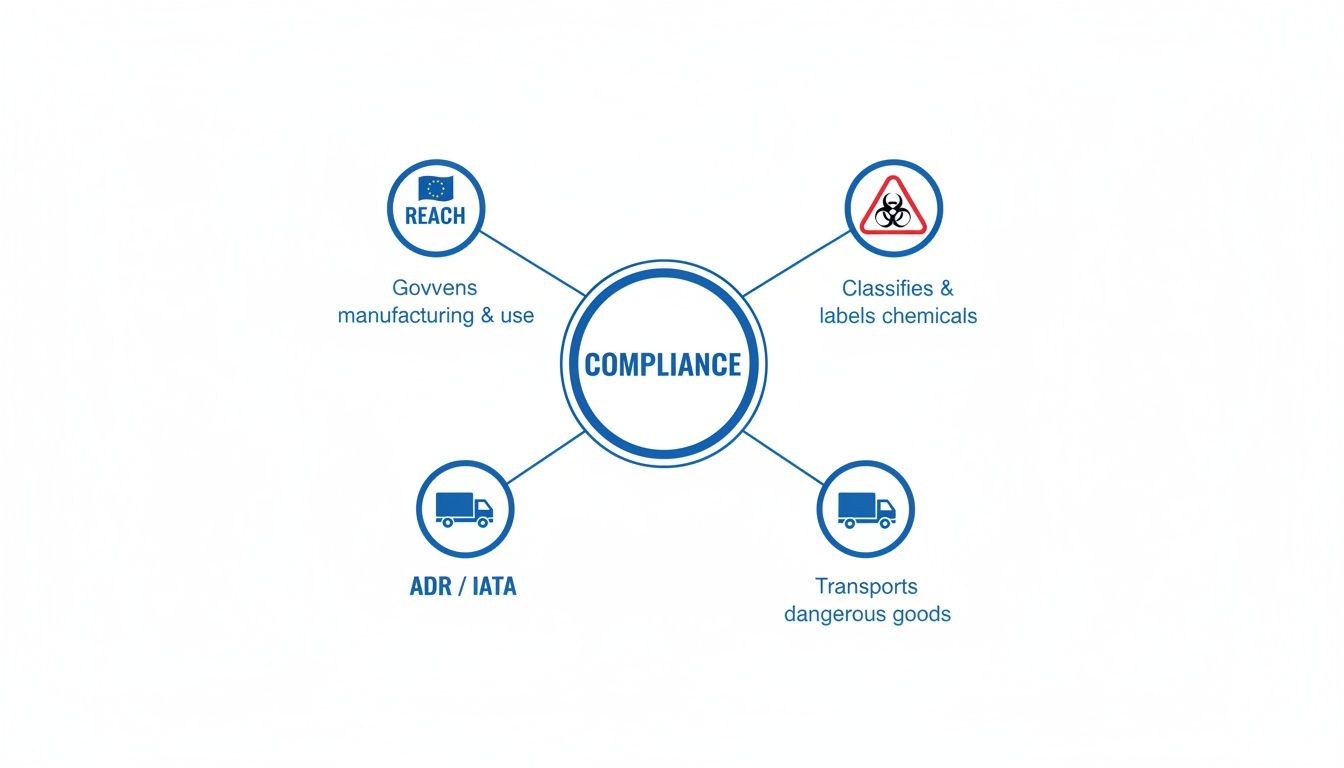
As you can see, compliance isn't one single task. It’s an interconnected ecosystem of rules that cover everything from manufacturing (REACH) and labelling (CLP) to transport (ADR/IATA).
Real-Time Screening and Intelligent Alerts
A static library of documents is practically useless when regulations are constantly changing. A modern safety data sheet database has to be active, screening your inventory in real time. As soon as a new chemical is added, the system should automatically check its ingredients against critical regulatory lists.
For instance, it can instantly flag if a substance appears on:
- The REACH Candidate List of Substances of Very High Concern (SVHCs).
- Regional lists of restricted or banned chemicals.
- Occupational exposure limit databases.
When a rule changes or a substance gets added to a watch list, the system sends out smart alerts to the right people. This proactive monitoring means your procurement team can vet chemicals before they’re even bought, helping HSE managers stay one step ahead of compliance deadlines.
Accessibility and On-the-Ground Tools
Finally, what good is all this safety information if the people who need it most can't get to it? Modern systems are built with the end-user in mind, providing practical tools for workers on the warehouse floor, in the lab, or out in the field.
Key features that make a real difference for your teams include:
- Mobile Access: Giving staff full access to the entire SDS library from any smartphone or tablet is non-negotiable.
- QR Code Access: Imagine placing a simple QR code on a container or in a work area. A quick scan with a phone and—boom—the right SDS pops up instantly.
- Integrated GHS Label Printing: The system should let you generate compliant labels for secondary containers directly from the SDS data. This ensures consistency and helps eliminate dangerous mislabelling errors.
Put it all together, and the SDS database is transformed from a passive storage unit into an active safety hub. It becomes an essential tool for managing the entire chemical lifecycle, from procurement to disposal, and forms the very backbone of a robust chemical inventory management software strategy.
Turning Data Into Actionable Safety Insights
A modern safety data sheet database is so much more than a digital filing cabinet. Thinking of it as just a place to store documents misses the point entirely. Its real power lies in turning that static information into active safety measures that protect your people and keep your operations running smoothly.
This is where the system really comes alive. It's about connecting the dots between raw data and your real-world chemical risks. It’s the difference between knowing what chemicals you have on-site and understanding what those chemicals actually mean for your teams day-to-day.
By plugging SDS data into smart, integrated modules, you can build a safety culture that's driven by evidence, not guesswork, and one that aligns perfectly with rigorous standards like ISO 45001.
Integrated Risk Assessment Modules
Think for a moment about calculating health risks manually for every single task that involves a hazardous chemical. You’d be buried in paperwork, cross-referencing dozens of SDSs, checking regulatory tables, and trying to assess different exposure scenarios. It’s a huge, complicated job, and one that’s incredibly easy to get wrong.
This is precisely the problem integrated risk assessment modules solve. They automate the whole process. Using data pulled directly from your SDS library, they can calculate exposure-based risk scores for specific roles and tasks across your organisation.
This is a game-changer. It finally connects the dots between a chemical's inherent hazards and how your employees are actually interacting with it, giving you a clear, quantifiable measure of risk. It means you can focus your time, budget, and attention where they're needed most.
A truly effective safety programme is predictive, not just reactive. By leveraging the rich data within an SDS, these tools empower organisations to identify and mitigate hazards before they can lead to an incident.
This proactive approach is essential for maintaining a safe workplace and proving due diligence to regulators. You move from simply ticking compliance boxes to actively managing and reducing risk on the ground.
Managing Occupational Exposure Limits
One of the most critical parts of chemical safety is managing Occupational Exposure Limits (OELs). These are the legally defined upper limits for the concentration of a hazardous substance in the workplace air. A good safety data sheet database makes this complex monitoring task far more manageable.
The system can automatically find and track key OEL figures from within an SDS, such as:
- Time-Weighted Average (TWA): The average exposure someone can have over a standard eight-hour workday.
- Short-Term Exposure Limit (STEL): The maximum concentration a worker can be exposed to for a short burst of time, usually about 15 minutes.
By linking this data directly to your chemical inventory, the system can flag any substance that needs special attention, like air monitoring or specific engineering controls. This is how you ensure your operations stay well within safe and legal thresholds.
In Belgium, the chemical sector is a major employer with 92,000 workers, and it relies heavily on solid SDS management to comply with CLP Regulation 1272/2008/EC. Yet, EU-OSHA statistics show that inadequate SDSs were a factor in 25% of the 1,800 chemical-related accidents in Belgian workplaces between 2020-2024. These incidents included 12 fatalities linked to improper PPE guidance. Modern platforms are changing this by giving warehouse staff mobile access to QR-coded safety cards and cutting exposure risks by up to 55% with automated OEL tracking. You can find out more about the crucial role of safety data sheets on oshwiki.osha.europa.eu.
From Inventory to Waste Disposal
A properly connected safety data sheet database gives you a full, end-to-end view of your chemicals' lifecycle. The visibility doesn't stop after the initial risk assessment; it extends right through to daily management and eventual disposal.
This is made possible with features like:
- Chemical Inventory Management: A live, site-wide picture of all your chemicals, including exactly where they are and how much you have.
- Automated Storage Compatibility: The system uses information from Section 7 (Handling and Storage) of the SDS to automatically check for dangerous chemical combinations, preventing potentially hazardous reactions before they happen.
- Waste Management Tools: Helps you correctly classify hazardous waste based on SDS data, ensuring you get the labelling and documentation right for disposal.
When all these functions work together, the database becomes the central nervous system for your chemical management. It delivers the actionable insights you need not only to meet regulations but to build a genuinely safe, efficient, and sustainable operation from the ground up.
How To Choose The Right SDS Database
Choosing the right safety data sheet database is a big decision, one that ripples through everything from day-to-day workplace safety to staying on the right side of the law. With so many options out there, it’s easy to get bogged down in technical specs and slick marketing. The real trick is to find a system that actually fits how your organisation works, whether you're running a busy manufacturing plant, a research lab, or a sprawling warehouse.
A great platform should feel less like a piece of software you have to wrestle with and more like a reliable partner in your safety programme. It needs to be smart enough to navigate tricky regulations but simple enough for everyone on your team to use without a fuss. Making the right choice means getting your key people—from HSE, procurement, and even IT—involved in a proper evaluation.
Core Functionality and Ease of Use
First things first, you need to look under the bonnet. How well does the system actually handle the basics of gathering, processing, and sharing safety information? The user interface is a huge part of this; a clunky, confusing system will just gather dust, making your investment pointless.
When you're talking to potential vendors, zoom in on these areas:
- Getting Your Data In: How easy is it to get your current SDS library into their system? Ask about bulk uploads or if they have a team that can handle the migration for you. Look for smart tools like a “Magic Mailbox” that can automatically process SDSs you forward via email.
- AI Extraction Accuracy: The quality of the data is everything. Insist on a demo where you can test the system with your own SDSs. How well does its AI pull out crucial details like CAS numbers, revision dates, and GHS pictograms?
- User Experience and Mobile Access: The platform needs to be dead simple for everyone, from the safety manager in the office to the worker on the shop floor. Can you find a document quickly? And, critically, does it work well on a phone? Look for features like QR code scanning that give people instant access to safety info when they need it most.
Integration and Technical Capabilities
In this day and age, an SDS database shouldn't be an island. Its real power comes from its ability to talk to the other business systems you already use. When everything is connected, your workflows become smoother, and you can be confident that safety data is consistent everywhere.
Think about the system’s technical chops:
- ERP Integration: Can the platform connect to your Enterprise Resource Planning (ERP) system? This is a game-changer for procurement teams, allowing them to screen new chemicals against regulatory lists before they even buy them.
- API Availability: Does the vendor offer an Application Programming Interface (API)? An API gives your IT team the keys to build custom connections and workflows tailored to your specific needs.
- Data Security and Hosting: Find out where your data will live. For companies in the UK and EU, it's vital to choose a vendor that hosts data within Europe to comply with GDPR and other data privacy laws. Make sure they use strong encryption for your data, both when it's stored and when it's being sent.
Choosing a system is a long-term commitment. Prioritise vendors that are known for transparent, high-quality customer support. Check their response times, read reviews, and ask for client references to get a real sense of what it's like to work with them after the contract is signed.
Before we get to the checklist, here's a practical tool to frame your thinking as you start comparing different systems.
SDS Database Vendor Evaluation Checklist
This checklist is designed to help your team systematically compare different solutions. Go through it with your stakeholders from HSE, procurement, and IT to make sure all your bases are covered.
| Evaluation Criteria | Key Questions to Ask | Importance (High/Medium/Low) |
|---|---|---|
| Data Management | How are new SDSs acquired and updated? Is the process automated? | High |
| Regulatory Compliance | Does the system automatically screen chemicals against global lists like REACH, TSCA, and Prop 65? | High |
| User Interface (UI) | Is the platform intuitive and easy to navigate for non-technical users? | High |
| Mobile Accessibility | Does it offer a fully functional mobile app or web version? Can users access SDSs via QR codes? | High |
| System Integration | Does it offer an API or pre-built connectors for our ERP/EHS systems? | Medium |
| AI Data Extraction | How accurate is the AI in extracting data? Can we test it with our own documents? | High |
| Reporting & Analytics | What kind of reports can we generate? Can we track chemical inventory and usage? | Medium |
| Customer Support | What are the support hours and typical response times? Is training included? | High |
| Data Security & Hosting | Where is the data hosted? Is it GDPR compliant? What are the security protocols? | High |
| Scalability & Cost | What is the pricing model (per user, per SDS)? Will it scale as our company grows? | Medium |
Using a structured checklist like this ensures you make a decision based on clear requirements, not just a flashy sales pitch. It helps you compare vendors apples-to-apples and select a partner that will truly support your safety goals.
Finally, always think about the future. Will the system you choose today still meet your needs in five years? A flexible safety data sheet database should be able to handle a growing chemical library, more users, and new sites without needing a complete overhaul. To explore this topic further, you might find our guide on choosing a safety data sheet management system that fits your needs helpful.
Getting It Right: Best Practices for Implementation and Common Pitfalls
Picking the right safety data sheet database is only half the battle. How you bring that system into your organisation is what truly determines whether it becomes an essential safety tool or just another piece of forgotten software. A great tool is useless if your team doesn't, or can't, use it properly.
This all starts with people, not software. You absolutely must assemble a cross-functional team to steer the implementation. This isn't a job just for the Health, Safety, and Environment (HSE) department. You need IT at the table to handle the technical side, and you definitely need Procurement involved, as they are on the front line of bringing new chemicals into the business.
Each group sees the challenge from a different angle. HSE knows the compliance risks, IT understands system integration, and Procurement gets the purchasing workflow. Bringing them together from the start means the system gets set up to solve real problems for everyone, which is the secret to getting people on board early.
Don't Try to Boil the Ocean
One of the biggest mistakes I see is companies trying to migrate their entire chemical inventory in one go. It’s a recipe for chaos. A far better strategy is to phase the rollout. Pick a starting point—maybe your most frequently used chemicals or the ones that carry the highest risk.
This approach lets you create a small-scale pilot. You can test your processes, find out where your data is messy, and sort out the kinks with a manageable batch of chemicals. Think of it as a dress rehearsal.
Once you’ve smoothed out the process with this first group, you'll have a proven template to confidently roll out across other sites or departments. It’s a methodical approach that prevents operational headaches and builds positive momentum for the full launch.
A successful implementation isn't just a project with an end date. It's about weaving the SDS database into the fabric of your daily work, making it the central hub for all things chemical safety.
Getting this mindset right is crucial. It treats the system as a living tool that adapts to your needs, not a digital filing cabinet that's instantly out of date.
Common Pitfalls and How to Sidestep Them
Even the most well-planned projects can run into trouble. Knowing where the common traps are is the best way to avoid falling into them.
Here are three classic blunders to look out for:
- Underestimating the Data Clean-up: Almost every company is shocked by the state of its existing SDS collection. You’ll find expired documents, multiple versions of the same sheet, and plenty of missing information. You have to allocate specific time upfront to cleanse and organise your data before you even think about migrating it.
- Skipping Proper Training: Handing someone a login and hoping for the best simply doesn't work. You need to invest in training that is specific to different roles. A warehouse operator needs to know how to pull up an SDS on a tablet in seconds. A procurement manager needs to know how to screen a new chemical against your restricted substance list. Show them how the tool makes their specific job easier and safer.
- Failing to Define Workflows: So, a new chemical arrives at the loading dock. What happens next? Who gets the SDS? Who uploads it? If you don't establish and document clear, simple workflows from day one, your shiny new database will become a mess in no time.
By mapping out your implementation with care and keeping an eye out for these potential issues, you can turn your new safety data sheet database into a cornerstone of a safer, more compliant workplace.
Frequently Asked Questions About SDS Databases
Even after getting a handle on what a safety data sheet database is, a few practical questions always seem to pop up when it's time to actually consider bringing one into your organisation. Let's tackle some of the most common ones to help you iron out the details and feel confident in your decision.
How Is an SDS Database Different from a Shared Drive?
It’s a fair question. On the surface, a shared drive like SharePoint or Google Drive seems like a simple place to store your SDS files. But that's all it is—a digital filing cabinet. It can hold the documents, but it has no idea what's inside them. It can't pull out data, flag an update, or check your chemicals against a restricted substance list.
A proper SDS database, on the other hand, is an intelligent system built for the job. It doesn't just store your documents; it actively manages them.
- It reads and indexes the information within each SDS.
- It lets you know when a document is old or has been updated by the supplier.
- It gives you powerful search tools, letting you find what you need by chemical name, CAS number, or even by ingredient.
- It connects with other safety tools to give you a complete picture of your chemical risk.
Think of it this way: a shared drive is like a shoebox full of paper files. An SDS database is a smart, automated library with a librarian who organises everything and tells you when something important changes.
Do We Still Need to Keep Paper Copies?
This one comes up a lot. Regulators like OSHA in the US and their European counterparts are clear: employees must have "readily accessible" access to safety data sheets during their work shifts. The key phrase here is "readily accessible." It doesn't explicitly demand paper.
If you go fully digital, you absolutely must have a solid backup plan for when the power goes out or the network drops. This might mean having local copies saved on a dedicated tablet or laptop that can run on battery. The goal is to guarantee that every single employee can get to that information without delay, especially during an emergency.
The rule is all about reliable, immediate access. Whether that’s digital, physical, or a mix of both depends on your workplace, but your system must be bulletproof to stay compliant.
What Happens When a Supplier Sends a New SDS?
This is where a modern database really proves its worth. The best systems have a feature that acts like a "Magic Mailbox." Your suppliers can simply email their new SDSs directly to a dedicated address. The platform then takes over, automatically grabbing the new document, using AI to see it's an updated version of an existing SDS, and neatly archiving the old one.
This completely automates the update process, meaning your library stays current without your team having to lift a finger. It cuts out the very real risk of someone using an old document with outdated first-aid instructions or exposure limits. A good system will also send out an alert to let key people know an update has occurred.
Ready to replace outdated spreadsheets and binders with an intelligent, automated solution? NextSDS provides an all-in-one platform to manage your SDS library, ensure compliance, and empower your teams with instant access to critical safety information. Learn more about how you can transform your chemical safety management.