

A Safety Data Sheet, or SDS, is the single most important document for managing chemicals in the workplace. Think of it as the complete biography for a chemical substance or mixture, detailing its properties, its dangers, and exactly how you should handle it to stay safe.
This standardised format is a cornerstone of the Globally Harmonized System (GHS), which is the international rulebook for chemical safety.
What Are GHS Safety Data Sheets and Why Do They Matter?
Picture this: a shipping container arrives from overseas holding a drum of chemicals with a warning label you simply can’t read. Before the GHS came along, that was a real—and very dangerous—problem. Every country had its own set of rules for classifying and labelling chemicals, which created a confusing and risky environment for anyone working with hazardous materials.
The GHS was designed to cut through that confusion. It created one universal standard for communicating chemical hazards, mainly through two key tools: labels and Safety Data Sheets (SDS). This unified system means a chemical hazard is described and understood the same way, whether you're in Brussels, Boston, or Beijing.
The Core Purpose of a GHS SDS
At its heart, a GHS Safety Data Sheet is all about communication. It takes complex, technical information and translates it into clear, practical guidance for anyone who comes into contact with that chemical. Its mission is to protect both people and the planet by providing straightforward answers to crucial questions:
- Potential Hazards: What are the actual risks? Is it flammable, corrosive, or toxic?
- Safe Handling Procedures: How do you store, use, and move this chemical without causing harm?
- Emergency Response: What’s the plan if there’s a spill, a fire, or accidental exposure?
This document isn’t just a tick-box exercise; it’s a critical part of any serious workplace safety programme. Being able to read and understand a GHS Safety Data Sheet is the first essential step in carrying out a proper chemical risk assessment. The universal 16-section format, which we'll dive into next, makes it easy to find the information you need quickly, no matter who made the chemical. You can find out more about this structure in our guide on what is a safety data sheet.
A GHS SDS bridges the gap between the chemical manufacturer and the end-user. It empowers workers with the knowledge to protect themselves and their colleagues, turning compliance requirements into a culture of proactive safety.
The impact of this global system is real and measurable. Take Belgium, for instance. By 2015, GHS-compliant SDS were mandatory. A year later, over 85% of industrial sites were using the new format, which led to a massive 42% drop in miscommunication errors from hazard labelling compared to the old days. This is a perfect example of how standardisation directly makes workplaces safer on a huge scale.
Decoding the 16 Sections of a GHS Safety Data Sheet
Think of a GHS Safety Data Sheet not as one massive, intimidating document, but as a well-organised book with 16 distinct chapters. Each chapter—or section—tells a specific part of a chemical’s story, from its basic identity to how you should respond in a worst-case scenario. This standardised structure is the heart of the Globally Harmonised System, making sure you can find critical information quickly, no matter who manufactured the chemical or where in the world you are.
Let's break down this "book" chapter by chapter. Understanding the purpose of each section is key to turning an SDS from a simple compliance document into a practical, life-saving tool on the shop floor.
Sections 1-3: Your Chemical's Identity Card
The first three sections are all about identification. They get straight to the point, answering the fundamental questions: what exactly is this substance, and what are its most immediate dangers?
Section 1: Identification This is the product's title page. It gives you the product name, any common synonyms, and, most importantly, the manufacturer's or supplier's contact details. You'll also find the chemical's intended uses and any known restrictions.
Section 2: Hazard Identification This section is your high-level summary of what could go wrong. It presents the GHS hazard classification (e.g., "Flammable Liquid, Category 2"), the relevant pictograms, a signal word ("Danger" for severe hazards, "Warning" for less severe ones), and the corresponding hazard statements.
Section 3: Composition and Information on Ingredients Here's where you get the recipe. This section breaks down the ingredients, their concentration ranges, and their unique Chemical Abstracts Service (CAS) numbers. For mixtures, this is crucial for knowing which specific components are driving the product's overall hazard profile.
Sections 4-6: Emergency Response Protocols
If an accident happens, these next three sections are your emergency action plan. They offer clear, step-by-step instructions for immediate response, covering everything from first aid to firefighting.
Section 4: First-Aid Measures This part details the necessary first-aid procedures for different types of exposure—inhalation, skin contact, eye contact, and ingestion. It describes the most important symptoms, both immediate and delayed, and tells you when to seek urgent medical attention.
Section 5: Fire-Fighting Measures Should the chemical ignite, this section is your guide. It specifies which fire extinguishers are suitable (and which aren't), points out any specific hazards that arise when the chemical burns, and outlines the protective gear and precautions for firefighters.
Section 6: Accidental Release Measures This section covers spill containment and clean-up. It provides instructions on personal precautions (like wearing the right gloves or a respirator), environmental safeguards to prevent contamination, and the proper methods for containing and cleaning up the material safely.
Sections 7-8: Safe Handling and Exposure Prevention
These sections shift from reactive emergency advice to proactive safety measures. They are arguably the most frequently used parts of an SDS for day-to-day work, focusing on how to handle chemicals safely and protect your team before an incident ever occurs.
Section 7: Handling and Storage This is all about best practices. It outlines how to handle the chemical safely, including tips to prevent fires, and gives clear recommendations for storage conditions. For example, it will specify if a chemical needs to be stored in a well-ventilated area or kept away from incompatible materials like acids or bases.
Section 8: Exposure Controls and Personal Protection This is one of the most practical sections for anyone on the floor. It lists official Occupational Exposure Limits (OELs) and recommends engineering controls (like local exhaust ventilation) and specific Personal Protective Equipment (PPE). If you need to know exactly what kind of gloves, eye protection, or respirator is required for a task, this is where you look.
This diagram shows how the GHS framework organises information to support these core safety functions.
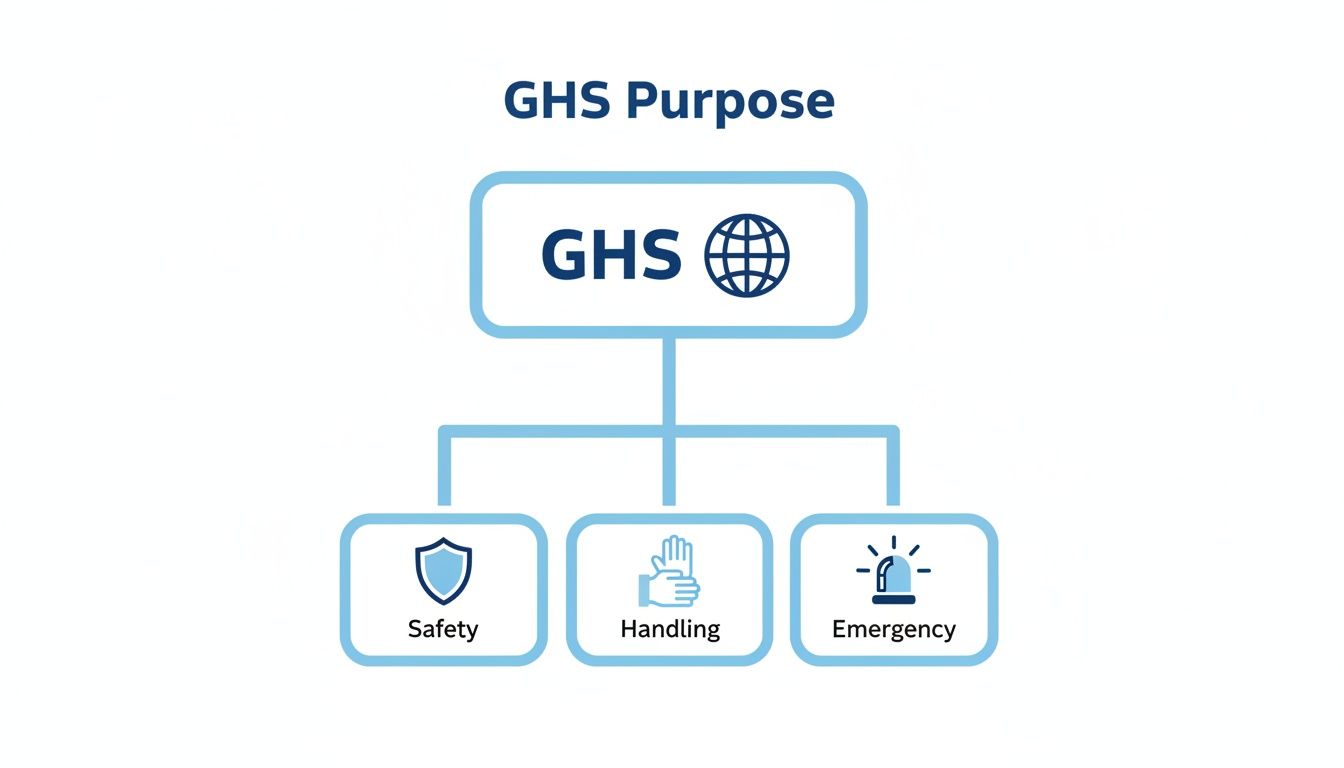
It visually breaks down the system's goals into three pillars: ensuring worker safety, guiding proper handling, and preparing for emergencies.
Sections 9-11: The Scientific Details
This next group of sections dives into the science of the substance. This technical data isn't just for chemists; it's the evidence and reasoning that underpins all the safety recommendations in the rest of the document.
Section 9: Physical and Chemical Properties Here you'll find the substance's physical data sheet: its appearance, odour, pH, flash point, boiling point, and so on. This information is vital for understanding how it will behave under different conditions.
Section 10: Stability and Reactivity This section describes the chemical's stability and warns you about conditions to avoid, like high temperatures, direct sunlight, or static discharge. It also lists any incompatible materials that could cause a dangerous reaction if mixed.
Section 11: Toxicological Information This is a detailed look at the health effects. It provides data on the likely routes of exposure (breathing it in, skin contact, etc.) and describes the symptoms associated with its physical, chemical, and toxicological characteristics.
Sections 12-16: The Bigger Picture
The final sections address the broader context of the chemical, including its environmental impact, disposal guidelines, and transport rules. To give you a clear overview, here's a quick breakdown of what each of the 16 sections covers.
Quick Guide to GHS SDS Sections and Their Purpose
| Section Number | Section Title | Primary Content and Purpose |
|---|---|---|
| 1 | Identification | Product identifier, manufacturer details, recommended use, and restrictions. |
| 2 | Hazard Identification | Hazard classification, pictograms, signal word, and hazard statements. |
| 3 | Composition/Information on Ingredients | Substance/mixture ingredients, including chemical names, CAS numbers, and concentrations. |
| 4 | First-Aid Measures | Instructions for immediate medical care by exposure route (inhalation, skin, eye, ingestion). |
| 5 | Fire-Fighting Measures | Suitable extinguishing media, specific hazards from combustion, and protective equipment for firefighters. |
| 6 | Accidental Release Measures | Personal precautions, environmental precautions, and methods for containment and clean-up. |
| 7 | Handling and Storage | Guidelines for safe handling and storage, including conditions to avoid and incompatible materials. |
| 8 | Exposure Controls/Personal Protection (PPE) | Occupational Exposure Limits (OELs), engineering controls, and required Personal Protective Equipment. |
| 9 | Physical and Chemical Properties | The substance's appearance, odour, pH, flash point, boiling point, and other physical data. |
| 10 | Stability and Reactivity | Chemical stability, conditions to avoid (e.g., heat), and incompatible materials. |
| 11 | Toxicological Information | Routes of exposure and description of health effects, including acute and chronic symptoms. |
| 12 | Ecological Information* | Potential environmental impact, including ecotoxicity and persistence. |
| 13 | Disposal Considerations* | Guidance on safe waste disposal methods and compliance with local regulations. |
| 14 | Transport Information* | Shipping details, including UN number, proper shipping name, transport hazard class, and packing group. |
| 15 | Regulatory Information | Safety, health, and environmental regulations specific to the product not covered elsewhere. |
| 16 | Other Information | Includes the date of the last revision and any other relevant information. |
Note: Sections 12-14 are not mandatory under OSHA's Hazard Communication Standard in the US but are required under GHS and other international regulations.
While workers might focus on Sections 7 and 8 for their daily tasks, EHS managers and logistics teams rely heavily on Sections 12-15 to ensure full compliance with environmental, transport, and waste regulations.
Finally, Section 16: Other Information acts as a catch-all for anything else, most notably the date of the last revision so you know if your copy is current.
By understanding these 16 sections, you can navigate any Safety Data Sheet with confidence, turning it from a compliance burden into a powerful tool for protecting your people.
Understanding Global GHS Regulations and Regional Differences
While the 'G' in GHS stands for 'Globally', its real-world application is anything but a simple copy-and-paste job across borders. Think of the Globally Harmonised System as a framework or a set of guidelines, not a rigid international law. Each country or region takes this framework and builds its own specific regulations on top of it.
This creates a complex patchwork of rules where what’s perfectly compliant in one country could be a major violation in another. For any business operating internationally, this isn't just a minor detail—it's a critical operational reality. A Safety Data Sheet that’s 100% valid in the United States could get your shipment stopped at a European port, leading to hefty fines, delays, or even product seizures. Treating safety data sheets ghs compliance as a one-size-fits-all strategy is a recipe for disaster.
The key is to see GHS as a set of building blocks. Regulators in different parts of the world pick and choose which blocks to use, and sometimes, they even add a few of their own.
Key Regulatory Frameworks You Need to Know
Several major regulatory systems drive GHS implementation around the world. Each has its own name and unique quirks, making it essential for supply chain and safety managers to know the rules for every region they operate in. It’s like they’re all speaking different dialects of the same GHS language.
- Europe (EU/EEA & UK): In the European Union, GHS is brought to life through the CLP Regulation (Classification, Labelling and Packaging) and the notoriously complex REACH (Registration, Evaluation, Authorisation and Restriction of Chemicals). Since Brexit, the UK has its own parallel systems: GB CLP and UK REACH.
- United States: The Occupational Safety and Health Administration (OSHA) aligns American workplace safety rules with GHS principles through its Hazard Communication Standard (HCS).
- Canada: Canada’s national standard is the Workplace Hazardous Materials Information System (WHMIS), which was updated back in 2015 to incorporate GHS.
While all these systems share the core 16-section SDS format, they diverge on some crucial requirements. For example, OSHA’s HCS doesn't require companies to complete Sections 12-15 (covering ecological, disposal, transport, and other regulatory information), but these sections are mandatory under the EU’s REACH regulation.
Why Regional Variations Matter in Practice
These differences aren't just on paper; they have very real consequences. A classic mistake is assuming an SDS from an American supplier is good to go for a European facility. It almost never is. The EU's REACH regulation, for instance, has far more demanding requirements for substance registration and the information that must be passed down the supply chain.
One of the biggest European variations is the extended Safety Data Sheet (eSDS). If you're in Belgium, REACH and GHS rules demand eSDSs for mixtures containing certain registered substances, which must detail specific exposure scenarios. This is no small matter. In 2023, Belgian importers registered 145,000 tonnes of chemicals, and a staggering 62% of that volume required these highly detailed eSDSs. Getting it wrong is expensive, with non-compliance hitting 12% of audited supply chains in Flanders and leading to 350 product recalls valued at a cool €18 million. You can learn more about the complexities of global GHS requirements on reach24h.com.
Other critical regional demands you can't ignore include:
- Language Requirements: In Canada, WHMIS mandates that all Safety Data Sheets and labels must be available in both English and French. No exceptions.
- Ingredient Disclosure: Different jurisdictions have their own rules about how to handle confidential business information (CBI) for ingredient concentrations listed in Section 3.
- Regulatory Updates: Each region updates its GHS alignment on its own schedule. OSHA recently updated the HCS to align with GHS Revision 7, but other countries might still be working from older or newer versions.
The core takeaway is this: A GHS-compliant SDS must be compliant for the specific region where the product is being sold or used. There is no such thing as a single, universally compliant Safety Data Sheet.
This regulatory maze highlights just how important it is to validate every incoming SDS against your local rules. It also means you need to understand the subtle but crucial differences in GHS label requirements as well. This diligence is what protects your organisation from compliance gaps and ensures your workers always have the correct, region-specific safety information they need to do their jobs safely.
Common GHS Compliance Pitfalls and How to Avoid Them
Trying to navigate the world of GHS compliance can often feel like you're walking through a minefield. Even organisations with what seem like solid safety protocols can stumble into common traps, leading to failed audits, hefty fines, and, most importantly, putting employees at risk. The first step to building a truly resilient chemical management system is understanding where things usually go wrong.
The most common mistake I see is companies accepting a supplier's Safety Data Sheet at face value without a second glance. A document can look perfectly official, but it might be years out of date, fail to meet local regulations, or be missing crucial information. Relying on outdated or incorrect safety data sheets ghs isn't just a paperwork problem; it means your risk assessments, PPE choices, and emergency plans could be based on dangerously flawed data.
And this isn't just a theoretical risk—it has very real financial consequences. Just look at the enforcement statistics from Belgium's regional authorities. A 2022 report revealed that 2,450 inspections led to 620 citations, and a quarter of those were for outdated or incomplete SDSs. The average fine was a staggering €12,500 per case. What's more, 70% of violations involved missing exposure scenarios in Section 8 or incorrect GHS classifications. You can explore more data on the global variations of SDS compliance and enforcement actions on sdsquantum.com.
Key Areas Where Compliance Breaks Down
Beyond simply outdated documents, a few other recurring issues often trip companies up during audits and inspections. Think of each one as a weak link in your chemical safety chain.
- No Centralised Management: Still using binders or scattered digital folders? This makes version control a nightmare. When a supplier sends an updated SDS, how can you be certain the old one is removed from every workstation and binder?
- Inadequate Employee Training: Giving people access to an SDS is only half the battle. If your team doesn’t know how to find, read, and apply the information in Sections 7 and 8, the document is essentially useless in a real-world scenario.
- Ignoring Regional Specificity: Trying to use a US-format SDS in a European facility is a direct violation of CLP and REACH regulations. Compliance is always local, and regulators will spot this immediately.
These failures almost always boil down to not having a systematic process for handling an SDS's lifecycle—from the moment you source a new chemical to when an employee needs to access it, and finally, to how it's archived.
A Practical Checklist for Validating Supplier SDS
To steer clear of these pitfalls, you need to be proactive. Don’t wait for an inspector to point out your mistakes. Instead, implement a simple but effective checklist for every new or updated SDS that comes through your door.
- Check the Revision Date: How recent is the SDS? Good practice is a review every three years, but it must be updated immediately if the chemical's formulation or hazard classification changes.
- Confirm Regional Compliance: Does the document explicitly state it complies with your local regulations (e.g., OSHA HCS, EU CLP/REACH, WHMIS)? Look for the specific legal text.
- Verify All 16 Sections Are Complete: Pay very close attention to Section 2 (Hazards), Section 3 (Composition), and Section 8 (Exposure Controls/PPE). Any missing data here is a massive red flag.
- Ensure Language and Formatting Are Correct: Is it in the required local language(s)? In Canada, for instance, this means providing both English and French versions.
A robust validation process transforms your SDS management from a passive library into an active defence mechanism. It's the gatekeeper that stops non-compliant and unsafe chemicals from ever entering your workplace.
Ultimately, the single most effective way to manage risks and avoid common GHS compliance pitfalls is to ensure your team is thoroughly prepared. Implementing an expert-level safety data sheets training program is crucial for giving your employees the skills to interpret and apply this vital safety information correctly, every single day. By combining systematic document validation with ongoing employee education, you build a culture where safety and compliance become second nature.
Modernising Your SDS Management with Automation
Are you still managing your Safety Data Sheets with overflowing binders and clunky spreadsheets? If that sounds familiar, you’re not just dealing with an inefficient system—you’re sitting on a major compliance risk. It’s time to stop chasing paperwork and embrace a modern, digital-first approach that turns SDS management from a chore into a proactive safety engine.
This means moving to a centralised platform that handles the entire lifecycle of your safety data sheets ghs. Instead of manually hounding suppliers for updates or wrestling with version control, a digital system becomes your diligent, always-on assistant. It ensures your chemical library is consistently accurate, accessible, and compliant.
From Manual Data Entry to Intelligent Automation
The real game-changer in a digital system is its power to take over the tedious, error-prone tasks. Picture this: a new SDS arrives in your inbox, and the system instantly captures it, pulls out all the essential data, and indexes it without anyone having to lift a finger. That's the power of automation.
These modern systems are smart enough to parse every section of an SDS, extracting critical information like:
- Product Identifiers and CAS numbers to build an accurate, searchable chemical inventory.
- GHS Hazard Classifications and Pictograms for at-a-glance risk identification.
- Revision Dates and Supplier Details to keep version control and contacts up-to-date automatically.
- PPE Recommendations from Section 8 to help you create practical, task-specific safety guides.
All this extracted data populates a central library that you can search in seconds. No more frantic page-flipping through a binder during an emergency or an audit. Your entire team gets the exact information they need, right when they need it, on any device.
Putting Safety Information Directly into Workers’ Hands
Let’s be honest, one of the biggest failings of the old binder system is accessibility. A binder locked in an office is completely useless to a worker on the factory floor who needs immediate first-aid information. This is a critical gap that automation closes by making safety data instantly available at the point of use.
A truly modern SDS management system doesn't just store documents; it delivers actionable safety intelligence precisely when and where it's needed most. This closes the dangerous gap between compliance paperwork and real-world application.
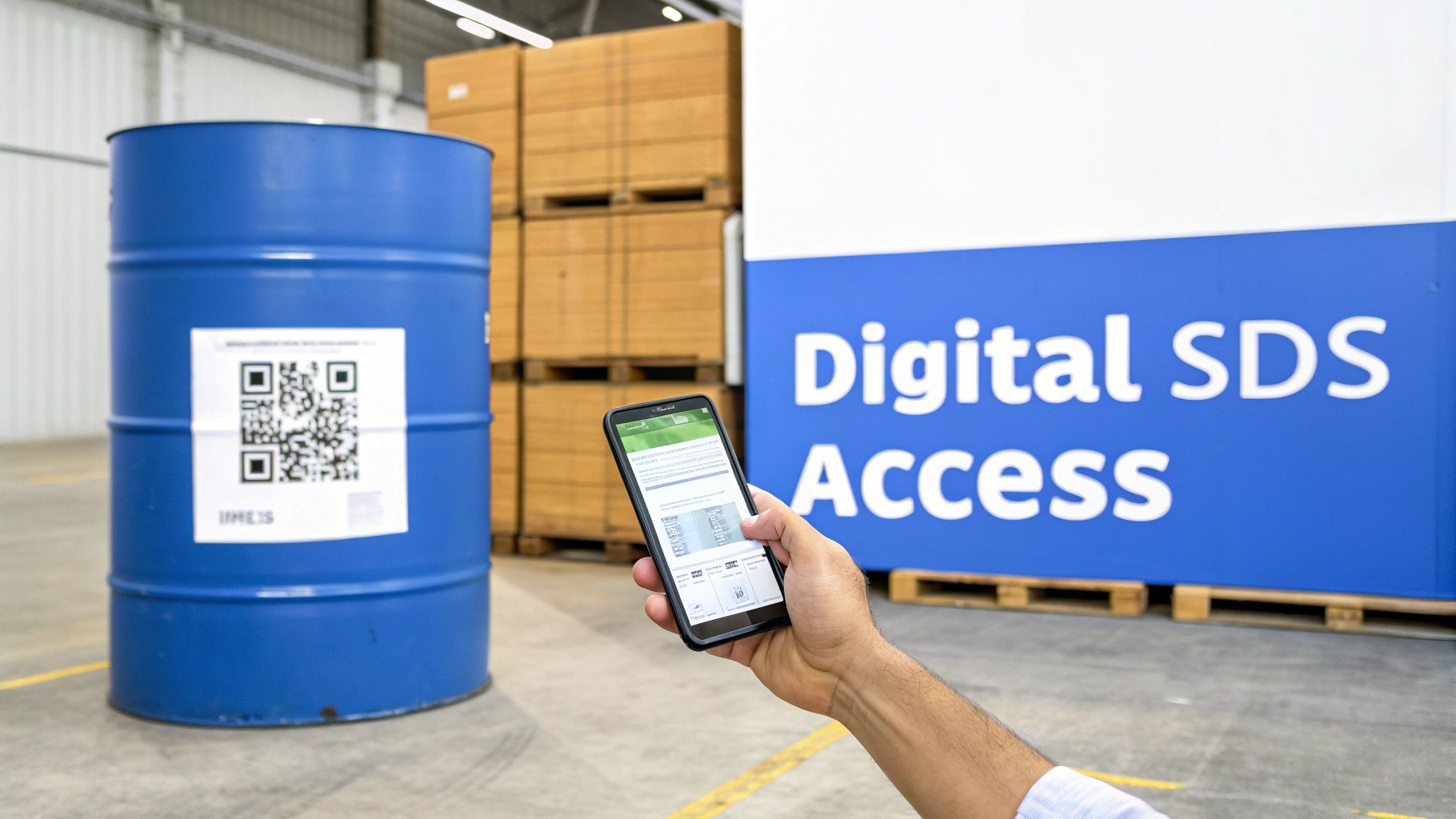
Imagine placing a QR code on every chemical container. A team member can simply scan it with their phone or tablet to instantly pull up the relevant SDS, a simplified safety summary, and specific PPE requirements. This direct access empowers employees to make safer decisions on the spot, drastically reducing the chance of incidents caused by a lack of information.
Creating a Connected Safety Ecosystem
The value of automation goes far beyond just managing the documents. When you integrate your SDS data with other critical safety workflows, you start building a fully connected ecosystem. This is where your EHS programme shifts from being reactive to genuinely proactive.
Think about the possibilities when your chemical data talks to your other systems:
- Automated Regulatory Screening: The system can automatically check every ingredient in your inventory against global watch lists like REACH’s SVHC list or other regional regulations, flagging restricted substances before they even make it through the door.
- Integrated Risk Assessments: Link SDS hazard information directly to your risk assessment tools. This lets you calculate exposure-based risk scores, track occupational exposure limits (OELs), and double-check that your controls are adequate for the specific chemicals in use.
- Smarter Inventory and Waste Management: Connect your SDS library to your inventory system to manage storage compatibility, flag separation requirements for reactive chemicals, and automatically generate accurate waste disposal documents.
By automating these processes, you free up your valuable EHS team from the grind of administrative tasks. Instead of spending their time chasing paper and updating spreadsheets, they can focus on high-value work like improving safety culture, conducting hands-on training, and implementing preventative measures. To see what this looks like in practice, explore our guide on choosing a safety data sheet management system. This isn't just an efficiency boost; it's a fundamental upgrade to your organisation's ability to protect its people.
GHS Safety Data Sheet FAQs
When you're dealing with GHS compliance day in and day out, the same questions tend to pop up. Whether you're in charge of the chemical store or using products on the factory floor, clear answers are vital for keeping everyone safe.
Here are some straightforward answers to the questions we hear most often about GHS Safety Data Sheets.
How Often Should a Safety Data Sheet Be Updated?
There’s no single, global rule for this, as the specifics change depending on where you are. But a solid rule of thumb that most experts stick to is reviewing your entire SDS library at least every three years. This helps catch anything that might have gone out of date.
However, an update isn't just a suggestion—it's mandatory when certain things happen. A supplier must send out a new SDS right away if:
- New data comes to light about the chemical's hazards.
- The product's formula or composition is changed in any way.
- New regulations are introduced that affect the information in the document.
For instance, in the US, OSHA’s Hazard Communication Standard gives suppliers a three-month window to issue an updated SDS after they learn of significant new hazard information.
What Is the Difference Between an SDS and a COSHH Assessment?
This is a really common question, especially for anyone working under UK regulations. The easiest way to remember the difference is to think of one as the information and the other as the action.
An SDS tells you what the hazards are. A COSHH assessment documents how you’re going to control them in your workplace.
The SDS comes from the chemical supplier or manufacturer. It's a standard document laying out all the inherent dangers and properties of their product. A COSHH (Control of Substances Hazardous to Health) assessment, on the other hand, is something the employer creates. You use the information from the SDS to figure out the real-world steps you need to take to protect your team, like installing ventilation or making sure everyone wears specific gloves for a certain task.
Who Is Responsible for Providing and Maintaining GHS Safety Data Sheets?
Responsibility for SDSs is a chain, and everyone has a part to play. It’s not just one person’s job; the duties are split between the company that supplies the chemical and the company that uses it.
It breaks down into two main roles:
- The Supplier: This includes the manufacturer, importer, or distributor. They have the legal responsibility to create the original, GHS-compliant SDS. It's their job to make sure it’s accurate and to provide it to anyone who buys the chemical from them.
- The Employer: Once the chemical is in your workplace, the responsibility shifts. As the employer, you have to get the SDS from the supplier, make sure you have the latest version, and—most importantly—make it easy for any employee who might be exposed to the chemical to find and read it. You also need to train them on what it all means.
So, one side creates and sends the document, while the other is responsible for managing it and putting its safety advice into practice.
Ready to stop chasing paperwork and modernise your chemical safety? NextSDS replaces outdated binders and spreadsheets with an automated platform that centralises your SDS library, monitors regulatory changes in real-time, and puts critical safety information directly into your team's hands. Discover how NextSDS can simplify your GHS compliance today.