

A well-structured safety data sheets template is the bedrock of your entire chemical safety programme. It's the key to making sure that crucial hazard information is laid out in a consistent, clear way, so your employees can find what they need in a pinch.
Why a Solid SDS Template Is Your Safety Linchpin
Let’s be honest, managing Safety Data Sheets can feel like a massive compliance headache. But a standardised, well-built template is more than just a box-ticking exercise—it’s the cornerstone of effective workplace safety. The globally recognised 16-section format isn't just a friendly suggestion; it's a mandatory standard that brings clarity and predictability to how we communicate hazards.

This consistency is vital for everyone. It helps the Environmental, Health, and Safety (EHS) manager putting together training programmes just as much as it helps the team member on the warehouse floor who needs to find first-aid measures, fast. When every SDS follows the same structure, finding information on personal protective equipment (PPE) or what to do in case of a spill becomes second nature.
The Real-World Impact of Inconsistency
Picture this: your logistics team gets two different shipments of the same industrial solvent, but from separate suppliers. One supplier’s SDS advises wearing standard safety glasses. The other, due to a slightly different formulation, specifies chemical splash goggles and a face shield. This conflicting advice immediately creates confusion and puts people at risk.
Without a consistent internal process for reviewing and validating supplier information, a worker could easily follow the weaker advice and end up with a serious eye injury. This kind of scenario really drives the point home: a strong safety data sheets template isn’t about creating more red tape. It’s about stamping out dangerous ambiguity.
A standardised approach removes guesswork. It ensures that your team receives clear, unified safety instructions for every hazardous substance they handle, protecting them from preventable injuries and your organisation from liability.
Beyond Compliance to Proactive Safety
Ultimately, a robust template system shifts your approach from simply reacting to compliance demands to proactively managing risk. It sets a clear baseline for all chemical information coming into your facility, which in turn makes it much easier to:
- Train employees effectively: Training becomes simpler and sticks better when the information is always found in the same place.
- Conduct accurate risk assessments: Standardised data means you can evaluate chemical hazards consistently across the whole organisation.
- Respond faster in emergencies: First responders and employees can quickly find the critical information in Sections 4, 5, and 6 without having to decode a unique document layout every time.
While a solid SDS template is a critical tool, it’s also part of a bigger picture. It's vital to stay informed about broader health and safety principles that support all your operational safety efforts. This comprehensive view ensures your documentation genuinely fosters a culture of safety, protecting both your people and your business from serious risks.
Building Your Compliant Template Section by Section
Creating a compliant Safety Data Sheet isn't about reinventing the wheel. It's more like methodical, precise construction. Each of the 16 Globally Harmonised System (GHS) sections has a very specific job, and the real key is understanding what information goes where—and how to phrase it. Get this right, and you'll have a document that’s not just compliant, but genuinely useful when things go wrong.
Let’s get into the blueprint.
Sections 1-3: Identification and Composition
Think of this first block of information as the product's identity card. It sets the stage by telling users exactly what the substance is and what's in it.
Section 1: Identification needs to include the product identifier that's actually on the label, along with any other names or codes. You'll also list its recommended use and any restrictions. Critically, this is where you put the full supplier details: name, address, phone number, and an emergency contact. A common slip-up I see is people using an internal product code that doesn't match the label. This causes immediate confusion for the end-user and can have serious consequences.
Section 2: Hazard Identification is, without a doubt, the most critical section for immediate safety. This is where you have to clearly state the GHS hazard classification (e.g., Flammable Liquid, Category 2; Acute Toxicity, Category 4), the correct signal word (Danger or Warning), all relevant hazard statements, and the corresponding pictograms. You also must include the precautionary statements for prevention, response, storage, and disposal. Vagueness is a huge risk here; simply writing "toxic" isn't good enough—you need the specific, official classification.
Section 3: Composition and Information on Ingredients breaks down the chemical makeup. For a single substance, you'll list its chemical name and CAS number. For a mixture, you must identify every hazardous ingredient above its concentration cut-off limit. This means providing the chemical name, CAS number, and either the exact percentage or a compliant concentration range for each. You can make trade secret claims, but be warned, they have to follow very strict regulatory rules.
Sections 4-6: Emergency Response Measures
When an incident happens, these are the first sections emergency responders will check. Clarity and accuracy are non-negotiable.
Section 4: First-Aid Measures must provide clear, actionable instructions for different exposure routes—inhalation, skin contact, eye contact, and ingestion. Describe the most important symptoms, both acute and delayed. Crucially, it must also include recommendations for immediate medical care. For instance, instead of the vague "seek medical attention," much better phrasing would be: "Rinse cautiously with water for several minutes. Remove contact lenses, if present and easy to do. Continue rinsing. Immediately call a POISON CENTRE or doctor."
Section 5: Firefighting Measures outlines exactly how to handle a fire involving the chemical. You have to specify suitable (and unsuitable) extinguishing media. It should also detail specific hazards that could arise during a fire, like toxic fumes, and recommend the right protective equipment for firefighters.
Section 6: Accidental Release Measures is the game plan for spills and leaks. It needs to cover personal precautions (like wearing specific PPE), protective equipment, and emergency procedures. It also needs to provide environmental precautions and describe practical methods for containment and clean-up. This has to be realistic. For a corrosive liquid, you might specify using an inert absorbent like sand or vermiculite.
Sections 7-8: Handling and Exposure Control
Here, the SDS shifts from emergency response to proactive, day-to-day safety. It’s all about preventing incidents from happening in the first place.
Section 7: Handling and Storage offers guidance on safe practices to minimise risk. This includes advice like "use only outdoors or in a well-ventilated area" and general hygiene measures such as "do not eat, drink or smoke when using this product." It also details the conditions for safe storage, pointing out any incompatibilities. A common mistake here is being too generic. Specifying "store away from strong oxidising agents" is far more helpful than "store in a safe place."
Section 8: Exposure Controls and Personal Protection is where you lay out the limits and equipment needed to keep workers safe. You must list any applicable Occupational Exposure Limits (OELs), like the Time-Weighted Average (TWA) or Short-Term Exposure Limit (STEL) values. Then, you detail appropriate engineering controls, such as local exhaust ventilation.
Finally, it must specify the exact Personal Protective Equipment (PPE) required:
- Eye/face protection: e.g., "Wear safety glasses with side-shields."
- Skin protection: e.g., "Wear chemically resistant gloves (e.g., nitrile rubber)."
- Respiratory protection: e.g., "If exposure limits are exceeded, wear a NIOSH-approved respirator with an organic vapour cartridge."
Pro Tip: Always specify the type of material for gloves or the type of respirator cartridge. Simply stating "wear gloves" is not compliant or protective. Different chemicals will eat through different materials in minutes.
Sections 9-11: Physical and Toxicological Properties
These sections get into the core scientific data. While it can look technical, this information is absolutely vital for conducting proper risk assessments and truly understanding the chemical's behaviour.
Section 9: Physical and Chemical Properties is a list of data points like appearance, odour, pH, flash point, and vapour pressure. GHS specifies at least 18 properties, and if the data for one isn't available, you have to state that explicitly.
Section 10: Stability and Reactivity describes the chemical's stability under normal conditions and any potential hazardous reactions. This includes conditions to avoid (like heat or direct sunlight), incompatible materials, and any hazardous decomposition products.
Section 11: Toxicological Information is a detailed summary of the substance's health effects. It covers routes of exposure, symptoms, delayed and immediate effects, and numerical measures of toxicity (like LD50 or LC50). It also must state whether the chemical is a known carcinogen, mutagen, or reproductive toxin. If you're finding this section a bit dense, our guide on how to read a safety data sheet can help clear things up.
Sections 12-16: Ecological, Disposal, Transport and Other Information
This final block of sections addresses the chemical's wider impact and regulatory status, ensuring it's managed responsibly from cradle to grave.
Section 12: Ecological Information (which is non-mandatory in some jurisdictions like OSHA's) covers the substance's environmental impact, including its ecotoxicity, persistence, and bioaccumulative potential.
Section 13: Disposal Considerations provides guidance on how to get rid of waste safely. It should describe appropriate disposal containers and methods, and point to any relevant local or national regulations.
Section 14: Transport Information is crucial for anyone in logistics and shipping. It must include the UN number, proper shipping name, transport hazard class(es), and packing group. It might also need to specify any environmental hazards for transport or special precautions for the user.
Section 15: Regulatory Information lists any other safety, health, and environmental regulations specific to the product that haven't been mentioned elsewhere. This is where you’d note things like TSCA inventory status in the US or REACH authorisations in the EU.
Finally, Section 16: Other Information is the catch-all for anything that doesn't fit neatly elsewhere. This includes the date of the latest revision, a key to abbreviations used in the SDS, and the main sources of data. Documenting the revision date here is absolutely essential for proper version control.
Getting to Grips with Global Compliance Using a Flexible Template
Having a solid, GHS-compliant safety data sheets template is the bare minimum to even get in the game. But if you want to compete on the world stage, that alone won't cut it. The minute your products cross a border, you’re playing by a whole new set of rules. An SDS that’s perfectly fine for the United States can fall completely flat in the European Union, and the other way around.
We’re not talking about small formatting preferences here; we’re talking about fundamentally different legal obligations. Trying to use a rigid, one-size-fits-all approach is just asking for trouble—think rejected shipments, eye-watering fines, and a hit to your reputation. For any company with international ambitions, a flexible template that can adapt to these global variations isn't just nice to have; it's essential.
EU REACH and CLP Versus North American Standards
The biggest headaches often pop up when you compare the EU's regulatory maze with the systems in North America. The EU’s REACH (Registration, Evaluation, Authorisation and Restriction of Chemicals) and CLP (Classification, Labelling and Packaging) regulations are famous for being incredibly detailed and strict.
For example, in the EU, you absolutely must include REACH registration numbers in Section 1 of an SDS if a substance is made or imported in amounts over one tonne a year. Take that a step further—for hazardous substances supplied over ten tonnes per year, you might need what’s called an "extended SDS" (e-SDS). This includes detailed exposure scenarios, which are specific annexes that spell out exactly how the substance can be handled safely to protect workers, consumers, and the environment.
These requirements simply don't exist under OSHA's Hazard Communication Standard (HCS) in the US or Canada's Workplace Hazardous Materials Information System (WHMIS). A template built only for North America would have no space for this critical information, making it instantly non-compliant in the EU.
A Real-World Export Scenario
Let's walk through a common situation. Imagine a chemical manufacturer in Belgium wants to start exporting a cleaning solution to Canada. Their current SDS is completely buttoned up according to EU CLP rules. But to get their product onto Canadian shelves, they have to tweak their documents to satisfy WHMIS requirements.
This means making several key changes:
- Bilingual Requirements: The Canadian SDS and the product label have to be in both English and French. No exceptions.
- Supplier Identification: The SDS must name the Canadian importer, providing their contact details, not just the original European manufacturer.
- Hazard Class Nuances: While both systems are built on GHS, WHMIS has some unique hazard classes, like "Biohazardous Infectious Materials," that have to be addressed.
The core chemical data from their EU template is still perfectly good, but these local additions are non-negotiable. This is where a flexible safety data sheets template saves the day. It allows them to spin up a Canadian version by adding the necessary fields without having to rebuild the entire document from the ground up.
The best practice is to build your template with adaptable sections. It should let you switch specific fields on or off for different regions—like REACH registration numbers for the EU or bilingual fields for Canada—so you can generate a compliant document every single time.
This concept map shows how a core template can act as a foundation, branching out to address the specific GHS sections that matter most for different compliance needs, like hazard identification, PPE, and transport information.
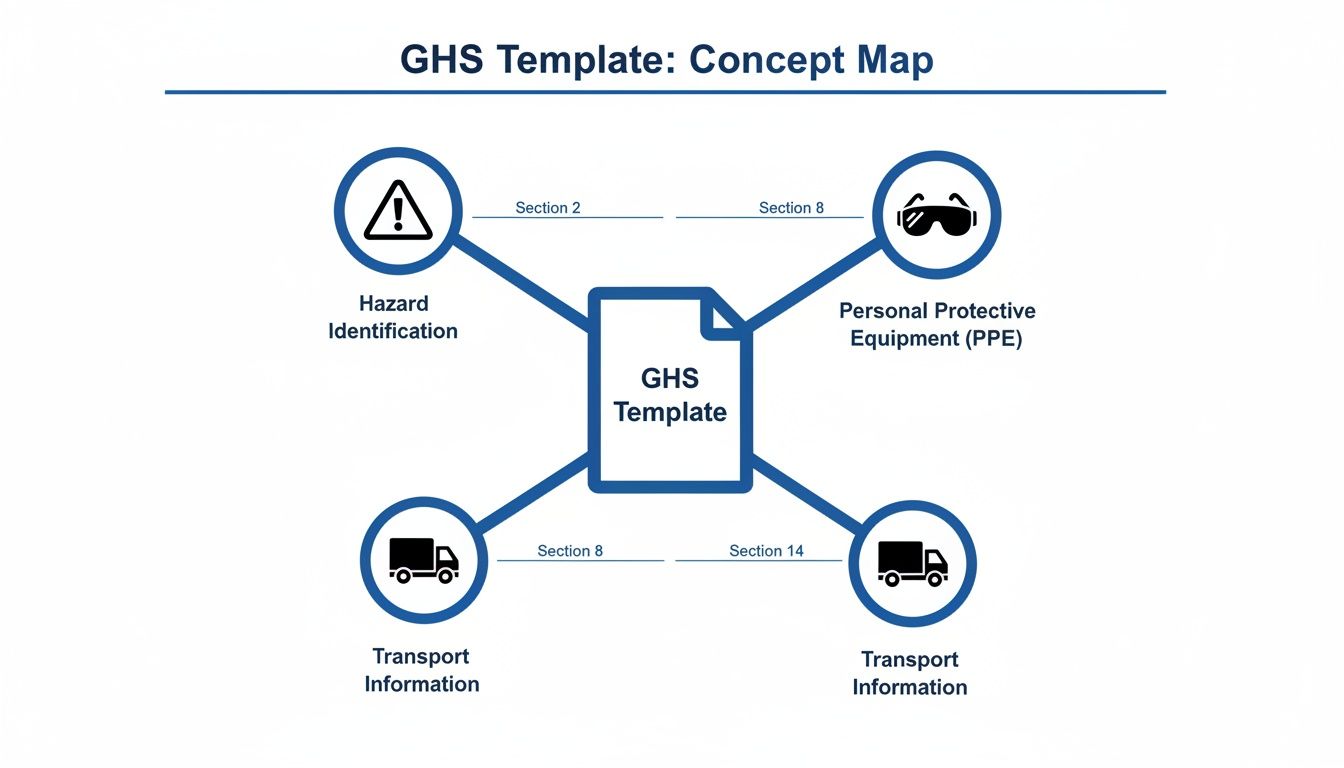
It’s a great visual reminder that while the GHS structure provides a universal framework, the fine print within key sections has to be tailored to meet local safety and transport rules.
A Practical Model from Belgium
In Belgium, particularly in the high-density industrial region of Flanders, the careful management of Safety Data Sheets under REACH and CLP has been a game-changer for industrial safety. As far back as 2010, they began using Spatial Safety Reports to assess risks around high-risk industrial sites. This approach ensures that data from an SDS directly informs public safety and even land-use planning decisions, proactively using information to reduce work-related incidents.
Creating a template that’s ready for the global market requires a real understanding of these regional differences. If you want to get into the weeds of GHS and its implementation, you might find our comprehensive overview of GHS and SDS standards helpful. At the end of the day, successfully juggling multi-jurisdictional demands with an adaptable framework is what keeps you out of trouble and maintains a strong compliance record worldwide.
Keeping Your SDS Library Alive: Version Control and Supplier Checks
Having a solid safety data sheets template is a great starting point, but it's just that—a start. The real challenge, and where safety truly lives or dies, is in the day-to-day management of those documents. Keeping them current through version control and supplier validation isn't just about ticking boxes; it's a fundamental part of keeping your people safe.

I've seen firsthand what can go wrong when this is overlooked. A client I worked with once operated with an outdated SDS for over a year. During that time, a primary ingredient in a widely used solvent was reclassified as a carcinogen. Suddenly, all their PPE recommendations, handling procedures, and risk assessments were dangerously wrong. Their team was exposed to a serious long-term health risk, and nobody even knew. It’s a sobering reminder that you have to be proactive.
A Simple System for Tracking Versions
Good version control doesn't need to be complex. In fact, the simpler, the better. A straightforward numerical system is usually the most reliable way to track changes and maintain a clear history.
Here’s a common-sense approach:
- Major Revisions (v1.0, v2.0): Roll over to a new whole number for big changes. Think product reformulations, major updates to GHS, or new toxicological data that changes a substance's hazard classification.
- Minor Updates (v2.1, v2.2): Use decimals for the small stuff. This could be anything from updating a supplier’s phone number to adding a new occupational exposure limit or clarifying some first-aid instructions.
For every single change, you need a record. A simple change log that notes what was updated, why, and when is invaluable. It’s your proof for both internal audits and regulatory inspections that you have a serious process for keeping information accurate.
The Supplier Validation Workflow
You can't force a supplier to update their SDS, but you absolutely can control what comes into your system. A rigorous validation workflow is your front line of defence against bad information. Every time a new SDS arrives, it should be put through its paces before it’s filed away.
A supplier’s SDS is only as good as your process for verifying it. Don’t just file it away—scrutinise it. This simple step transforms your SDS library from a passive repository into an active safety tool.
Your checklist should confirm a few critical points:
- Revision Date: First things first, is this version newer than what you already have? Regulators like OSHA require manufacturers to send updated sheets as soon as they have new information.
- Completeness: Are all 16 mandatory sections actually there and filled in? Blank sections are a huge red flag.
- Local Compliance: Does the SDS meet the rules for your specific region? If you’re in the EU, are there REACH registration numbers? For Canada, are the WHMIS hazard classes listed? You can dive deeper into this in our guide on ensuring safety data sheet compliance.
- Consistency: Does the product name on the SDS perfectly match the label on the container? Do the pictograms in Section 2 line up with the hazard statements?
This isn't just theory. Look at a country like Belgium, where the chemical industry is a massive part of the economy. They rely on tightly controlled SDS templates to manage risks across more than 1,200 high-risk industrial sites. This commitment to data validation has helped Belgium achieve a worker non-fatal injury rate of just 2.3 per 100,000, which is far better than many of its neighbours. A key factor is the mandated toxicological summaries in Section 11, proving how detailed data saves lives. You can read more about how road and industrial safety are linked in Belgium.
Turning Your SDS Library into Actionable Intelligence
A library of safety data sheets is a regulatory must-have, but let's be honest—it often turns into a digital graveyard of forgotten PDFs. The real magic happens when you stop thinking of it as a collection of documents and start treating it as a dynamic safety system. This is precisely where modern SDS management platforms come in, bridging the gap between simply having the documents and having genuine, actionable intelligence.
The old way of doing things? Messy spreadsheets and endless manual data entry. It was painfully slow and, more importantly, a recipe for human error. Today’s tools, however, can automatically scan and pull critical data from any supplier SDS, regardless of the format. This means your central, searchable library gets populated without an EHS manager having to type a single CAS number.

This process of scanning and digitising information is about more than just convenience. Automation doesn't just save time; it builds a solid, reliable data foundation that lets you make smarter, faster safety decisions.
From Reactive Filing to Proactive Risk Management
Just think about the efficiency boost. Instead of painstakingly cross-referencing chemicals against regulatory lists by hand, the system handles it for you. A good platform can send you an instant alert the moment a substance in your inventory gets added to a list like the REACH Substances of Very High Concern (SVHC). This single feature transforms your safety programme from being reactive to truly proactive, helping you get ahead of compliance headaches before they even start.
I’ve seen EHS managers make the switch from a chaotic shared drive to a dedicated platform, and the difference is night and day. Previously, finding the right PPE for a specific chemical meant digging through folders, opening half a dozen PDFs, and just hoping the information was up to date.
With an automated system, that entire process becomes instant:
- A Searchable Database: A quick search pulls up the exact chemical and all its safety data in seconds.
- Mobile Access: Your team on the floor can get crucial information right on their phones, right where they need it.
- Instant Alerts: You’re automatically flagged when regulations change or a supplier issues a new SDS version.
The real aim is to get the right information into the right hands at the right time. An intelligent SDS platform makes safety information immediate and accessible, not something buried in a filing cabinet or a forgotten folder.
Making Safety Instantly Accessible
To really bring your SDS library to life, you have to think about digital access. Learning how to create a QR code for your PDF documents is a game-changer. It gives your team instant mobile access to safety information directly from a product label or workstation. A worker could simply scan a code on a container with their phone and immediately see first-aid measures or required PPE, all without leaving their post.
This represents a fundamental shift in how we should view safety documentation. It’s no longer just about storing paperwork to tick a compliance box. It’s about building a responsive, intelligent system that actively helps you manage risk, improve efficiency, and most importantly, keep your people safe in real-time. The immediate gains in productivity and proactive compliance speak for themselves.
Common Questions About Safety Data Sheet Templates
Even with a solid system, a few practical questions always seem to pop up when you're in the weeds creating and managing safety data sheets. Let's get straight to the point and tackle some of the most common queries I hear from safety professionals.
How Often Should My SDS Template Be Reviewed?
Think of it in two parts: the template and the individual documents.
Your master safety data sheets template—the blank framework you use—should get a check-up at least once a year. It's also smart practice to give it a fresh look whenever major regulations shift, like when a new GHS revision is officially adopted in a region you sell to.
The actual SDS documents for your products, however, are a different story. They need to be revised the moment any new hazard information comes to light or if you've tweaked the product's formulation. A good habit is to proactively ask your suppliers for updated SDSs every one to three years. This simple step helps ensure you aren't caught off guard by old data, especially since regulators expect manufacturers to update their documents as soon as significant new information is known.
What Is the Difference Between an SDS and a CoA?
This is a common point of confusion, but the distinction is critical. These two documents serve completely different functions and you can't substitute one for the other.
- A Safety Data Sheet (SDS) is a legal requirement. Its job is to communicate a chemical product's hazards and provide clear guidance on safe handling, storage, and emergency procedures.
- A Certificate of Analysis (CoA) is all about quality assurance. It's a document that confirms a specific batch of a product meets its promised quality specifications, like purity or concentration.
The easiest way to remember it is: the SDS is for safety and compliance, while the CoA is for quality control. You'll often need both, but they answer very different questions.
Can I Just Use My Supplier's SDS?
This is a big one, and the answer hinges entirely on what you do with the chemical once it's in your hands.
If you are simply using the chemical product exactly as you bought it, then yes, you should absolutely use the SDS your supplier provided. There’s no need to reinvent the wheel.
However, the second you modify, mix, or repackage that substance into a new product that you sell under your own brand, the game changes. You are now considered the manufacturer in the eyes of the law. This means you are legally obligated to author a new, compliant SDS for your final mixture. Just stapling the ingredient SDSs together won't cut it—you have to evaluate the hazards of the final product and create a new document from scratch.
Trying to juggle all these details manually can quickly become overwhelming. This is where a dedicated platform like NextSDS can be a lifesaver. It automates everything from supplier validation and version control to authoring and regulatory monitoring, making sure your SDS library is always compliant and ready to use.
Learn how NextSDS can simplify your chemical safety management.