

In the world of chemical safety, GHS and SDS are the two cornerstones that keep everyone, from the loading dock to the lab, informed and protected. Think of them as a team: the Globally Harmonized System (GHS) sets the universal rules and symbols for identifying chemical hazards, while the Safety Data Sheet (SDS) gives you the detailed, product-specific game plan based on those rules.
Your Guide to Chemical Safety GHS and SDS
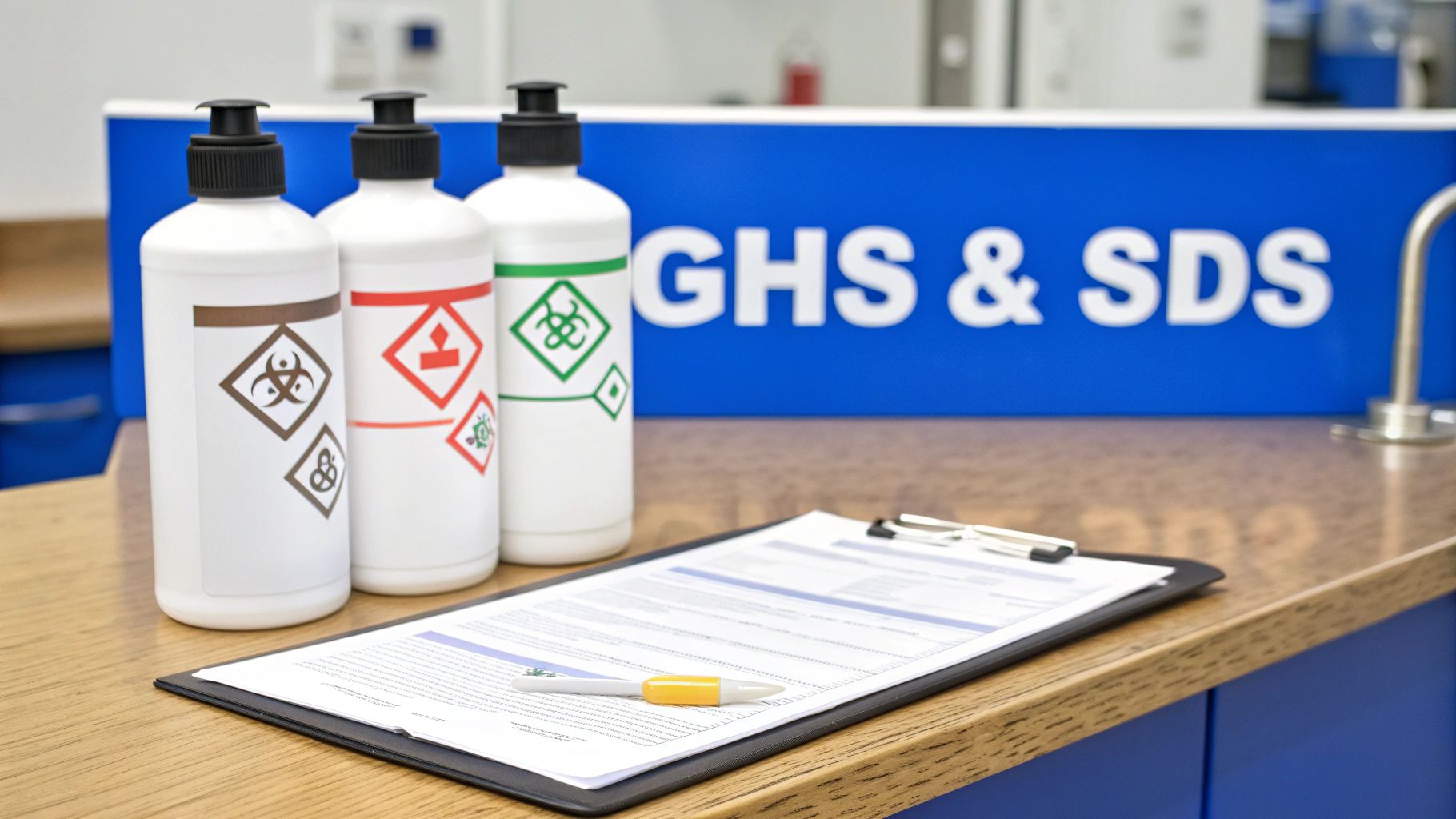
Imagine trying to navigate a foreign city where every street sign is in a different language and uses unique symbols. It would be confusing, slow, and downright dangerous. For decades, that was the reality of chemical hazard communication, with every country using its own playbook for classifying and labeling hazardous materials.
To fix this global communication breakdown, the United Nations developed the Globally Harmonized System of Classification and Labelling of Chemicals (GHS). It's crucial to understand that GHS isn't a law itself. Instead, it’s a standardized framework—a common language—that countries can adopt and write into their own regulations. It's the international rulebook for how we talk about chemical safety.
The Role Of GHS
The main goal of GHS is simple: create consistency. It lays out clear criteria for classifying chemical hazards and standardizes how that information shows up on labels and safety data sheets. This system is built on a few key components:
- Standardized Pictograms: These are the nine universal symbols that give you an immediate visual heads-up about a specific hazard, like the familiar skull and crossbones for acute toxicity or the flame for flammability.
- Signal Words: Simple but powerful words like "Danger" or "Warning" are used to quickly communicate the severity of the hazard.
- Hazard and Precautionary Statements: These are standard phrases that spell out the nature of the hazard and recommend specific steps to take to prevent or minimize harm.
To quickly see how these two systems work together, here’s a simple breakdown.
GHS vs SDS At a Glance
This table offers a quick comparison of the roles GHS and SDS play in chemical safety, clarifying their relationship for easy understanding.
| Aspect | Globally Harmonized System (GHS) | Safety Data Sheet (SDS) |
|---|---|---|
| Purpose | A universal framework for classifying and communicating chemical hazards. | A detailed, product-specific document providing comprehensive safety information. |
| Scope | Global standard (a "common language"). | Specific to one chemical product from one manufacturer. |
| Format | Provides the rules for labels and SDS, including pictograms and signal words. | A mandatory 16-section format dictated by GHS rules. |
| Analogy | The grammar and vocabulary of the safety language. | A detailed instruction manual written in that safety language. |
This table shows that while GHS provides the overarching system, the SDS is where that system is put into practice for a specific product.
From MSDS to SDS
Before GHS became the global standard, the go-to safety document was the Material Safety Data Sheet (MSDS). While it served a purpose, the MSDS format could vary wildly between manufacturers and countries, often leading to critical information getting lost in the confusion.
The adoption of GHS brought a much-needed change: a strict, 16-section format for all safety documentation, which we now call the Safety Data Sheet (SDS). This shift from the inconsistent MSDS to the standardized SDS was a massive leap forward for workplace safety.
This standardized structure means that employees, emergency responders, and safety managers can find the exact information they need—fast. Whether you're looking for first-aid measures or firefighting instructions, you'll always know which section to check.
The SDS is the practical application of GHS principles. It's the comprehensive instruction manual where the GHS framework meets the real world, delivering actionable safety information for everyone in the supply chain. For a deeper look into each of the 16 sections, you can explore our complete guide on what is a safety data sheet.
Navigating Global Differences in GHS Compliance
It's a common and dangerous mistake to think that “Globally Harmonized System” means “globally identical.” While GHS provides a brilliant framework for chemical safety, it’s not a strict, universal law. Think of it more like a shared recipe book. Each country gets to be the chef, deciding which parts of the recipe to use and adding its own local ingredients.
This is what’s known as the GHS “building block” approach. The United Nations offers a complete set of hazard classifications and communication rules, but it’s up to individual countries to decide which “blocks” they want to implement into their own national regulations. This built-in flexibility allows nations to adapt the system to their specific industrial needs and existing laws.
The end result? A chemical product with an SDS and label that are perfectly compliant in the United States might get you flagged for non-compliance in the European Union or Canada. For any company operating internationally, this creates a complex web of regulatory headaches that can cause shipping delays, fines, and—most importantly—put people at risk.
Why One SDS Does Not Fit All
For any HSE or procurement manager, getting a handle on these regional differences is absolutely critical. A Safety Data Sheet isn't a "one and done" document; it has to be tailored to the specific jurisdiction where the chemical is actually being used.
A major reason for the differences comes down to timing. The GHS is updated periodically, with new revisions released every two years, but countries adopt these updates on their own schedules.
- The United States, through OSHA's Hazard Communication Standard (HCS), is currently aligned with GHS Revision 7.
- The European Union, under its CLP regulation, often operates on a different revision timeline and folds in its own extensive requirements, like those from REACH.
- Canada’s system, WHMIS, has also moved to align with GHS Revision 7 but still keeps its own unique Canadian twists.
This staggered adoption means that hazard classifications, precautionary statements, and even the pictograms on a label can change significantly from one country to the next. You can see how these variations impact product identification in our comprehensive guide to GHS labeling requirements.
Deeper Regulatory Divergence
It’s not just about different GHS revisions, either. Countries often add their own unique regulatory layers on top, which usually reflect national priorities around environmental protection, transportation safety, and public health.
Despite the "Globally Harmonized System's" goal to create a uniform standard, the reality is that significant differences persist in how SDS requirements are implemented. Each country has the autonomy to pick which GHS revision to adopt and to add its own rules for transportation, environmental impact, and toxicological limits. This "building block" approach has created a complex web of compliance requirements that is anything but truly harmonized.
For example, an SDS in the EU must often include REACH registration numbers and detailed environmental hazard information that simply isn't required on a US-based SDS. In the same vein, some jurisdictions have much stricter rules about what can be claimed as confidential business information (CBI) or have different occupational exposure limits (OELs).
Here are a few common areas where GHS and SDS compliance tends to split:
- Environmental Hazards: The EU's CLP regulation places a much stronger emphasis on environmental classifications compared to OSHA's HCS in the US.
- Physical Hazard Classifications: Some countries may choose not to adopt certain GHS physical hazard categories, like pyrophoric gases, if they aren't relevant to their national industries.
- Update Timelines: When new hazard information becomes available, the clock starts ticking to update the SDS—but the deadline varies. The US, for instance, gives you 90 days, while other regions may have different timeframes.
- Language and Formatting: An SDS must be provided in the official language(s) of the country where the product is sold. Even small formatting details can differ based on how local regulators interpret the rules.
For any organization that operates across borders, managing these variations is not just a best practice—it's a legal requirement. Trying to use a single, generic SDS for all your global operations is a surefire way to run into non-compliance, exposing your business to serious operational and safety liabilities. This reality makes a robust system for managing multiple, region-specific SDS documents an absolute necessity.
The 16 Sections of an SDS Explained
A Safety Data Sheet can look intimidating, but its standardized 16-section format is actually designed to make your life easier. It’s not just a compliance document to be filed away; it’s a practical, often life-saving guide for anyone who works with chemicals. Each section is there to answer a specific question you might have about handling, storing, or responding to an incident.
Let’s walk through the SDS, not as a long, dry list, but as a logical flow of information. We'll start with what you need to know in an emergency and then move into the details for safe daily operations.
What Is This and What Do I Do Right Now? (Sections 1-6)
This first block of sections is all about immediate identification and emergency response. If a spill happens or someone is exposed, this is where you’ll find the critical, need-to-know information for fast action.
Section 1: Identification This answers the most fundamental questions: What is this stuff, who made it, and who do I call if something goes wrong? You'll find the product name, manufacturer contact info, and an emergency phone number.
Section 2: Hazard Identification Think of this as the "at-a-glance" summary of the dangers. It contains the GHS pictograms, a signal word like "Danger" or "Warning," and clear hazard statements (e.g., "Causes severe skin burns").
Section 3: Composition/Information on Ingredients This is where you find out what's actually in the container. It lists the chemical ingredients and their concentration ranges—vital information for medical professionals and safety managers.
Section 4: First-Aid Measures For front-line employees, this is one of the most important sections. It gives clear, step-by-step instructions on what to do for exposure via inhalation, skin or eye contact, or ingestion.
Section 5: Fire-Fighting Measures If the chemical is flammable, this section tells you how to fight a fire involving it. It specifies the right extinguishing tools (water, foam, dry chemical) and warns of any toxic fumes that could be released.
Section 6: Accidental Release Measures This is your cleanup playbook. It outlines exactly how to contain and clean up spills or leaks, including what PPE to wear and how to keep the chemical out of drains and waterways.
How Do I Handle and Store This Safely? (Sections 7-10)
Once you've got a handle on the immediate dangers, the next set of sections shifts focus to long-term safety and prevention. This is your guide to day-to-day safe handling, storage, and personal protection.
The real power of an SDS is in proactive safety, not just reactive response. Sections 7 through 10 are what turn this document from an emergency guide into a daily operational tool, giving you the playbook to prevent incidents from happening in the first place.
Section 7: Handling and Storage This section gives you practical advice on how to handle the chemical safely and what the ideal storage conditions are. It also warns you about storing it near incompatible materials that could cause a dangerous reaction.
Section 8: Exposure Controls/Personal Protection This is where you’ll find the specific Personal Protective Equipment (PPE) you need, like certain types of gloves, safety glasses, or respirators. It also lists Occupational Exposure Limits (OELs) that define the maximum safe concentration of a chemical in the air.
Section 9: Physical and Chemical Properties Here you’ll find the technical specs of the substance—its appearance, odor, pH, boiling point, and so on. This data is key to understanding how the chemical will behave in different situations.
Section 10: Stability and Reactivity This section essentially tells you what not to do with the chemical. It identifies conditions to avoid (like high heat or direct sunlight) and other substances it could react dangerously with.
What Are the Long-Term Details? (Sections 11-16)
The final group of sections gets into the highly technical weeds. This information is primarily for health and safety professionals, medical experts, and environmental regulators. While you might not need it for daily tasks, it's essential for a full risk assessment.
Section 11: Toxicological Information This provides in-depth data on the chemical's health effects, covering routes of exposure and symptoms of both short-term (acute) and long-term (chronic) exposure.
Section 12: Ecological Information This section details the chemical’s potential impact on the environment, like its toxicity to fish and other aquatic life. (Note: This section is recommended by GHS but not mandatory for OSHA compliance in the US).
Section 13: Disposal Considerations Here, you'll find guidance on how to get rid of the chemical waste properly and in accordance with local and national regulations.
Section 14: Transport Information This contains all the classification information needed for shipping the chemical safely by road, rail, air, or sea.
Section 15: Regulatory Information This section lists any other national or regional safety, health, and environmental regulations that apply specifically to the product.
Section 16: Other Information This final catch-all section includes the date the SDS was created or last updated, and it may contain any other useful information not covered elsewhere.
Why Modernizing Your SDS Management Is No Longer Optional
Let's be honest, the days of managing chemical safety with dusty binders and sprawling spreadsheets are over. For a long time, that was just how things were done. But in today's world, clinging to those manual systems isn't just inefficient—it's a serious compliance risk and a major drag on your operations.
The world of chemical regulations isn't standing still. It's constantly shifting, with new rules and updates rolling out all the time. Trying to keep up manually is like trying to navigate a new city with a 10-year-old paper map. You're going to get lost, and the consequences could be serious. A single outdated document can lead to someone using the wrong PPE, handling a chemical incorrectly, or failing a regulatory audit. That puts your people in danger and your company on the hook for hefty fines.
The Crushing Weight of Manual Compliance
The biggest problem with manual SDS management is that it forces you to be reactive. Too often, an HSE manager only finds out an SDS is out of date during a frantic pre-audit scramble or, far worse, after an accident has already happened. This approach leaves dangerous, preventable gaps in your safety program.
You also see a lot of communication breakdowns between departments that don't talk to each other. A procurement manager might order a new chemical, completely unaware that it's on a restricted substance list. Suddenly, the safety team is left scrambling to figure out compliance after the substance is already on-site. It's a classic case of creating unnecessary work and inviting risk into the workplace.
The sheer volume of information alone makes manual tracking a losing battle. A typical facility might have hundreds, if not thousands, of chemicals. Each one has its own SDS that needs to be checked and updated periodically. Without a good system, keeping track of every revision date and regulatory change becomes a full-time, soul-crushing administrative nightmare.
Juggling Deadlines and Global Complexity
The pressure to modernize is even greater when you consider how global GHS regulations are rolled out. Different countries adopt new revisions on their own staggered timelines, which adds layers of complexity. The push toward mandatory GHS and SDS formats is a direct result of regulators demanding better, more dynamic communication about chemical hazards. This means you have to hunt down and replace old MSDS documents and, in many cases, maintain different SDS versions for different countries. You can find more details about how GHS revisions impact compliance on sdsmanager.com.
For any company that operates in more than one country, manual management is simply no longer a realistic strategy. The risk of using a non-compliant SDS in a specific region is just too high, which builds a rock-solid business case for a central, automated system.
A binder or a spreadsheet can't handle this level of detail. It can’t flag when a chemical’s classification changes in Europe but not in Canada, or automatically alert you when a supplier issues a revised SDS. This is precisely where modern, automated platforms make all the difference. They help you shift from a reactive, paper-shuffling approach to a proactive, digital strategy that truly protects your people and your business.
How Automation Makes GHS and SDS Compliance Effortless
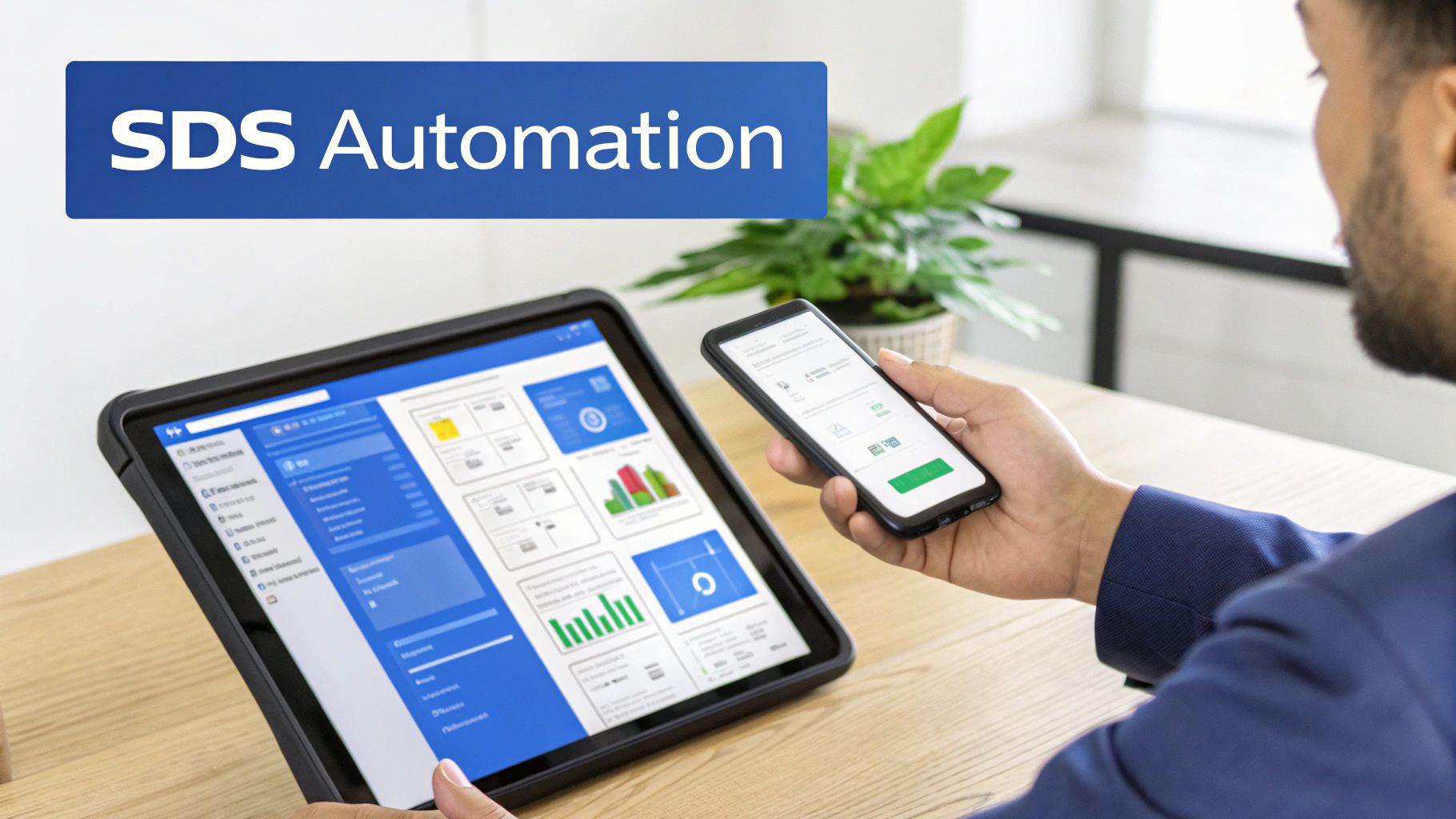
If you've ever managed SDSs manually, you know the drill: outdated binders, regional compliance headaches, and a constant struggle to keep teams on the same page. It’s a huge operational drag. Modern platforms flip this script, turning a reactive chore into a proactive, well-oiled workflow. Instead of chasing paperwork, your teams can focus on what really matters—keeping people safe.
Think of these systems as a central command center for all your chemical safety information. The biggest win is moving away from scattered files and into a single, searchable, and always-up-to-date digital library. This simple shift gets rid of the guesswork and makes sure everyone is working from the same accurate data.
Building an Intelligent Chemical Library
It usually starts by just uploading your existing SDS documents. From there, the magic happens. The platform’s AI scans each document and pulls out all the critical data points, building a detailed, intelligent profile for every chemical in your inventory.
This isn't just basic data entry. The AI-driven extraction identifies and organizes:
- Product Identifiers and CAS Numbers: So every substance is correctly cataloged and easy to find.
- Hazard Classifications and Pictograms: Instantly categorizing risks based on GHS and SDS standards.
- Revision Dates and Supplier Information: Automatically flagging any outdated sheets that need updating.
What you get is a living database that acts as the backbone of your entire chemical management program. The system doesn't just hold onto documents; it understands the information inside them, turning static PDFs into actionable safety intelligence.
Proactive Regulatory Monitoring
Here’s where automation really shines: it keeps an eye on global regulatory lists for you in real time. Manually trying to track every update from agencies like OSHA, REACH, and others is a recipe for falling behind. An automated system does all that heavy lifting.
The real value of automation is foresight. Instead of reacting to an audit or a surprise update from a supplier, the system tells you about regulatory changes as they happen. This gives you the breathing room to adapt before it becomes a problem.
Imagine a chemical you use is suddenly added to a restricted list, like Europe’s SVHC list. A smart platform will flag this immediately and alert your HSE team. You can then take action—like finding an alternative or changing your handling protocols—long before you're caught in a compliance bind. To see how these tools can transform operations, it's worth exploring what compliance automation software can do.
Empowering Teams with Instant Access
Automation also breaks down the walls that often separate departments. It gives different teams the tools they need to weave chemical safety right into their daily routines. Compliance stops being one person's headache and becomes a shared responsibility.
For Procurement Teams: Before a new chemical is even ordered, it can be screened against your company’s rules and external regulatory lists. This quick pre-purchase check stops restricted or high-hazard substances from ever making it through the door, saving time and cutting risk right at the source.
For Safety Officers and Employees: Mobile access is a total game-changer. An employee can just scan a QR code on a container with their phone or tablet and instantly see a simplified safety card with the most critical info. This includes:
- Emergency first-aid steps
- Required Personal Protective Equipment (PPE)
- Simple, color-coded hazard ratings
This puts life-saving information directly into the hands of the people who need it, exactly when they need it. By looking into the capabilities of modern SDS management software, companies can see a direct link between these tools and a stronger, more efficient safety culture.
Your Action Plan for Effortless Compliance
Alright, let's get practical. Moving your chemical safety program from a constant headache to a well-oiled machine isn't as daunting as it sounds. Think of it this way: GHS is the universal language, the SDS is the detailed instruction manual, and understanding global regulations is simply the rulebook for playing in different arenas. Once you grasp that, building a solid compliance framework becomes much clearer.
The path forward is a straightforward, three-step process. This isn't just about collecting documents; it's about spotting the weak points in your current system and making real improvements that create a safer, more efficient workplace.
Step 1: Audit Your Current Inventory and SDS Library
First things first: you need to know exactly what you have on-site. Walk the floor, open the cabinets, and create a master list of every single chemical product. The goal here is to hunt down outdated documents, find any missing Safety Data Sheets, and phase out old MSDS files that are no longer compliant. This audit gives you an honest baseline of where you stand right now.
Step 2: Evaluate Your Management Process
With your inventory in hand, take a hard look at how your team actually handles chemical safety. Is procurement talking to the safety team when a new product comes in? Can your current system even track when an SDS was last updated or flag that a chemical has different rules in another country? This is where the hidden risks and time-wasting inefficiencies usually pop up.
For example, keeping up with GHS revisions is a massive challenge. As of July 19, 2024, the United States aligned with GHS Revision 7, which now demands a tight 90-day window for updating an SDS with new information. Meanwhile, Brazil is implementing its own version based on Revision 7, but their deadline is July 4, 2025. This proves why a one-size-fits-all SDS just doesn't work for international business. You can find more details on these timelines in this guide to GHS compliance timelines on xcelpros.com.
Step 3: Explore an Automated Solution
Finally, it’s time to look beyond spreadsheets and binders. An automated platform can solve the problems that manual tracking simply can't. Imagine having a central library for all your SDSs that monitors global rule changes for you and gives anyone on your team immediate access to the right safety information. If you're looking for more strategies on regulatory topics, these broader compliance resources are a great place to start.
By following this simple plan, you build a foundation for sustainable, stress-free GHS and SDS compliance. You’ll be setting up your organization to handle whatever regulatory challenges come your way.
Your GHS and SDS Questions, Answered
When you're dealing with chemical safety day in and day out, a few questions tend to pop up again and again. Let's clear up some of the most common points of confusion around GHS and SDS so you can focus on keeping your team safe.
So, What’s the Real Difference Between an SDS and an MSDS?
Think of it as the difference between a random assortment of notes and a well-organized report. The old Material Safety Data Sheet (MSDS) was a bit of a wild west—manufacturers could format it however they wanted, which often made finding critical information in an emergency a frantic scramble.
The GHS framework changed all that by introducing the standardized, 16-section format for the Safety Data Sheet (SDS). Now, whether you’re looking at a document from a supplier in Texas or one from Tokyo, you know that first-aid instructions will always be in Section 4 and PPE recommendations are waiting for you in Section 8. This global consistency is the single biggest upgrade.
How Often Does a Safety Data Sheet Need to Be Updated?
This is a big one, and the answer isn't as simple as a set "expiration date." The golden rule is that an SDS must be updated whenever significant new information about a hazard comes to light. This could be anything from new toxicology findings to a minor tweak in the product's formula.
Regulatory bodies have their own timelines for how quickly this has to happen:
- In the United States, OSHA gives manufacturers and importers 90 days to issue an updated SDS once they learn of significant new hazard information.
- Canada's WHMIS rules echo this with a similar 90-day window.
- The European Union is a bit more immediate, requiring updates "without delay" when new hazard data is discovered or a REACH authorization changes.
A common myth is that an SDS is good for a specific number of years. The reality is that it's a living document. It has to reflect the latest safety science, which means you need a system to stay on top of the most current versions.
Can I Just Use a US-Compliant SDS in Europe?
Absolutely not. This is a critical mistake that can land companies in hot water. While both the US and the EU follow the GHS, their local implementations are very different.
A European SDS has to meet the specific demands of the EU's CLP and REACH regulations. This means it often requires information that simply isn't on a US-based SDS, like REACH registration numbers or far more detailed environmental impact data. Using the wrong document isn't just bad practice—it's a direct compliance failure.
Ready to stop chasing compliance and start mastering it? NextSDS replaces outdated manual processes with an intelligent, automated platform that keeps your chemical safety program accurate, up-to-date, and accessible. See how effortless GHS and SDS management can be by visiting the NextSDS website.