

When someone asks, "where should chemicals be stored?" the most straightforward and critical answer is this: group them by their hazard, not by their name or how often you use them. It's a fundamental safety rule that ensures incompatible materials are kept physically apart, stopping dangerous reactions before they can even start. It's the same logic as never keeping bleach and ammonia together under the kitchen sink, just scaled up for the workplace.
Establishing the Ground Rules for Chemical Storage
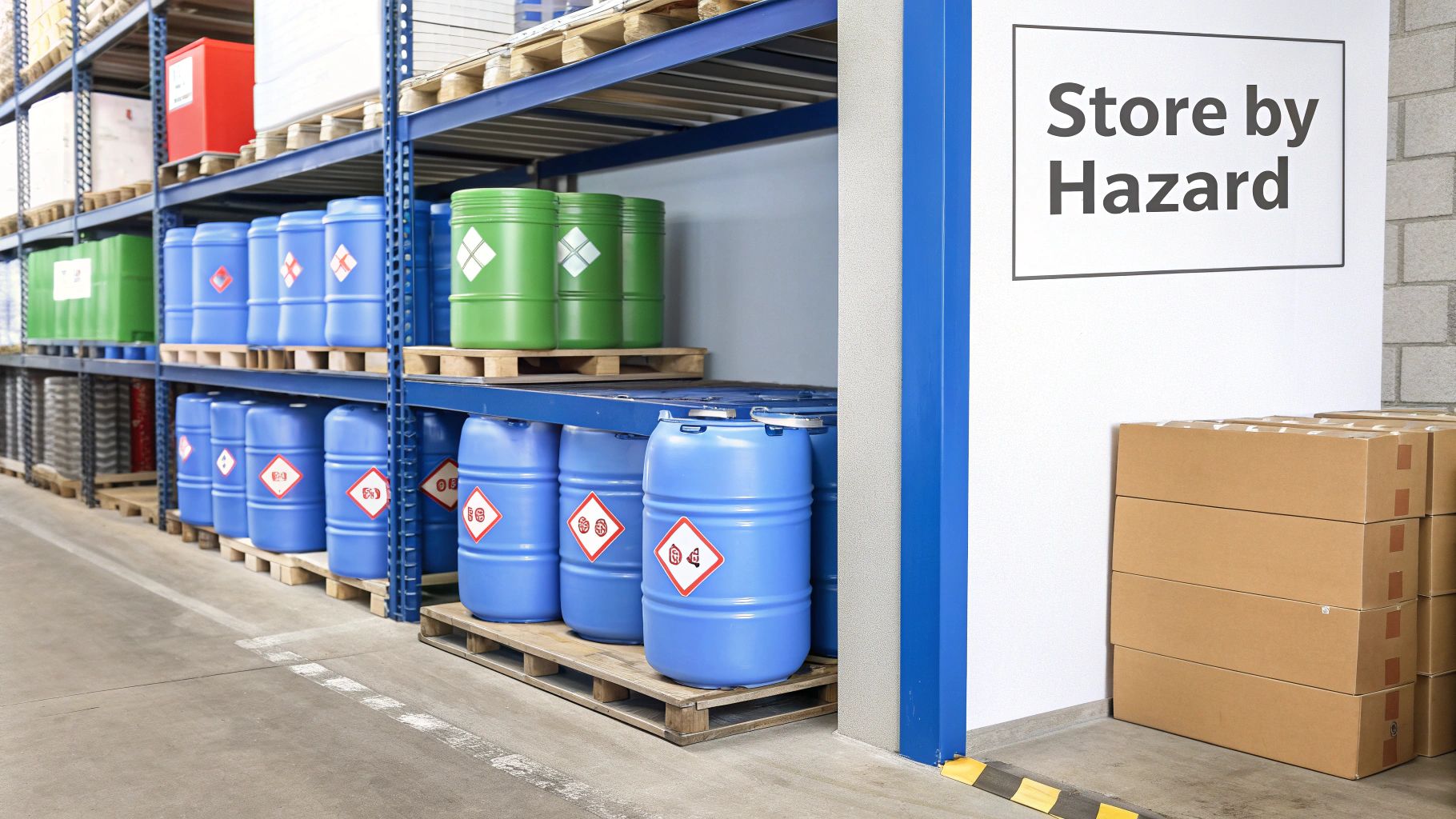
The first and most important rule for storing chemicals is a simple one: store by hazard class, not alphabetically. It might seem tidy to arrange your inventory from A to Z, but doing so can create a ticking time bomb. You could accidentally place a strong acid next to a base, or a powerful oxidiser right beside a flammable solvent. If a leak or spill were to happen, the results could be disastrous.
This is exactly why the Safety Data Sheet (SDS) and the GHS pictograms on labels are your most important resources. They aren't just paperwork; they are your definitive instruction manuals, telling you precisely how to store each substance, what it can't be near, and the precautions you must take. Overlooking this information isn't just a bad idea—it’s a direct breach of safety regulations.
The Foundation of a Safe Storage Plan
A solid chemical storage plan is much more than just putting bottles on a shelf. It's about building a complete safety system that protects your people, your facility, and the environment. As you lay this groundwork, incorporating the right fire protection solutions is absolutely essential for safeguarding your team and assets.
Your plan should be built on these key pillars:
- Hazard Identification: Start by confirming the primary hazard of every chemical. Check the SDS and label—is it flammable, corrosive, toxic, or an oxidiser?
- Segregation: Keep incompatible chemicals physically separated. This could mean using different cabinets, separate shelves, or even entirely different rooms.
- Engineered Controls: Invest in the right equipment, like ventilated cabinets for chemicals that give off fumes or corrosion-proof shelving for acids.
- Clear Communication: Make sure every container is properly labelled and storage areas have clear signs that instantly communicate the hazards present.
The core principle of safe chemical storage is proactive prevention. It’s about creating an environment where accidental reactions are physically impossible because incompatible materials never have the opportunity to mix.
From Household Common Sense to Industrial Safety
The common sense rule about not mixing bleach and ammonia at home is the perfect analogy. A small mistake there can create toxic chloramine gas, which is bad enough. But imagine that situation in an industrial setting, with hundreds of litres of far more reactive chemicals. The potential for a major incident—whether a fire, an explosion, or a toxic gas release—grows exponentially.
That’s why a disciplined, hazard-based approach is the only responsible way to decide where your chemicals belong. It's the bedrock of workplace safety and regulatory compliance.
To make this easier to follow, this table breaks down the basic rules for common hazard types.
Table: Core Principles of Hazard-Based Storage
| Hazard Type | Primary Storage Requirement | Common Example |
|---|---|---|
| Flammables | Store in a dedicated, ventilated flammable cabinet, away from ignition sources. | Acetone, Ethanol |
| Corrosives (Acids) | Store in a corrosion-resistant cabinet, separate from bases and flammables. | Hydrochloric Acid |
| Corrosives (Bases) | Store in a corrosion-resistant cabinet, separate from acids. | Sodium Hydroxide |
| Oxidisers | Isolate from flammables, combustibles, and reducing agents. | Hydrogen Peroxide |
| Toxics/Poisons | Store in a secure, well-ventilated, and clearly marked area. | Formaldehyde |
This table is a starting point. Always refer back to the specific SDS for each chemical, as it provides the most detailed and accurate guidance for safe storage.
Using Safety Data Sheets to Decide Where Chemicals Live
Think of a Safety Data Sheet (SDS) as a chemical’s passport. It tells you everything you need to know about its identity, its personality, and most importantly, how it behaves around others. You wouldn't put complex machinery together without the instruction manual, and for the same reason, you should never guess where to store a chemical without first consulting its SDS. It's your single best source of truth for preventing a costly or dangerous mistake.
An SDS is a comprehensive document with 16 sections, but for figuring out storage, two parts are absolutely critical. They give you the exact details needed to keep your workplace safe and compliant.
The Two Must-Read Sections for Storage Planning
To get storage right, you need to become very familiar with these two key parts of any SDS.
Section 2: Hazards Identification: This is your quick-glance summary of what can go wrong. It’s where you’ll find the GHS pictograms—the little diamond-shaped symbols like the flame for flammables or the skull and crossbones for acute toxicity—that instantly signal the main risks.
Section 7: Handling and Storage: This section moves from symbols to plain English instructions. It lays out the specific conditions needed for safe storage, like temperature controls, ventilation needs, and, crucially, which other chemical families it must be kept away from.
By looking at both, you get the full story. Section 2 shows you the hazard, and Section 7 tells you the practical actions you must take to manage it.
One of the most common oversights is treating SDSs as just compliance paperwork to be filed and forgotten. Instead, they should be living documents, active guides for your team. An SDS isn't just a form to tick a box; it's a vital safety tool that should shape your daily storage practices.
Turning Pictograms into Practical Storage Decisions
Those GHS pictograms in Section 2 aren't just for decoration; they are direct commands for your storage strategy. Each image should immediately trigger a specific action for where and how that chemical is stored.
Flame Pictogram (Flammables): This one is impossible to misinterpret. Any chemical with this symbol belongs in a dedicated, fire-rated flammable cabinet, kept well clear of any potential ignition sources like sparks, static, or open flames.
Corrosion Pictogram (Acids/Bases): This symbol tells you the substance can eat through metal and skin. These chemicals need a home in a corrosion-resistant cabinet, often made of polyethylene, not your standard steel one. Just as important, acids and bases must always be stored in separate cabinets.
Flame Over Circle (Oxidisers): This warns of a chemical that can supercharge a fire or even cause one to start spontaneously. Oxidisers have to be strictly segregated from flammable and combustible materials—mixing them can lead to violent, dangerous reactions.
Skull and Crossbones (Acute Toxicity): This represents a severe and immediate health threat. These substances demand a secure, locked area with restricted access to prevent anyone from handling them without authorisation. Good ventilation is also non-negotiable.
Think of these pictograms as a visual checklist. Spotting a symbol should automatically kick off the right storage protocol in your facility, ensuring every chemical ends up in the correct place, every time.
Putting it All Together: A Real-World Example
Let's walk through a common scenario. A new solvent arrives at your facility. The first thing you do is find its SDS.
In Section 2, you immediately spot the Flame pictogram and the Health Hazard pictogram. Right away, you know it's flammable and could have long-term health effects. Now, you flip to Section 7. The text is clear: "Store in a cool, dry, well-ventilated area away from sources of ignition. Keep separate from strong oxidising agents."
With that information, the decision is made. The solvent goes directly into your designated flammable storage cabinet. It absolutely cannot go on an open shelf, especially not next to the container of hydrogen peroxide (a strong oxidiser).
By following this simple process—consulting the SDS every time—you replace guesswork with a precise, safe, and compliant decision. This habit is the bedrock of any solid chemical management system.
Mastering Chemical Segregation and Compatibility
Storing incompatible chemicals together is asking for trouble. Think of it like a dinner party with sworn enemies—it's a recipe for disaster. Once you’ve used the Safety Data Sheet (SDS) to understand the hazards of each substance, the next critical step is figuring out where everything goes. This isn't just about being tidy; it's about preventing a catastrophic reaction before it has a chance to happen.
Picture your chemical store as a well-planned city. Each type of chemical is its own neighbourhood, and you have to keep the feuding families on opposite sides of town. Strong acids and strong bases, for instance, should never be neighbours. If their containers leaked and the contents mixed, they could create a violent, heat-generating reaction.
Likewise, powerful oxidisers must be kept far away from any flammable liquids. An oxidiser is like rocket fuel for a fire, providing the oxygen it needs to rage. Storing them together dramatically increases the risk and potential intensity of any fire. A tiny spark could become an inferno.
Practical Rules for Chemical Separation
Segregation isn't just a vague idea; it requires real, physical barriers and distances. The entire point is to make it physically impossible for incompatible chemicals to mix, even in a worst-case scenario like a major spill or a container failing completely.
There are a few solid ways to achieve this:
- Distance: Keeping a minimum distance between incompatible groups is a simple but effective rule. In open storage areas, this is often at least 6 metres.
- Separate Cabinets: The best approach is to give different hazard classes their own dedicated homes. Acids go in a corrosion-proof cabinet, while flammables are stored in a specialised fire-rated one. It's common sense, really.
- Physical Barriers: For highly reactive groups, you need more than just space. Using non-combustible partitions or, even better, entirely separate rooms creates a robust physical barrier that can contain a problem.
The simple 3-step decision tree below shows how you can use an SDS to quickly figure out the basic storage needs for any chemical that comes through your door.
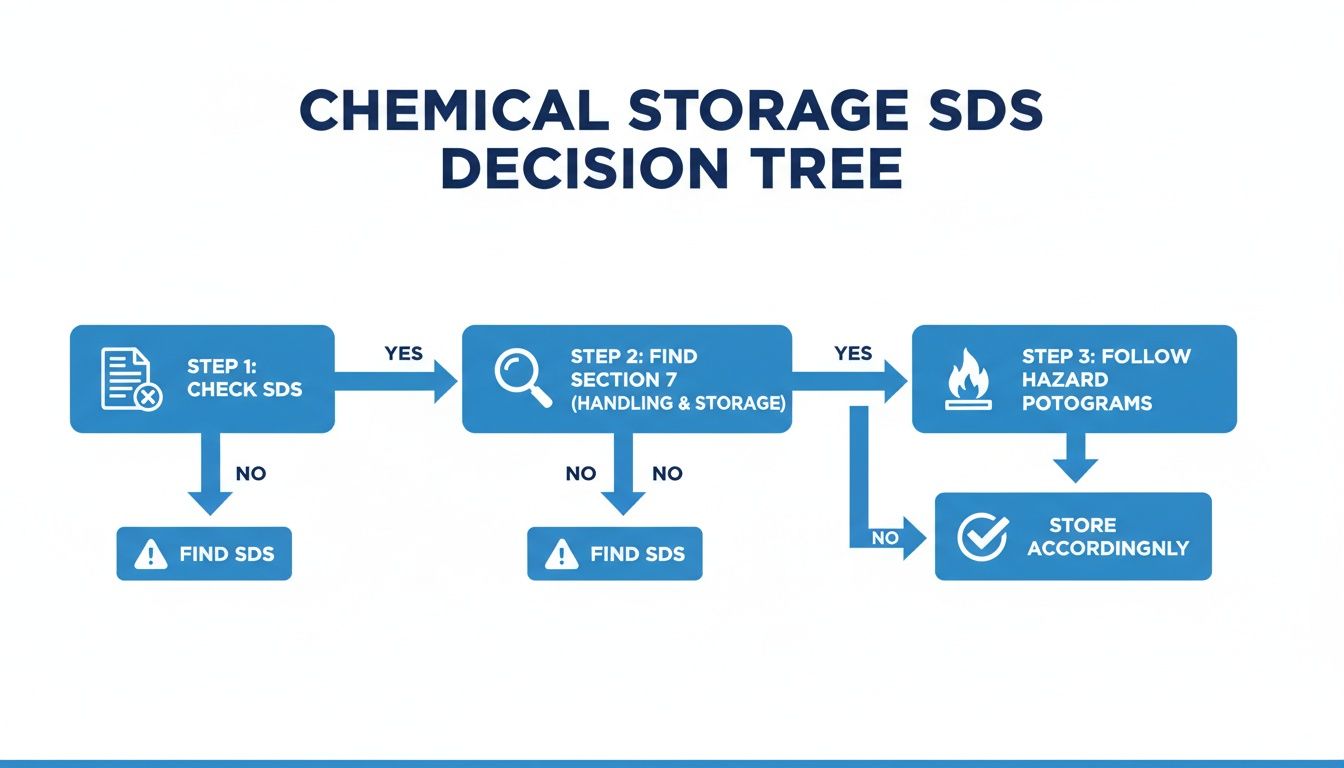
This visual guide drives home the point that the SDS is always your starting line, leading you straight to hazard identification and the right storage decisions.
Using Compatibility Charts as Your Blueprint
When you're dealing with a complex inventory, a chemical compatibility chart is an indispensable tool. It acts as a blueprint for your storeroom, clearly showing which chemical families can be stored together and which must be kept well apart. It’s a practical, visual way to turn a confusing list of chemicals into a safe, organised system. You can learn more about creating a chemical storage compatibility chart in our article.
Safe segregation isn't just a best practice—it's a legal and ethical obligation. Every chemical, from the moment it arrives on-site to its final disposal as waste, must be managed according to its hazard profile. This 'cradle-to-grave' responsibility is a cornerstone of modern chemical safety regulations.
This duty is particularly serious in industrial centres. For example, Belgium's intense industrial activity makes proper chemical storage absolutely critical. With 99.6 million tonnes of hazardous waste generated across Europe in 2022, and Belgium exporting a massive 62.7 kg per inhabitant, the stakes are incredibly high.
This reality underscores the 'cradle-to-grave' responsibility under CLP regulations. Your storage practices must reflect the hazard labels on every container, from fresh chemicals right through to waste. For any HSE manager on a manufacturing site, secondary containment is non-negotiable. Spill pallets or bunded areas must be able to hold at least 110% of the largest container's volume to prevent leaks from contaminating soil or water. This is a perfect example of how local regulations reinforce the universal need for meticulous segregation and containment, ensuring that where chemicals are stored meets the strictest safety and environmental standards.
Selecting the Right Chemical Storage Equipment
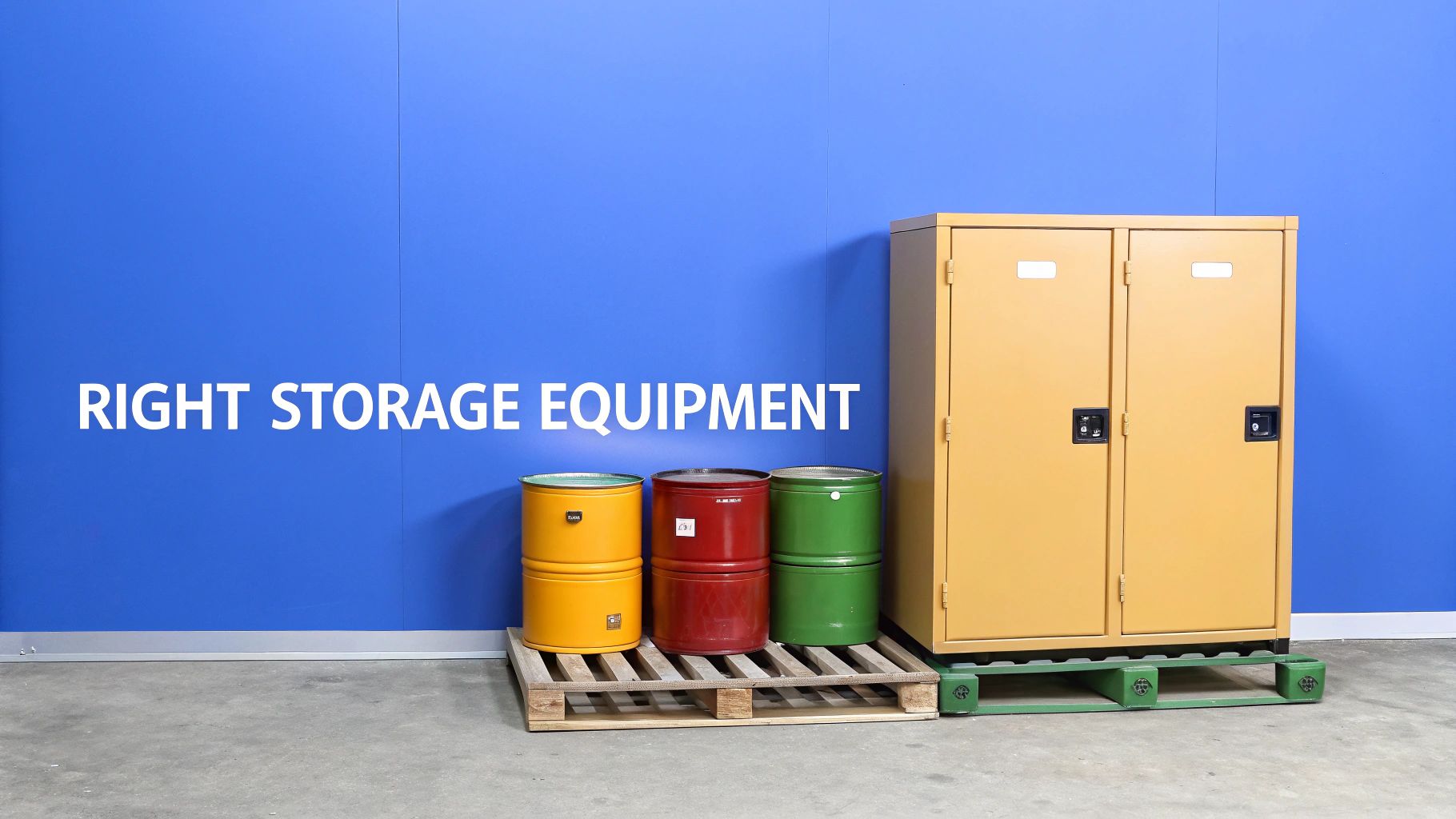
Your physical infrastructure is the first line of defence against chemical incidents. Once you have a firm grasp of your inventory's hazards, the next step is choosing the correct hardware to contain them. This isn’t about just finding any available shelf space; it’s about strategically matching the equipment to the specific risks identified on the Safety Data Sheet (SDS).
Think of your storage equipment as specialised armour. You wouldn't wear the same gear for every battle, and you shouldn't use the same cabinet for every chemical. The right equipment creates a physical barrier that neutralises hazards, containing potential spills, preventing fires from spreading, and stopping dangerous reactions before they can begin. This is a critical investment in workplace safety and regulatory compliance.
Cabinets Designed for Specific Hazards
Chemical storage cabinets are purpose-built to handle distinct hazard classes. Using the wrong type of cabinet is a common but dangerous mistake that completely undermines your safety efforts. The choice between steel and polyethylene, for example, is dictated entirely by the chemical's properties.
- Fire-Rated Steel Cabinets: These are the non-negotiable standard for flammable liquids. Constructed with double-walled steel and an insulating air space, they are engineered to protect their contents from external fires for a specific period, giving personnel crucial time to evacuate.
- Corrosion-Resistant Polyethylene Cabinets: Strong acids and bases will corrode standard steel cabinets over time, compromising their integrity. Polyethylene (plastic) cabinets are designed to resist this corrosive attack, ensuring long-term, leak-free storage for these substances.
For a deeper dive, our guide explains the essential flammable storage cabinet requirements in much greater detail. It’s well worth a read to ensure your setup meets all necessary safety standards.
Choosing the right container for the right chemical is the first step. The table below breaks down the most common types of storage equipment and what they're designed to handle.
Chemical Storage Equipment Selection Guide
| Equipment Type | Best For (Hazard Class) | Key Features | Regulatory Note |
|---|---|---|---|
| Fire-Rated Steel Cabinets | Flammable & Combustible Liquids | Double-walled steel construction with an insulating air gap; self-latching doors. | Must meet specific fire-resistance ratings (e.g., FM Approved, EN 14470-1). |
| Polyethylene Cabinets | Corrosive Acids & Bases | All-polyethylene (plastic) construction that will not rust or corrode. | Often includes spill-catching sumps and trays. Shelves must be compatible. |
| Gas Cylinder Cages | Compressed Gases | Heavy-duty steel mesh for security and ventilation; lockable doors. | Must be located away from heat sources and ignition points. |
| Spill Pallets/Bunds | Large drums of any liquid hazard class | Built-in sump to capture leaks and spills. | Sump capacity must meet local regulations (e.g., 110% of the largest container). |
| Vented Cabinets | Toxic or highly volatile substances | Equipped with vents to connect to an external exhaust system. | Essential for preventing the buildup of hazardous fumes. |
| Temperature-Controlled Units | Thermally unstable or reactive chemicals | Refrigerated or heated units to maintain a specific temperature range. | Critical for chemicals with a low flash point or those that can decompose. |
This guide is a starting point. Always cross-reference your selection with the chemical's SDS to confirm compatibility and specific storage needs.
Essential Engineered Controls for a Safe Environment
Beyond the cabinet itself, the surrounding environment must be controlled. Engineered controls are systems designed to mitigate risks automatically, reducing reliance on human intervention. Two of the most important are ventilation and temperature control.
Proper ventilation is crucial for chemicals that release hazardous vapours. It prevents the build-up of flammable or toxic fumes that could create a fire, explosion, or health hazard. This can be achieved through general room ventilation or, for highly volatile substances, dedicated vented cabinets connected to an exhaust system.
Similarly, temperature control is vital for thermally unstable chemicals. Some substances can degrade, become dangerously reactive, or build up pressure if stored above a certain temperature. Your SDS will specify these temperature limits in Section 7, guiding your decision on whether a climate-controlled storage area is necessary.
The Critical Role of Secondary Containment
No matter how robust your primary containers are, you must always plan for the possibility of a leak or spill. This is the core principle of secondary containment—having a backup system ready to capture any accidental release.
Secondary containment is your safety net. It ensures that even if the worst happens and a primary container fails, the hazardous material is safely captured, preventing it from spreading into the workspace or the environment.
The universal rule for secondary containment is that it must be capable of holding 110% of the volume of the largest single container or 25% of the total volume stored, whichever is greater. This ensures it can handle a complete failure without overflowing. Common solutions include:
- Spill Pallets: These are pallets with a built-in sump to catch leaks from drums or IBCs.
- Bunded Storage: These are larger cabinets or outdoor storage units with an integrated, liquid-tight floor designed for containment.
- Spill Trays: Used for smaller containers, these trays sit on shelves and catch minor drips and spills.
In Belgium, with its massive chemical sector, these rules are applied with particular rigour. The country's Seveso-class sites must follow strict storage regulations under the EU Seveso Directive, especially for high-risk substances. As chemicals account for 33% of the country's total exports, the focus on safe infrastructure is paramount. For high-risk facilities like tank farms, regulations are being enforced to demand firewater retention bunds and thorough drainage checks by April 2026, showcasing how secondary containment is a top-level regulatory concern. Learn more about these stringent national regulatory frameworks and their implications for high-risk installations.
Implementing Effective Labelling and Inventory Systems
Having the right cabinets and containment is a great start, but it's only half the job done. If your team can't tell what’s inside them, those expensive physical barriers lose their effectiveness almost immediately. This is where a rock-solid system for labelling and inventory management comes in; it’s the procedural backbone holding your entire chemical safety strategy together.
This system essentially bridges the gap between the physical equipment you’ve invested in and the people who interact with it every single day. It boils down to two key things: unmistakable communication through clear labels, and real-time awareness through a dynamic inventory. Get these right, and everyone from a seasoned technician to a first responder can instantly grasp the risks and act accordingly.
The Non-Negotiable Role of GHS/CLP Labels
Let's be clear: every single chemical container in your facility must be properly labelled. From a 200-litre drum right down to the smallest spray bottle, there are no exceptions. These labels are your first line of defence, communicating critical hazard information at a glance with standardised pictograms and simple statements.
Under the Classification, Labelling and Packaging (CLP) Regulation, these labels are a legal must-have. They create a universal language for hazard communication, ensuring a symbol for flammability or corrosivity means the same thing to everyone, everywhere.
Think of a GHS/CLP label as a chemical’s business card. It introduces itself, states its primary hazards, and provides essential precautions. Without it, you're dealing with a dangerous stranger, turning safe handling into pure guesswork.
This level of clarity is especially crucial in today's tough economic climate. With Belgium and Germany feeling the pinch from the recent downturn in the EU chemicals industry, protecting every last drop of inventory is vital. Proper labelling, as mandated by CLP, dictates precise storage conditions—for example, requiring corrosives to be kept in bunded, ventilated areas capable of holding 110% of the largest container's volume. As the industry prepares for updated CLP hazard logic in 2026, which will overhaul SDSs and labels, a rigorous system is more important than ever.
Building a Dynamic Chemical Inventory
Your chemical inventory should be a living, breathing document, not a dusty binder forgotten on a shelf. An accurate, up-to-the-minute inventory is fundamental for compliance, emergency planning, and simply answering the question of where a chemical ought to be stored. It tells you what you have, how much you have, and exactly where to find it.
A modern inventory system, however, is much more than a simple list. It should link directly to your library of Safety Data Sheets (SDS). This integration is what transforms your inventory from a static record into an active, intelligent safety tool.
A truly effective system should let you:
- Instantly Access SDSs: Anyone should be able to look up a chemical in the inventory and pull up its corresponding SDS in seconds.
- Screen for Compatibility: A digital system can automatically flag incompatible chemicals stored too close to each other, preventing dangerous mistakes before they happen.
- Monitor Quantities: Easily track chemical volumes to stay below regulatory thresholds and manage your stock more efficiently.
- Simplify Audits: Generate reports on the fly for regulatory inspections or internal safety audits.
To get a better idea of what to look for, check out our detailed guide on what a modern chemical inventory management system should offer.
Preparing for the Worst with Emergency Equipment
Even with perfect labels and inventory control, you have to plan for the unexpected. Accidents can and do happen. That’s why every chemical storage area must be equipped with the right emergency response tools, placed strategically for immediate access. This is all about empowering your team to respond quickly and effectively, minimising harm to people and the environment.
Key emergency equipment includes:
- Spill Kits: Have kits specifically designed for the types of chemicals stored nearby (e.g., acid neutralisers, solvent absorbents).
- Fire Extinguishers: Make sure the correct type of extinguisher (like a Class B for flammable liquids) is available and clearly marked.
- Eyewash Stations and Safety Showers: These must be unobstructed and located within a 10-second walk from the hazard.
- Emergency Contact Information: Post phone numbers for your internal response team, the local fire department, and poison control centres in a highly visible spot.
By combining clear labels, a smart inventory, and accessible emergency gear, you create a comprehensive safety net. This ensures your team has the information and the tools they need to work safely and respond decisively when it matters most.
Got Questions About Chemical Storage? We’ve Got Answers.
When it comes to chemical storage, navigating the rules often brings up practical, on-the-ground questions. Even with a solid plan, specific scenarios can feel like a grey area. This section tackles some of the most frequent queries we hear, providing clear, straightforward answers to help you keep your facility safe and compliant.
Think of this as the troubleshooting guide for your chemical management plan. We’ll get into the common sticking points and offer practical advice to make sure your daily practices line up with the highest safety standards. It's often these details that make the biggest difference in preventing incidents.
Storing Small Quantities of Incompatible Chemicals
A question we get all the time is: "Can I store a small bottle of acid and a small bottle of base in the same cabinet if they are on opposite sides?"
The short answer is no, not without some serious extra controls. The whole point of segregation isn’t about the quantity of the chemical; it’s about preventing any possibility of them mixing.
Even a small leak from each container could cause a violent reaction, releasing toxic fumes or a burst of heat inside the confined space of a cabinet. If you absolutely must store small amounts of incompatible chemicals nearby due to space constraints, you have to use independent secondary containment.
- Place each chemical in its own separate, leak-proof containment tray or bin.
- The containment bin must be made of a material that won't be eaten away by the chemical it holds.
- Make sure the bins are large enough to hold the entire contents of the container if it were to leak or break.
This method creates a physical barrier inside the cabinet, but it really should be your last resort. The best and safest practice is always to use separate, dedicated cabinets for incompatible hazard classes.
How Often Should We Inspect Our Chemical Storage Areas?
Knowing how often to inspect your storage areas is the bedrock of proactive safety management. A regular inspection schedule helps you spot small issues—like a peeling label, a minor drip, or a blocked aisle—before they balloon into major hazards. A multi-tiered approach works best.
A consistent inspection routine transforms safety from a reactive chore into a proactive habit. It's about finding and fixing problems when they are small, cheap, and easy to handle, not after an incident has already happened.
A simple yet effective schedule includes three levels of checks:
- Daily Visual Checks: Just a quick, informal look-over at the start or end of a shift. Are there any obvious spills? Damaged containers? Is the eyewash station blocked?
- Weekly Audits: This is a more formal check using a simple checklist. Verify that containers are properly sealed, labels are easy to read, spill kits are fully stocked, and segregation rules are being followed.
- Monthly/Quarterly Inspections: This is a comprehensive, documented audit of the entire storage area. It should involve checking SDS availability, confirming inventory records are accurate, inspecting the integrity of cabinets, and reviewing emergency procedures with your team.
This structured routine ensures nothing falls through the cracks and keeps your storage areas in a constant state of readiness.
What's the Best Way to Manage a Safety Data Sheet Library?
Another frequent question revolves around managing that ever-growing library of Safety Data Sheets (SDS). Is a traditional paper binder good enough, or is a digital system better?
While a paper binder can meet the basic legal requirement for accessibility, it comes with some significant drawbacks. In practice, modern digital systems solve these problems far more effectively.
The key headaches with paper-based systems are accessibility, version control, and integration. If a spill happens, is the binder even in the affected area? Is the SDS in that binder the most current version from the manufacturer? Can you quickly cross-reference that SDS with your inventory list? A digital platform is built from the ground up to handle these issues.
Digital vs Paper SDS Management: A Quick Comparison
| Feature | Paper Binders | Digital SDS System |
|---|---|---|
| Accessibility | Limited to one physical spot; easily lost, damaged, or inaccessible. | Instantly accessible from any device (phone, tablet, PC) anywhere. |
| Version Control | A manual nightmare; tough to ensure every binder has the latest version. | Automatically flags outdated SDSs and helps you get updated ones. |
| Emergency Use | Might be unreachable during an incident (e.g., inside a fire or spill zone). | Puts emergency procedures and PPE info right on your mobile device, instantly. |
| Inventory Linkage | Completely separate from inventory lists, demanding manual cross-checking. | Directly links SDSs to your live chemical inventory for seamless management. |
| Compliance | Hard to audit and prove compliance; relies on manual, often messy, records. | Simplifies audits with searchable databases and automated reporting. |
At the end of the day, a digital system offers a more reliable, efficient, and safer way to manage your SDS library. It goes beyond simple document storage, turning your compliance data into an active tool for risk management, inventory control, and emergency preparedness. It helps you answer not just where chemicals should be stored, but how to manage them safely every single day.
Take control of your chemical safety with a system built for today’s compliance demands. NextSDS offers an all-in-one platform to automate SDS management, screen for hazards, and ensure your storage practices are safe and compliant. Discover how NextSDS can simplify your chemical management.