

In the world of workplace safety, some dangers are immediate. A Short-Term Exposure Limit (STEL) is a specific occupational exposure limit that defines the maximum concentration of a hazardous substance a worker can be exposed to continuously for 15 minutes without suffering from harmful health effects.
Think of it as a safety net for those brief, intense moments of exposure.
What is a Short-Term Exposure Limit?
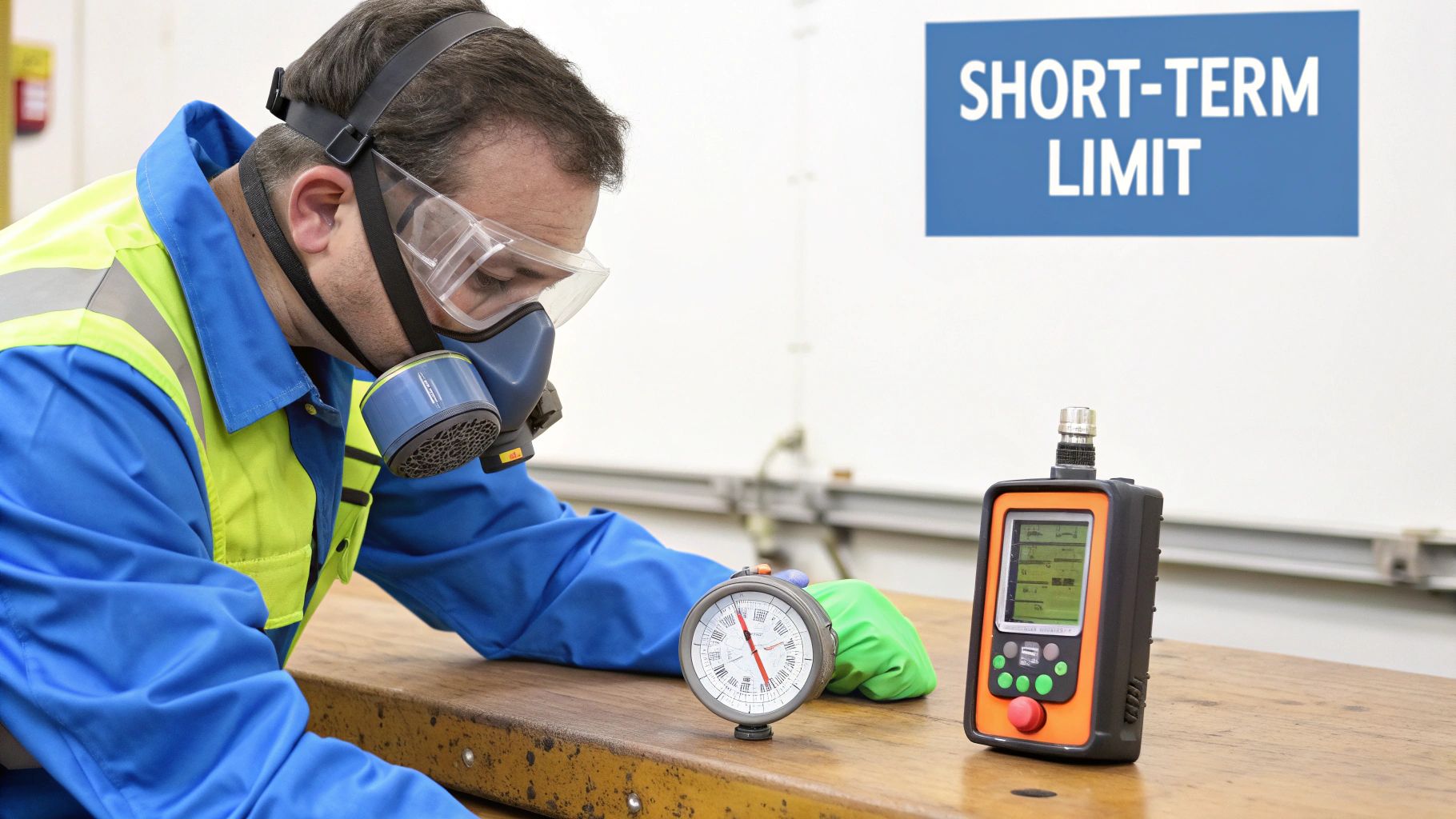
To really get your head around the STEL, it helps to compare it to other exposure limits. If the main workplace limit, the 8-hour Time-Weighted Average (TWA), is like your average cruising speed on a long journey, the STEL is the absolute maximum speed you can hit for a short stretch without things getting dangerous.
This 15-minute window is critical. Many chemicals can cause significant harm in just a few minutes, long before they would ever push the 8-hour average into the red zone. The entire point of a STEL is to prevent these immediate health problems that come from short, sharp spikes in exposure.
Key Protections Offered by STELs
So, what specific dangers are STELs designed to prevent? They act as a guard against:
- Irritation: Preventing immediate reactions to the eyes, skin, and respiratory system.
- Chronic and Irreversible Tissue Damage: Shielding workers from permanent harm caused by a brief but potent chemical encounter.
- Narcosis: Stopping the onset of drowsiness, dizziness, or impaired coordination that can lead to accidents and injuries.
By setting this clear boundary for peak exposure, the STEL provides a vital layer of protection. It ensures that even during high-risk tasks like mixing chemicals, pouring solvents, or cleaning up spills, workers are kept safe from immediate harm. For any health and safety professional, recognising the difference between the STEL’s ‘sprint’ and the TWA’s ‘marathon’ is fundamental to a robust safety plan. You can learn more about what acute toxicity means and see how it ties directly into these rapid-exposure scenarios.
The Core Idea: A worker’s exposure level isn't a flat line throughout the day; it has peaks and troughs. The STEL directly addresses those peaks, filling a crucial safety gap that an 8-hour average simply can't cover on its own.
Why STELs Are a Critical Safety Benchmark
Knowing the definition of a Short-Term Exposure Limit is a good start, but understanding why it matters is what truly keeps people safe. Think of the 8-hour Time-Weighted Average (TWA) as your long-game protection—it guards against the slow, creeping damage from repeated exposure over months and years.
But what about immediate danger? The TWA can completely miss the risk from a sudden, intense spike in chemical concentration.
Here’s a simple analogy. A slow, dripping tap might cause serious water damage over a year (that’s your TWA). But a pipe bursting can flood a room in five minutes, causing immediate and devastating harm. The STEL is designed to prevent that burst-pipe scenario—the sudden chemical surge that can overwhelm a worker long before their 8-hour average is even close to being breached.
The Dangers of Acute Exposure Peaks
Many hazardous substances don't need hours to cause harm; minutes are all it takes. Relying only on an 8-hour average to manage these chemicals is like judging a sprinter's top speed by looking at their average pace over a full marathon. You miss the most critical moment entirely.
These short, sharp bursts of exposure can trigger severe health effects, including:
- Immediate Respiratory Irritation: Causing sudden coughing, shortness of breath, or inflammation of the airways.
- Central Nervous System Depression: This can lead to dizziness, confusion, or a loss of coordination, dramatically increasing the risk of accidents and falls.
- Sensory Irritation: Affecting the eyes and skin with burning sensations or rashes.
- Irreversible Tissue Damage: In the worst cases, a brief but potent exposure can cause permanent damage to vital organs.
Monitoring these intense, short-term exposures isn’t just about ticking a regulatory box; it's a non-negotiable part of creating a proactive safety culture. The same logic applies at home, where you need to detect carbon monoxide in the home to prevent immediate poisoning. The workplace just has a much wider menu of potential chemical threats.
A worker could be perfectly compliant with their 8-hour TWA for a solvent, yet a single 10-minute task in a poorly ventilated room could make them dizzy enough to fall from a ladder. The STEL is the safety net designed to prevent exactly that.
For any Health and Safety manager, STEL monitoring plugs a critical hole that TWA tracking alone can't fill. It’s the tool for managing the acute risks of specific tasks like mixing chemicals, cleaning spills, or working in confined spaces. This focus is a cornerstone of any robust occupational safety programme, and you can learn more in our practical guide to chemical safety in the workplace.
At the end of the day, understanding what a short term exposure limit really means is about recognising its power to prevent immediate harm and protect your team, moment by moment.
How STELs are Regulated Across Europe
Knowing what a Short-Term Exposure Limit is becomes truly meaningful when you understand the rules that back it up. In Europe, these safety values aren't just numbers plucked out of thin air; they’re the product of serious scientific debate and EU-wide laws designed to keep people safe at work.
The whole system starts with European Union directives. Expert groups like the Scientific Committee on Occupational Exposure Limits (SCOEL) dive deep into the science, advising the European Commission on the real-world health effects of hazardous substances. From there, agencies like the European Agency for Safety and Health at Work (EU-OSHA) translate that science into practical limits, which are then passed down to each member country to become law.
From EU-Wide Rules to Local Regulations
This top-down process creates a strong, consistent baseline for worker safety across the continent. However, individual countries often add their own, sometimes stricter, rules. For any business, this means you need to keep one eye on the EU standards and the other on the specific laws in the country you’re working in.
For example, the STEL is a cornerstone of workplace safety everywhere from Belgium’s chemical plants to its manufacturing floors. It’s defined as the absolute maximum average concentration a worker can be exposed to over a 15-minute window without risking immediate health problems. Belgium, like all EU members, enforces this by writing EU-OSHA’s guidelines into its own national law. You can get a much clearer picture of these standards by checking out the detailed guidance on occupational exposure limit values from EU-OSHA.
This chain of command from the EU to the factory floor directly impacts your day-to-day operations, especially when it comes to two massive pieces of legislation:
- REACH (Registration, Evaluation, Authorisation and Restriction of Chemicals): This regulation makes it mandatory for companies to know exactly what’s in their chemicals and to register that information. STELs are a non-negotiable part of the chemical safety assessments required under REACH.
- CLP (Classification, Labelling and Packaging): The CLP regulation is all about clear communication. It ensures hazards are spelled out for everyone, and that means STEL values must be listed right there in Section 8 of a substance’s Safety Data Sheet (SDS).
For any HSE or procurement team, this is where the rubber meets the road. If you get an SDS for a hazardous substance and the STEL is missing, that’s a major red flag. It points to an incomplete safety profile and a serious compliance risk.
Ignoring these limits isn't an option. The consequences range from hefty fines and legal battles to forced shutdowns by national safety inspectors. But more importantly, it puts your people in harm’s way, exposing them to potentially severe health effects. Managing STELs properly isn’t just about ticking a legal box—it’s a fundamental part of running a responsible business and ensuring your operations continue without disruption.
Practical Ways to Monitor and Calculate STELs
Knowing the rules is one thing, but putting them into practice on the factory floor is where it really counts. For a safety officer, managing STELs effectively comes down to having the right tools for the job and knowing how to use them to keep people safe during those high-risk, short-burst tasks.
There are two main ways to measure what's in the air. The first is personal air sampling. This involves a worker wearing a small pump, usually clipped to their collar, which draws air through a special tube or filter. It captures a sample over a set time, which then gets sent off to a lab. The results are highly accurate and legally solid.
The other option is using direct-reading instruments. These are portable gadgets that give you real-time data, showing you concentration levels right there and then. Good gas monitoring practices are crucial for STEL compliance, and these instruments are perfect for quick spot-checks or pinpointing exactly when those exposure peaks happen.
How to Calculate STEL Compliance
Once you've collected the data, you need to work out if the exposure is within limits. The STEL isn't just a single snapshot; it's an average concentration measured over a continuous 15-minute period.
To figure this out, you’ll typically take several readings within that 15-minute window and calculate the average. For instance, if you took three separate 5-minute samples that showed concentrations of 20 ppm, 40 ppm, and 30 ppm, your 15-minute average would be 30 ppm.
It's vital to remember the rules around frequency. A worker can't be exposed to the STEL concentration more than four times a day, and there must be at least a 60-minute break between each of these exposures.
A Practical Walkthrough Example
Let's walk through a real-world scenario. Imagine you're a safety officer overseeing a worker who is cleaning machine parts with a solvent—a job known to create high vapour levels. The Safety Data Sheet (SDS) for that solvent states a STEL of 100 ppm.
Here’s how you’d approach it:
- Preparation: You'd give the worker a direct-reading instrument, making sure it’s properly calibrated for that specific solvent. You’d also explain that you'll be measuring their exposure during the most intense part of the cleaning task.
- Sampling: As the worker starts cleaning, you start a 15-minute timer and begin taking readings from the device every minute.
- Calculation: After 15 minutes, you’ll have 15 data points. You simply add them all up and divide by 15 to find the average concentration for that period.
- Assessment: Let's say your calculated average comes out to 85 ppm. Since this is safely below the 100 ppm STEL, the exposure is compliant for this task. You would then document this result, making a note of the time, the task, and any controls you had in place, like local exhaust ventilation.
This flowchart shows how STEL regulations are passed down from bodies like EU-OSHA, through frameworks like REACH/CLP, and finally onto the Safety Data Sheet you use for your on-site assessments.
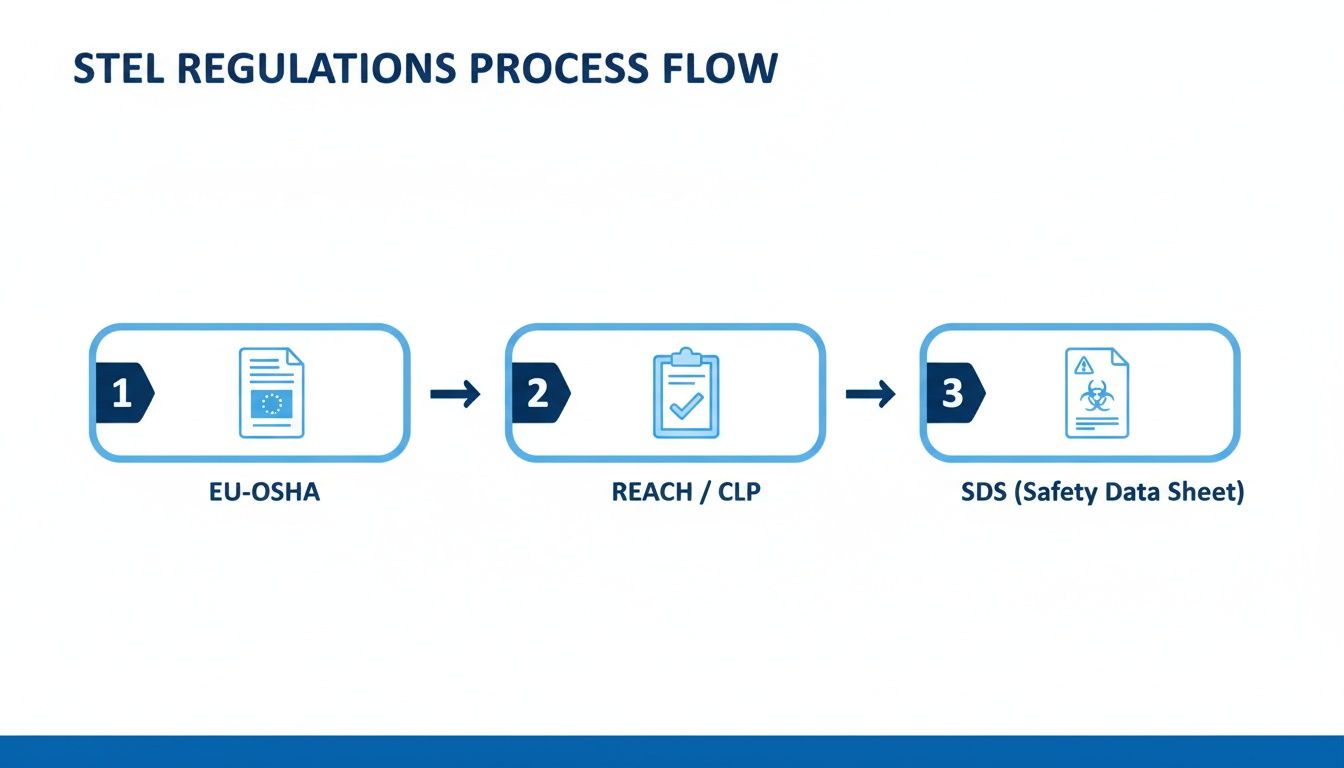
As the graphic shows, the SDS is the final, most practical tool in the chain. It’s where those official limits are clearly communicated to the people on the ground, making it an essential document for carrying out accurate calculations and keeping everyone safe.
Putting STEL Control Strategies into Practice
Knowing the Short-Term Exposure Limit is one thing, but keeping your team safely below it is the real job. Managing these short, sharp spikes in exposure isn't about guesswork; it requires a solid strategy built on the tried-and-tested hierarchy of controls. This framework forces you to start with the most effective solutions, rather than just handing out Personal Protective Equipment (PPE) and calling it a day.
The smartest way to deal with any hazard is to get rid of it at the source. This means working your way through a clear sequence of controls until the risk is properly managed.
Applying the Hierarchy of Controls for STELs
The hierarchy gives you a clear playbook for tackling acute chemical risks. At the top of the list are the big wins that remove the problem entirely. At the bottom are the last resorts that just protect the worker from a hazard that’s still very much present.
Here’s how it works for managing STELs:
Elimination: By far the best control is to get rid of the hazardous substance completely. Can you re-think a process so that a volatile solvent is no longer needed? For example, moving from a solvent-based degreaser to a high-pressure aqueous washing system completely eliminates that particular STEL risk. Problem solved.
Substitution: If you can’t eliminate the chemical, can you swap it for a safer one? This could be as simple as choosing a substance with a much higher STEL (meaning it's less toxic) or one that doesn't have a STEL at all.
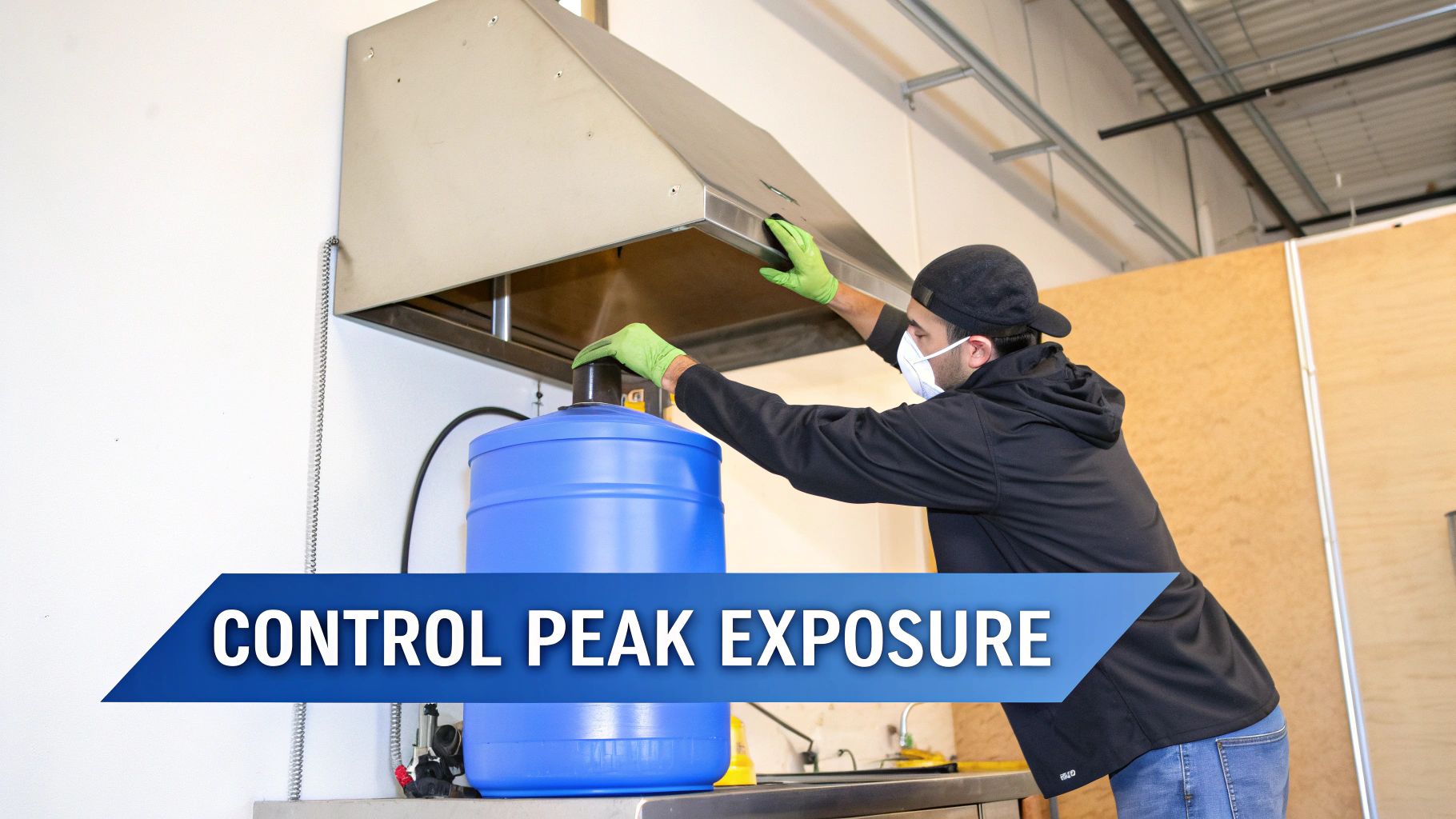
Engineering Controls: This is where you make physical changes to the workplace to put a barrier between people and the hazard. For STELs, this is often the most practical and effective step. Installing a local exhaust ventilation (LEV) hood right over a mixing tank, for instance, can suck up dangerous fumes before they ever reach a worker’s breathing zone. It directly tackles the risk of a short-term exposure spike.
For warehouse and logistics managers, even simple procedural changes can act as powerful controls. Storing volatile chemicals in a dedicated, well-ventilated area and using closed-loop systems for decanting liquids can drastically reduce ambient vapour concentrations and prevent accidental peak exposures.
Administrative Controls: Next, you change the way people work. This might involve limiting how long a worker can perform a high-exposure task or scheduling these jobs for times when fewer people are around. Proper training on the specific risks of exceeding a STEL is also a crucial administrative control.
Personal Protective Equipment (PPE): PPE, like respirators and chemical-resistant gloves, is your absolute last line of defence. It should only ever be used after you’ve exhausted all other options, or as a stop-gap while you’re installing more permanent engineering controls. Our guide explains in more detail how to properly integrate exposure controls and PPE into your safety programme.
By working through this hierarchy step-by-step, Health and Safety managers can build a robust, layered defence against the very real dangers that STELs are designed to prevent.
How Digital Tools Make STEL Compliance Easier
Let's be honest, trying to manage Short-Term Exposure Limits with a mountain of spreadsheets and manual data entry is a losing game. It’s a reactive approach that puts immense pressure on busy safety officers to spot every new chemical, track every regulatory tweak, and cross-reference every Safety Data Sheet. This way of working isn't just a time sink; it’s a recipe for human error and unnecessary risk.
But modern safety management has moved on from paper trails and endless spreadsheets. Digital platforms, like NextSDS, can turn this compliance headache into a straightforward, automated process. Instead of someone having to manually comb through a new SDS, these tools can automatically pull out the critical exposure limits, including both STEL and TWA values.
Suddenly, you have a single, searchable chemical inventory. Think about it: being able to find the exact STEL for any substance on your site in seconds, without having to dig through filing cabinets or shared drives. This is the new baseline for effective STEL management.
Moving From Data Entry to Automated Alerts
The real game-changer with these systems is how they actively monitor your chemical inventory. For example, NextSDS can be set up to fire off an instant alert to the Health and Safety team as soon as a new chemical with a particularly low STEL is logged into the system.
This means safety managers can get ahead of the risk, putting the right engineering controls or handling procedures in place before a single drop of the substance is even used. The system also keeps an eye on regulatory changes for you.
When a regulatory body like EU-OSHA updates the Short-Term Exposure Limit for a chemical you have on-site, the platform flags it for you. This simple feature completely flips the script, moving your team from constantly playing catch-up to being fully prepared for changes.
This approach offers some clear wins:
- A Single Source of Truth: All your STEL and TWA data is organised in one place, easy for anyone who needs it to access. No more chasing scattered files.
- Proactive Warnings: Getting alerts for new high-risk chemicals or regulatory updates gives your team the heads-up they need to act quickly and decisively.
- Smarter Purchasing: Your procurement team can check a chemical’s STEL risks before they even buy it, helping to prevent new hazards from being introduced in the first place.
Ultimately, using digital tools gives your HSE and operations teams the ability to manage chemical safety with real precision. It replaces guesswork with certainty, giving you the confidence that your STEL compliance is built on accurate, up-to-the-minute data.
Got Questions About STELs? We’ve Got Answers.
When you get down to the practical side of managing chemical safety, the details really matter. We often hear the same questions from safety professionals trying to get a handle on Short-Term Exposure Limits, so let’s clear up a few common points.
How Often Can a Worker Actually Be Exposed to the STEL?
There's a very specific rhythm to STEL exposures. Think of it as a set of hard-and-fast rules. A worker can be in that higher concentration zone for a maximum of 15 minutes.
This can only happen up to four times in a single workday. Crucially, there must be at least a 60-minute break between each of these short-term exposures to give the body time to recover. And remember, even with these brief peaks, the average exposure over the entire 8-hour shift must stay below the TWA limit.
What If a Safety Data Sheet Doesn't list a STEL?
You'll sometimes find an SDS that lists a TWA but has no mention of a STEL. This doesn't mean you can ignore short-term exposure risks. It often just means a specific STEL hasn't been officially established by the regulators for that substance.
Best Practice: When there's no STEL, your guiding principle should be caution. Stick rigidly to the 8-hour TWA and work hard to minimise any and all short-term spikes in exposure. This is especially important for chemicals known to cause irritation or act quickly on the body.
Are STELs the Same Everywhere?
Definitely not. This is a critical point for any business operating across different regions. STELs, along with other exposure limits, can vary quite a bit from one country to another.
For instance, a limit set by EU-OSHA might be interpreted or adopted differently in member countries like Belgium. Meanwhile, the limits set in the US by OSHA or recommended by ACGIH could be completely different again. Always check and follow the specific regulations for the location where you're working. Local laws always take precedence.
Keeping track of all these regional rules and chemical limits can feel like a full-time job. NextSDS is designed to lift that burden by organising your safety data and keeping an eye on regulatory changes for you. See how our platform can give you complete confidence in your STEL compliance by visiting https://nextsds.com.